_________________________________________________________________________
“What did the triumphant revolution offer our women? A new life, filled with possibilities and prospects, in which their deepest dreams might become reality. A society in which that which is most precious to us all-our children’s future-would be assured. A different society, where the people would be masters and mistresses of their own destiny, where they would exert their rights fully, where new values would come into being. The triumph offered our women the opportunity to study and to work, it offered them economic security, thereby putting an end to oppression and hardship. It opened prospects of health care, of social security. For women, the revolution meant the opportunity to attain human dignity.” —Vilma Espin.
________________________________________________________________________
Para la versión en español: https://carlitoboricua.blog/?p=13709&preview=true
Salute to Vilma Espin, heroine of the Cuban Revolution
April 7, 1930 – June 18, 2007
By Carlos “Carlito” Rovira
One of the greatest highlights of the 1959 Cuban Revolution is the role played by women. Among the heroines of this historic event was Vilma Lucila Espin Guillois, better known as Vilma Espin. She was born on April 7, 1930, in Santiago De Cuba to a relatively wealthy family that taught her progressive values. It was during her formative years when she developed affinities for the poor.
Espin became politically active at a young age during her studies for chemical engineering at the University of Oriente, in Santiago de Cuba. She organized student demonstrations there against the 1952 military coup and dictatorship of the notorious U.S.-puppet Fulgencio Batista. In a country where poverty, misery, and turmoil prevailed compelled the young Vilma to question what the causes were for unpleasant things she witnessed.
Although the political status of Cuba was cleverly disguised with semblances of “independence” it was actually under a colonial-type domination by the United States. Cuba was militarily invaded and colonized along with the Philippines, Guam and Puerto Rico, the consequence of the 1898 Spanish-American War.

After completing her post-graduate studies at the Institute of Technology (MIT) in Cambridge, Massachusetts Vilma Espin became one of the first Cuban women to earn a degree in chemical engineering. When Espin returned to Cuba, she met with the 22-year-old Cuban revolutionary Frank Pais. Soon after, she eagerly participated in organizing the July 26 Movement.
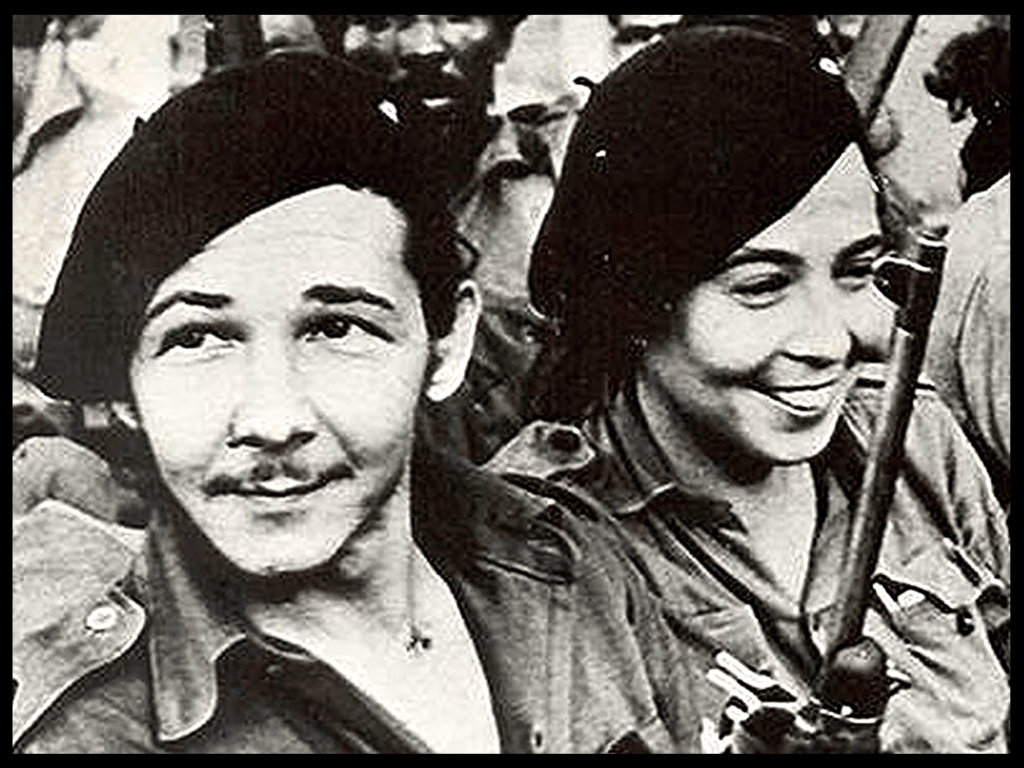
Vilma Espin began working as a messenger between survivors of the failed 1953 Moncada Barracks attack who were exiled in Mexico and the anti-Batista movement in Cuba. After the disastrous arrival to Cuba of the Granma yacht carrying revolutionary combatants who engaged in a gun battle with pro-Batista troops, Vilma Espin joined Fidel and Raul Castro in the Sierra Maestra. By then Espin was a guerilla fighter herself.
After Espin proved her loyalty to the revolutionary cause by diligently performing her duties, she earned a leadership rank in the Rebel Army, alongside other staunch leadership figures like Ernesto Che Guevara, Fidel Castro Ruz, Raul Castro Ruz, Celia Sanchez, Haydee Santamaria, Melba Hernandez, Camilo Cienfuegos, Teté Puebla, and others.
Eventually, the circumstances of political activity influenced the personal lives of Vilma Espin and Rebel Army leader Raul Castro Ruz. The two revolutionaries developed a romantic relationship and married shortly after the overthrow of the Batista regime. They established a family with four children, three daughters and a son. Their names are Deborah, Mariela, Nilsa, and Alejandro (Castro Espin).
In addition to serving as a political cadre in the Cuban government and Communist Party, Espin played an exemplary role in her professional field as a chemical engineer. She led the way to establish the country’s chemical industry, such as in biopharmaceuticals, industrial and medicinal gases, fertilizers, pesticides, and more.
Vilma Espin’s contributions in this scientific field proved valuable for Cuba’s medical research in vaccines and treatments for infectious diseases like Covid-19, HIV/AIDS, Ebola, as well as for cancer and so on. Long after her death, the achievements of her work continue to play a vital role pushing back on the vindictive U.S. economic blockade.

As the moment for the seizure of power approached, Vilma Espin’s work as a leading intelligence operative for the underground spy network of the July 26 Movement proved decisive for demoralizing and neutralizing enemy troops. Along with another Cuban revolutionary heroine Celia Sanchez, Espin was responsible for maintaining a steady flow of weapons, food, and medical supplies for revolutionary forces in the Sierra Maestra Mountains.
Being well-versed in the intricacies of organization, Espin played a pivotal role in the creation of the new revolutionary government. She served as a member of the Central Committee of the Cuban Communist Party from 1965 to 1989. She was chair of the Commission for Social Prevention from 1967 to 1971, director of Industrial Development in the Ministry of Food in 1971, President of the Institute of Childcare, and member of the Cuban Council of State in 1976. In addition, Vilma Espin served as Cuba’s representative on the United Nations General Assembly.
No one can ever dispute that Vilma Espin’s and Raul Castro Ruz’s daughter, Mariela Castro Espin, took after both her parents. It is evident that she was ideologically influenced by the ideals of the revolution during her childhood rearing. Today, Mariela is known throughout the world as a leading voice for LGBTQ+ rights in Cuba, as director of the Cuban National Center for Sex Education.
The Federation of Cuban Women
Espin was a bulwark for revolutionary ideas, upholding Socialism. She made it her life-mission to challenge backward traditions long established by the Roman Catholic Church, especially, that which justifies gender oppression. This is why Espin was an outspoken advocate for gender equality and in 1960 she set out to create the Federation of Cuban Women (La Federación de Mujeres Cubanas, FMC).

The FMC is an organized force with the purpose of empowering women in Cuba. Throughout its existence the organization has introduced and argued for enacting decrees that protect the interest of women. Vilma Espin served as president of the FMC until her death on June 18, 2007.
The FMC continues to be a vital organ of the Cuban Revolution. It follows the motto that without the participation of women would pose a hinderance to the aims of the revolution. This is what made the Communist Party’s support for the FMC a matter of supreme importance.
The FMC addresses issues of the utmost concern to women, such as:
- A general pronouncement for women’s equal rights.
- Intergration of women in politics and government administration.
- Complete integration of women into the economy.
- Adequate healthcare for women.
- Childcare for the very young.
- Women’s access to education.
- Reorganizing households that keep women in subservient positions.
- Creating self-defense classes for women to end physical abuse.

During the CIA-organized Bay of Pigs invasion in 1961 and the Cuban Missile Crisis of 1962, Vilma Espin’s role in the FCW was vital. This powerful entity mobilized women of all ages for battle during a threatening moment when U.S. intervention seemed likely. They stood ready as part of an armed infrastructure composed of all mass organizations in Cuban society.
In the days leading up to that crisis, the CIA conducted acts of sabotage on the country’s food supply. Many crop fields were viciously set ablaze. A state of emergency was called by the Cuban government. The Revolutionary Cuban Army and the various mass organizations, including the FMC, were mobilized. Thousands of armed women in organized contingencies were dispatched to protect farming fields throughout Cuba.
Despite the hardships Cuba faces caused by the U.S. economic blockade the FMC continues to be the most profound part of Vilma Espin’s legacy. What she symbolizes provides a big energy source for the continual resilience and valor of the Cuban people. Her countless examples of selflessness surely point to her noble character, but at the same time sheds light on the moral strength and legitimacy of the Cuban Revolution.
This heroine’s name continues to inspire freedom-loving people throughout the world, especially those following in her footsteps in defense of the Cuban homeland. That alone should serve as a warning to any imperialist power foolishly contemplating on using military force to re-colonize Cuba.
LONG LIVE THE CUBAN REVOLUTION!


