Reconstruction & African American political power

By: CarlosCarlito” Rovira

A revolution drowned in blood

The period of U.S. history known as Reconstruction, following the Civil War, lasted from 1865 to 1877. During this period, former slaves in the South made some of the most far-reaching gains that African Americans have seen in U.S. history. Those gains, ultimately drenched in blood, were not to be seen again until the civil rights struggle nearly 100 years later.

The Civil War, which began in 1861 and lasted until 1865, was a profound social revolution. It brought an end to chatte slavery, which until that time had been the foundation for the rise of U.S. capitalism.

Although the victory of the North resulted in the end of slavery, that was not the stated aim of either President Abraham Lincoln or the industrial bourgeoisie that was the dominant social class in the North when the war commenced. The war began only as a result of the decision by most of the “slave states” to secede from the Union in 1861.

Lincoln refused to end slavery, assuring all slave owners who cooperated with the federal government that they would maintain “their property.” His eventual decision to issue the 1863 Emancipation Proclamation, which decreed the end of legal slavery, was fundamentally a military decision.

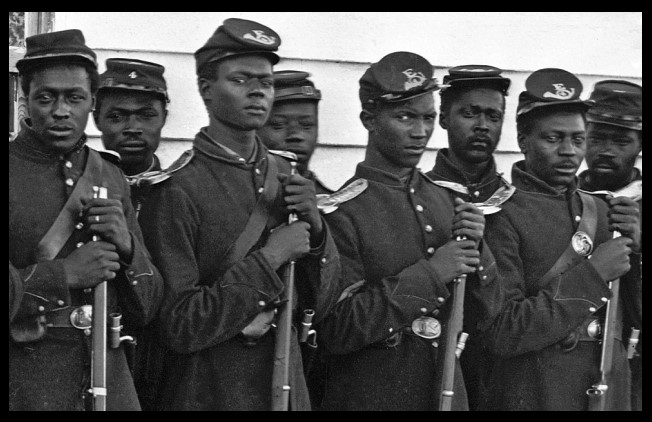
Without the enlistment of thousands of escaping slaves into the Northern army, the defeat of the Confederate army seemed remote. These newly enlisted Black soldiers, with their incredible resolve, determination and self-sacrifice, turned the tide of the war. It was a case of law following reality: Enslaved people were deserting or refusing to work on the plantations in growing numbers. They demanded the right to join the battle.

African Americans were decisive in the outcome of the Civil War.

The military exigencies of the day overcame the white supremacist policy of the Northern army and the federal government, which had refused to abolish slavery until that time.

The Emancipation Proclamation had the effect of drawing into the struggle the Black masses—and it proved decisive. African Americans comprised a social class rooted in the slave system itself, and ultimately determined the outcome of the Civil War. After the proclamation, some 180,000 freed slaves enlisted in the Union Army and became fearless fighters against the army of their former masters.

When Confederate General Robert E. Lee surrendered in 1865, the question of how to reintegrate the Southern states into the Union was sharply posed. This was the basis for the period of Reconstruction. It represented a continuation of the conflicts of the Civil War, but under new circumstances determining the direction of the life-and-death struggle between the overthrown and the overthrowing classes.

Suppressing counterrevolution

Like every revolution, the military conflict of the Civil War was followed by a period in which the remnants of the previous order were suppressed, both by political means and by force. The French Revolution, the 1917 Russian Revolution, the 1949 Chinese Revolution, the 1959 Cuban Revolution and others all relied upon extraordinary measures to survive and fight off the attempts of the former rulers to regain political power.

How to suppress these forces had been the subject of debate in Northern political circles throughout the war. On the one hand, were moderates like Lincoln who wanted to incorporate as many elements as possible of the old slave-owning class into a new pro-Union government. On the other hand, Radical Republicans like Thaddeus Stevens and Charles Sumner favored harsh repression and exclusion of Confederate society from political power.

The Radical Republicans were the political driving force of Reconstruction. They were in an objective sense the revolutionary, unwavering and determined wing of the divided capitalist class. Their political base was in Congress, where they held a majority that grew in the years immediately following the end of the war.

They understood that the freed slaves were the most solid base of support for the Union. African Americans rejoiced at the military defeat of the Confederacy. Across the South, ex-slaves organized meetings and political organizations to take advantage of their new freedom.

The freed slaves were the most solid base of support for the Union.

Social gains of Reconstruction

In March 1865, just weeks before Lee’s surrender, the federal government created the Freedmen’s Bureau. Under the military protection of Union troops, Black and white, the Bureau organized a vast education project for former slaves—a project which laid the foundation for public education nationwide, from which poor whites also benefited. It was even authorized to carry out a land redistribution program, although such radical measures were never widely implemented.

The decrees following emancipation challenged racist notions and recognized former slaves as human beings. The formerly enslaved and property-less Black masses looked forward to a new beginning free from racist violence and with compensation for everything they had endured.

But differences emerged almost immediately over how to reconcile the interests of the freed slaves with the needs of the victorious Northern capitalist class. The tenuous political alliance of the anti-slavery forces during the Civil War soon broke apart.

The Radical Republicans understood the strategically important role of African Americans in smashing the former slave-owning class. The moderates, however, sought to rely on a partnership with the old ruling class as opposed to the revolutionary momentum of the Black masses.

Johnson’s ‘Black Codes’

President Andrew Johnson, who had assumed the presidency after Lincoln’s assassination, had postured as a Radical during the war. But he quickly emerged as the leading force of political reaction within the national Republican Party.

After the defeat of the Confederacy, Johnson installed new governments in the Southern states made up wholly or primarily of pardoned ex-Confederates. In late 1865, several of these Johnson-installed state legislatures passed laws known as “Black Codes.” These laws set up the terms for the newly freed Black population to participate in Reconstruction. They were in many ways precursors to Jim Crow laws, creating a separate and unequal system for African Americans.

The Black Codes varied from state to state, but they had common features. They required labor contracts for Black laborers—often with terms not much different than slavery. They prohibited Blacks from migrating from one state to another unless they possessed papers specifying that he or she was bonded by contract to labor for an employer. They limited African Americans’ participation in politics with educational or property restrictions. Former slaves were generally described by the laws as “servants, “while the description used for employers was “master.”

Economically, the main thrust of the Black Codes was to reinstitute the plantation system. For example, Blacks were restricted from choosing where they worked and the type of work they did. In many parts of the South, they were forbidden to work in towns and cities. In some areas, skilled Black workers were required to receive a license or certificate in order to get employment in occupations other than in agriculture or domestic work.

In the eyes of many, both former slaves and Northerners, the power of the former slavocracy was being restored. Johnson’s “Presidential Reconstruction” was seen as selling out the gains of the Civil War. Further inflaming Radical sentiment, in 1866 Johnson vetoed an extension of the Freedmen’s Bureau and a Civil Rights bill that would extend citizenship to African Americans.

Radical Reconstruction and Black political power

New elections to the House of Representatives took place in 1866. With the southern states not yet readmitted to the union, Radical Republicans made big gains, winning enough seats to override Johnson’s vetoes.

The 10-year period beginning in 1867 is what is known as “Radical Reconstruction” and was a period of the most far-reaching social change seen in United States history. A Civil Rights Act was passed over Johnson’s veto in March 1866. The Congress passed the Reconstruction Act, which put the whole former Confederacy under military control and forced the creation of new state governments in accord with voting rights for African Americans.

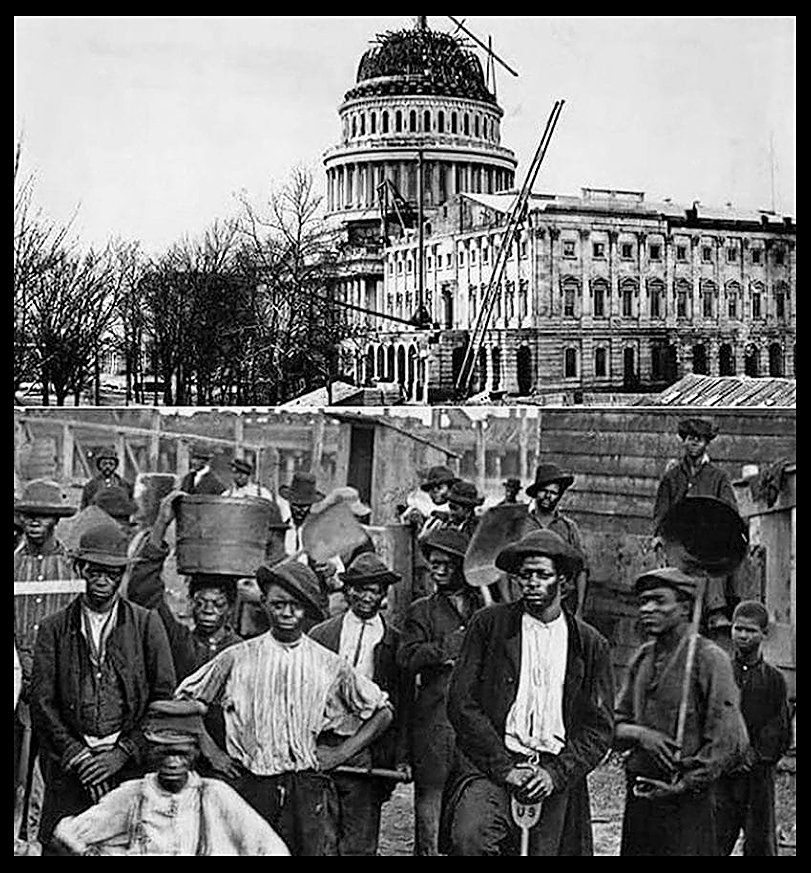
It was enslaved Black people who constructed the Capitol building and most of Washington, DC.

African Americans organized into Union Leagues to exert their new political power. Over 600—a majority former slaves—were elected to state office during this period. A wide variety of social programs were introduced: widening public education, funding for health care for the poor in South Carolina, free legal aid for the poor in Alabama.

Racist violence

But each step forward for the newly emancipated African Americans was met by violent resistance from the former rulers. White Southern politicians colluded to undermine Reconstruction. As early as May 1866, Gen. Nathan Bedford Forrest rallied a group of ex-Confederate soldiers in Pulaski, Tennessee., to form the infamous Ku Klux Klan, which spread quickly throughout the Southern states.

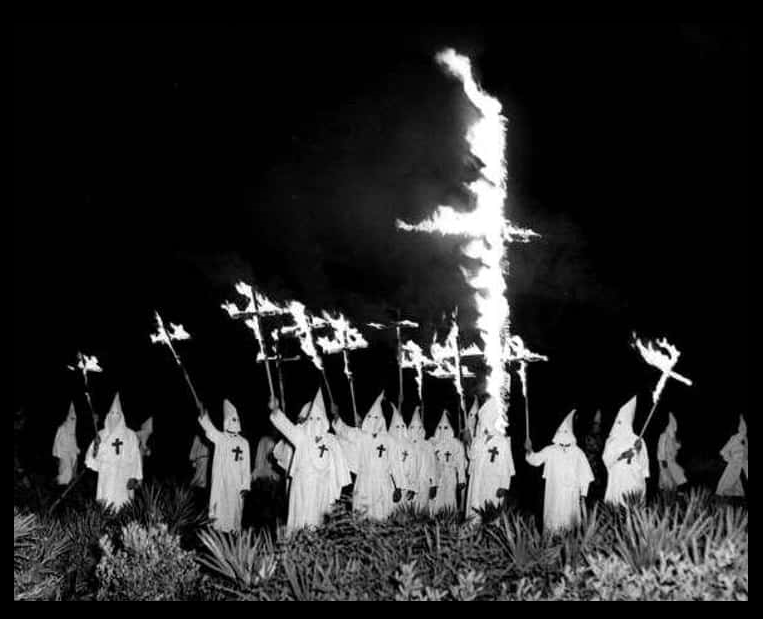
The sickening cross-burning gatherings of the Ku Klux Klan, designed to intimidate.

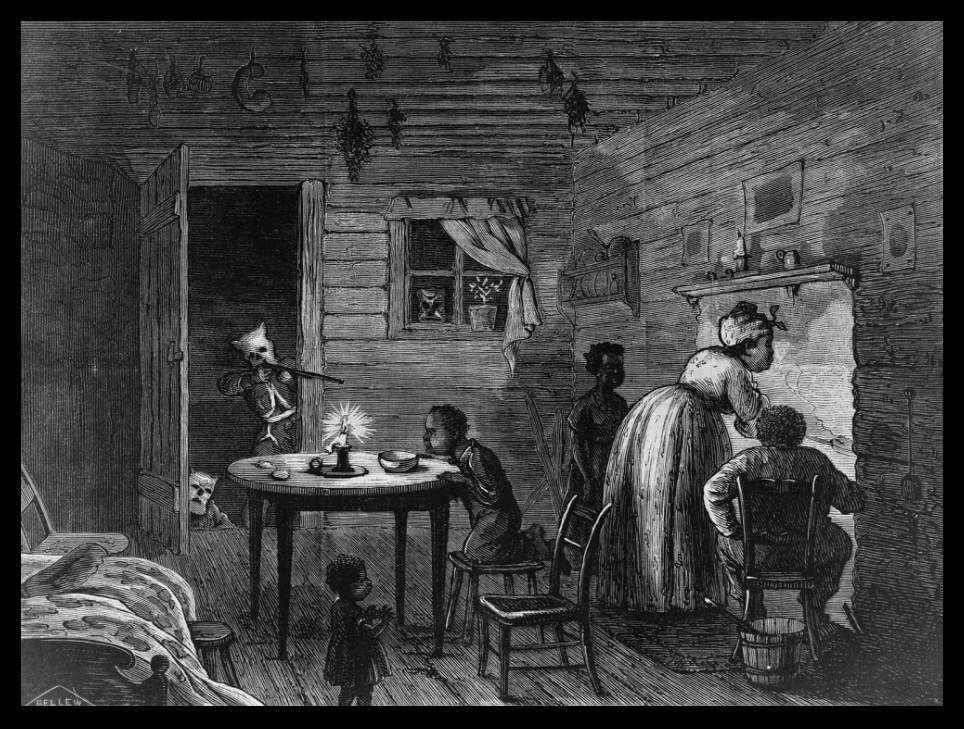
The KKK invaded the homes of outspoken African Americans.

The KKK’s primary objective was to crush the new mobilization of African Americans. Knowing that the African American people had the will and numerical advantage to create the South in their own interests, the KKK targeted the families of outspoken Black leaders in twilight-hour raids of their homes. The terrorist organization also attacked progressive Northern whites who were serving the purposes of Reconstruction.

Throughout Reconstruction, political debates in Congress or in state legislatures were accompanied by violent massacres committed by organized white racist groups. Such massacres took place in New Orleans in 1866, Memphis, Tenn. in 1866, Pulaski, Tenn. in 1868, Opelousas, La. in 1868, Camilla, Ga. in 1868, Meridian, Miss. in 1870, Eutaw, Ala. in 1870, Laurens, S.C. in 1870, New York City in 1870 and again in 1871 and in Colfax and Coushatta, La. in 1873. The list of these atrocities continues for the duration of Reconstruction, setting the precedent for the lynchings and apartheid terror for African Americans into the 20th century.

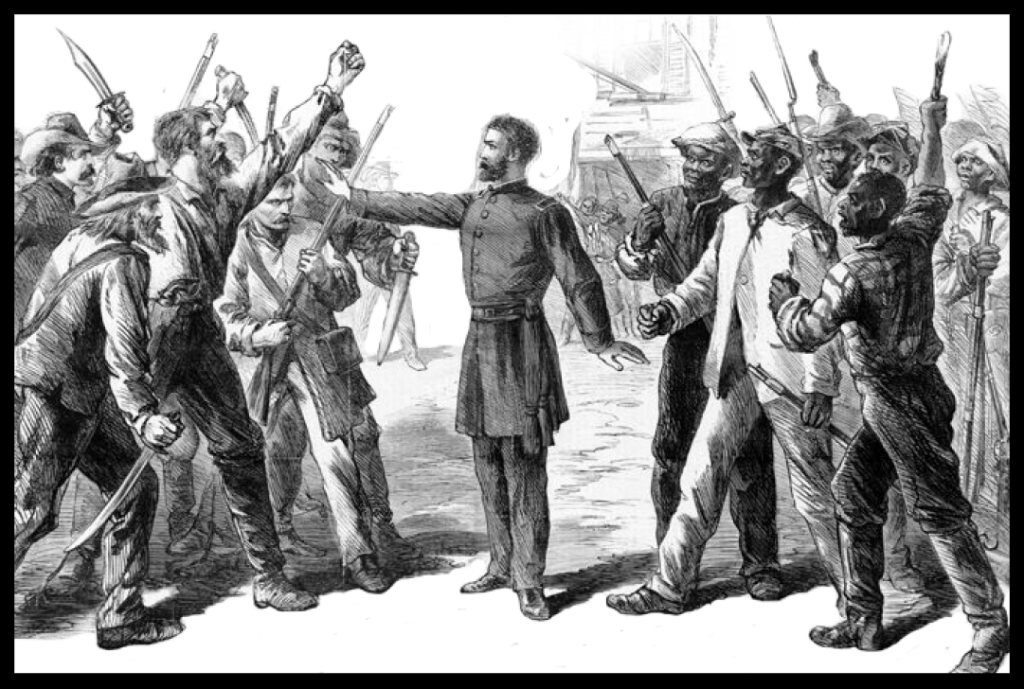
African Americans defended themselves and the gains of emancipation through mass campaigns and with arms in hand. Regiments of Black soldiers patrolled streets throughout the South. But the weight of the racist whites’ organizations proved to be too powerful for the African American community to overcome—especially as support for Reconstruction waned in the North.

African Americans defended Reconstruction with guns at hand.

Racists sought to disarm the Black masses. Throughout the Southern states and neighboring regions, gun control laws were introduced—but selectively applied only to African Americans, who relied on their guns to defend themselves.At the same time, economic depression in the 1870s along with corporate corruption scandals led to the emergence of a growing anti-Reconstruction coalition in the federal government. Federal troops were removed in one state after another, each time resulting in the reversal of political and economic gains for African Americans.

In 1877, Republican president-elect Rutherford B. Hayes—having lost the popular vote in the 1876 elections and with the election outcome uncertain in the electoral college — agreed to what became known as the Compromise of 1876, or in the Black community as the “Great Betrayal of 1876.” Hayes and the Republicans agreed to remove all remaining federal troops from the South in exchange for the Republicans retaining the White House.

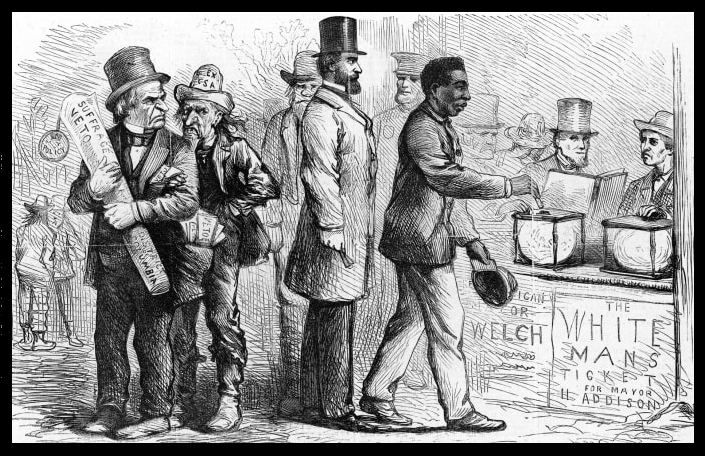
Laws were created to deny Black people their right to vote.

A reign of KKK terror and lynching enveloped the South as the Northern troops were removed. The dictatorship of the Reconstruction period—with the old slave owners repressed and formerly enslaved people living in a semi-democracy—was replaced by the reintroduction of the old dictatorship of the slavocracy.

The former slave owners could no longer possess human beings as their property, but they reemerged as junior partners of the Northern industrial bourgeoisie. In the southern part of the United States, this dictatorship of the Southern and Northern capitalists continued the legacy of unmatched cruelty and oppression of an entire people. The period known as Reconstruction was officially over.

The first real experience of Black political power—coming after centuries of attempted slave insurrections and resistance—was ultimately defeated.

Capitalist consolidation vs. Black liberation

The Civil War that was led by the Northern industrial bourgeoisie, uprooting the slave-owning class in the South, opened the door for the exploited Black masses to organize and make real social gains. During the period of Radical Reconstruction, the interests of this oppressed class dovetailed with the Northern capitalists’ short-term interests in crushing their former rivals. This was despite the fact that the African American masses’ class interests were hostile to both Northern capital and Southern chattel slavery.

The most important task for the U.S. capitalist class was increased centralization and consolidation. It was in the midst of the genocidal campaign against the Native peoples in the west. Life-and-death battles with the newly emerging industrial working class were taking place in railroads, mines and factories across the country. The capitalists were within 20 years of joining the worldwide race for colonial plunder.

The industrial capitalists made peace with the defeated slavocracy at the cost of many concessions—the easiest for them being the aspirations of the exploited African American working classes. Although subjected to renewed and constant terrorism from the forces of white supremacy, who had all the institutional threads to political power in the form of control over local and state police forces, the freedom movement of the African American community could not be extinguished. Generation after generation found new methods of struggle.

Between the mid-1950s and the 1970s, this freedom struggle culminated in the emergence of the broadest and most militant social movement in the history of the United States. It was this movement that would eventually force the U.S. government to formally outlaw the apartheid system that replaced the Reconstruction era following its overthrow in 1877. The passage of the 1964 Civil Rights Act and the 1965 Voting Rights Act restored the legal rights that had been violently suppressed 90 years earlier.

The Civil Rights and Black Power movements were the continuum of the Black liberation struggle.

The democratic aspirations of African Americans were betrayed precisely because it is impossible to reconcile the interests of the capitalist class with the social interests of Black people. The lucrative system of African chattel slavery was born as an appendage of capitalism.

The relatively young U.S. white working class of the 1860s and 1870s was too infected with racism to serve as an ally to the aspirations of the African American masses, even though their objective social interests overlapped.

The completion of the tasks of Reconstruction and the later civil rights and Black liberation movements remains on the agenda today, nearly two centuries later. Building a united class struggle against the imperialist ruling class remains the best hope for fulfilling that agenda.

Long Live the African American struggle for emancipation!

The African Blood Brotherhood and the Proletarianization of Blacks in Amerika

As a tribute to the African Blood Brotherhood I am re-posting this article on my blog. The history of the ABB and the role of African Americans in the socialist movement should be of the utmost importance for all to research.                                                                                                                                                                              -Carlito Rovira


The African Blood Brotherhood and the Proletarianization of Blacks in Amerika


By Comrade Tom Big Warrior (2010)
Reprinted from Right On! #1


The African Blood Brotherhood for African Liberation and Redemption (ABB) was the first Marxist, Revolutionary Black Nationalist organization in Amerika. Founded in 1917, it grew rapidly during the wave of white racist riots known as the “Red Summer of 1919,“ the ABB was a secret, armed, community self-defense-oriented society headquartered in Harlem.


Many of the “Blood Brothers” were combat vets who had fought in France in World War I. Many were workers, conscious of their proletarian class exploitation and oppression in capitalist society, as well as their caste oppression as “Negroes,” and national oppression as members of a nation of a new type defined by color and refined by slavery, terror and segregation.


The Nation of New Afrikans in Amerika, which was then a peasant nation concentrated in the cotton-producing “Black-Belt South,” was also evolving into a proletarian nation in the industrial centers and defined urban ghettos. The white riots were pogroms directed at these ghettos, which were expanding with the “Great Migration” from the South to the North and the West that had been encouraged by the need for industrial workers during the World War. Many of the white rioters were also returned war vets. There was also a big resurgence of the KKK at this time that peaked in the mid-1920s.


The urban Black proletarian had to be tough to survive. They were consigned to the dirtiest, most menial and demeaning jobs, and there was brutal competition for these jobs. The ghettos were overcrowded and transient, and Black on Black violence was rampant. Rubes from the country were sheep to slaughter for the lumpen criminals who preyed on them, and they kept coming as mechanization was displacing share-cropping in the South. Black workers quickly learned that whites who were not racist against them were probably class-conscious and Socialist. Militant unions like the IWW brought together workers of all ethnic backgrounds. But the core of leadership of the ABB was part of another migration from the Caribbean to the U.S., and particularly to Harlem.


The African Blood Brotherhood was the brain-child of Cyril Briggs, a light-skinned native of the Caribbean island of Nevis, where he was born in 1887. He migrated to New York on July 4th, 1905 and joined a growing community of West Indian Blacks in the city. That was the year of the first attempted revolution in Russia in which the Leninist Bolsheviks played a conspicuous role. The successful October Revolution of 1917 sent a shock wave around the world that was felt by oppressed people everywhere.


EE
CYRIL BRIGGS – Founder and leader of the African Blood Brotherhood.


Lenin particularly had a lot to say to the colored peoples of the colonial and semi-colonial countries and directly to the Black people in Amerika. Eventually, the ABB was absorbed into the underground communist Workers Party of America (WPA) which evolved into the CPUSA. The communist party founded by the Russian Federation declared its stance on the Negro Question in 1920: “The Communist Party will carry on agitation among Negro workers to unite them with all class conscious workers.”


Leninism distinguished itself from earlier Marxism by its conscious commitment to the national liberation struggles of the colonial and subject peoples which Lenin recognized to be closely linked to the World Proletarian Socialist Revolution. The class conscious ABB veterans and West Indians shared an understanding of a wider world of exploitation and oppression than the “Jim Crow” South and the ghetto street corner, the world of global capitalist-imperialist empire and world proletarian socialist revolution – a world illuminated by Leninism.


The ABB was committed to the liberation of Afrika and the whole of the Afrikan Diaspora from white world supremacy and capitalist-imperialism and saw the necessity of overthrowing this system to end the racist oppression of Black people and other people of color. As the immediacy of defending the oppressed Black communities from the violence of vigilante white mobs subsided, the ABB comrades began to see more and more the need to win white comrades to fight against white racism in the overall workers movement and all strata of society and prepare the U.S. for proletarian socialist revolution.


Former ABB members formed the core of the CPUSA’s Black cadre, and they were rigorous in opposing white racism in the Party and the unions and mass organizations influenced by the Communist Party. In the 1920s & 30s, the Communist Party initiated work in the South, including forming sharecropper unions uniting both Black and poor whites and unions among southern textile workers.


This was the CP’s most revolutionary period – though it tended towards “left economism” and “dual unionism” — and a period when many Blacks were first exposed to Communist ideology and organization. The “Harlem Renaissance” saw a flowering of Black consciousness and culture, and most of the artists and intellectuals involved were strongly influenced by Marxism-Leninism and leftist ideas.


The World War had shaken things up and raised Black expectations. Most expected progressive changes after the war and were disappointed and frustrated by the resurgence of KKK activity and overall reactionary backlash that swept white Amerika. Large numbers turned to the new Communist Party looking for direction.


LONG LIVE THE MEMORY OF THE

AFRICAN BLOOD BROTHERHOOD!


Image may contain: one or more people and people standing
Statue in honor of the African Blood Brotherhood, at the John Hope Franklin Reconciliation Park in Tulsa, Oklahoma 

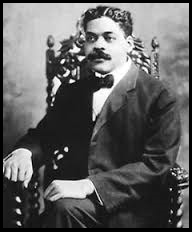
Arturo Alfonso Schomburg January 24, 1874 – June 10, 1938

By Carlos “Carlito” Rovira

Arturo Alfonso Schomburg was born on January 24, 1874 in Santurce, Puerto Rico. He was a Black Puerto Rican scholar, historian, author and activist, who devoted his entire life to compiling vast collections of writings and art documenting significant events in Black history.

When Schomburg was just 8 years old he was told by a school teacher that Black people had no history. This assertion naturally bothered him for a long time. But as he gradually grew older, Schomburg found the teacher’s claim to make absolutely no sense. That encounter became Schomburg’s motivation which led him to set out and prove wrong such racist notions.

African chattel slavery also took place in Puerto Rico, it was the consequence of Spanish colonialism in both Africa and Latin America. In the year 1527, the first of many slave revolts in Puerto Rico occurred which was among the bloodiest in Western Hemisphere history.

Despite the numerous contributions Schomburg made to the preservation of Black-Latino history, like many other Black scholars and professionals in different fields, he was not immune to anti-Black discrimination. Throughout his entire life, Schomburg experienced blatant racism, sadly within the Puerto Rican community as well.

Colorism, as an extension of white supremacy, often permeated conversations about “Los prietos” (the dark ones), “Pelo bueno y pelo malo” (good hair and bad hair), and so on. As in the United States, the not-so-hidden practices of racism has also existed in Puerto Rico and all of Latin America, like the widely known anti-Black, anti-Haitian “legal” practices of the Dominican Republic.

Arturo Schomburg was instrumental in documenting the role of African people in the cultural development of the Puerto Rican nation. The psychic, spirituality, linguistics, diet, music and dance of Puerto Rico pointed to the contributions made by Africans. Schomburg proudly identified as an Afroborinqueño (Afro-Puerto Rican).

Harlem Renaissance & Puerto Rico’s independence struggle

Schomburg became known during the famous Harlem Renaissance. He collaborated with prominent figures like Marcus Garvey, Carlos A. Cook, Hurbert Harrison, Langston Hughes, Alain Leroy Locke, W.E.B. Du Bois and other pillars of that movement. It was an exciting and enlightening period in history for the African diaspora, following the struggles to end the horrors of slavery. Harlem was viewed as the political and cultural Mecca of the African American people.

The Harlem Renaissance, which unveiled the beauty of African culture also shattered many racist myths. This movement resulted from Marcus Garvey’s call for Black people to be profound with their identity in all areas of dignified expression. It succeeded in challenging the ideological facets of white supremacy through the literary, visual and performing arts.

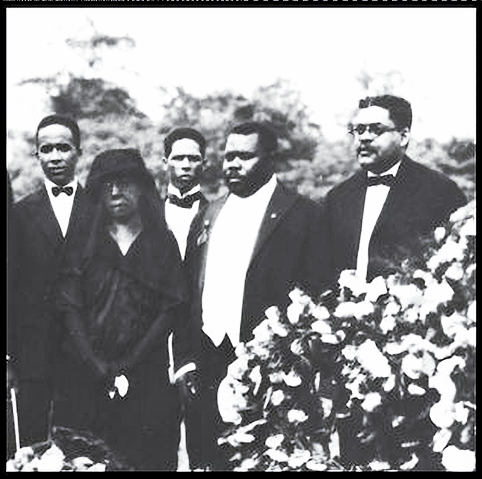
Marcus Garvey, Arthur Schomburg and other mourners at the grave of John E. Bruce

Thanks to the powerful momentum inspired by Marcus Garvey and the Universal Negro Improvement Association and African Communities League (UNIA-ACL) Black people now had relative freedom to develop culturally, economically and politically in the surroundings of a white racist society. This was the setting in which Arturo Schomburg was able to make his contributions to Black history.

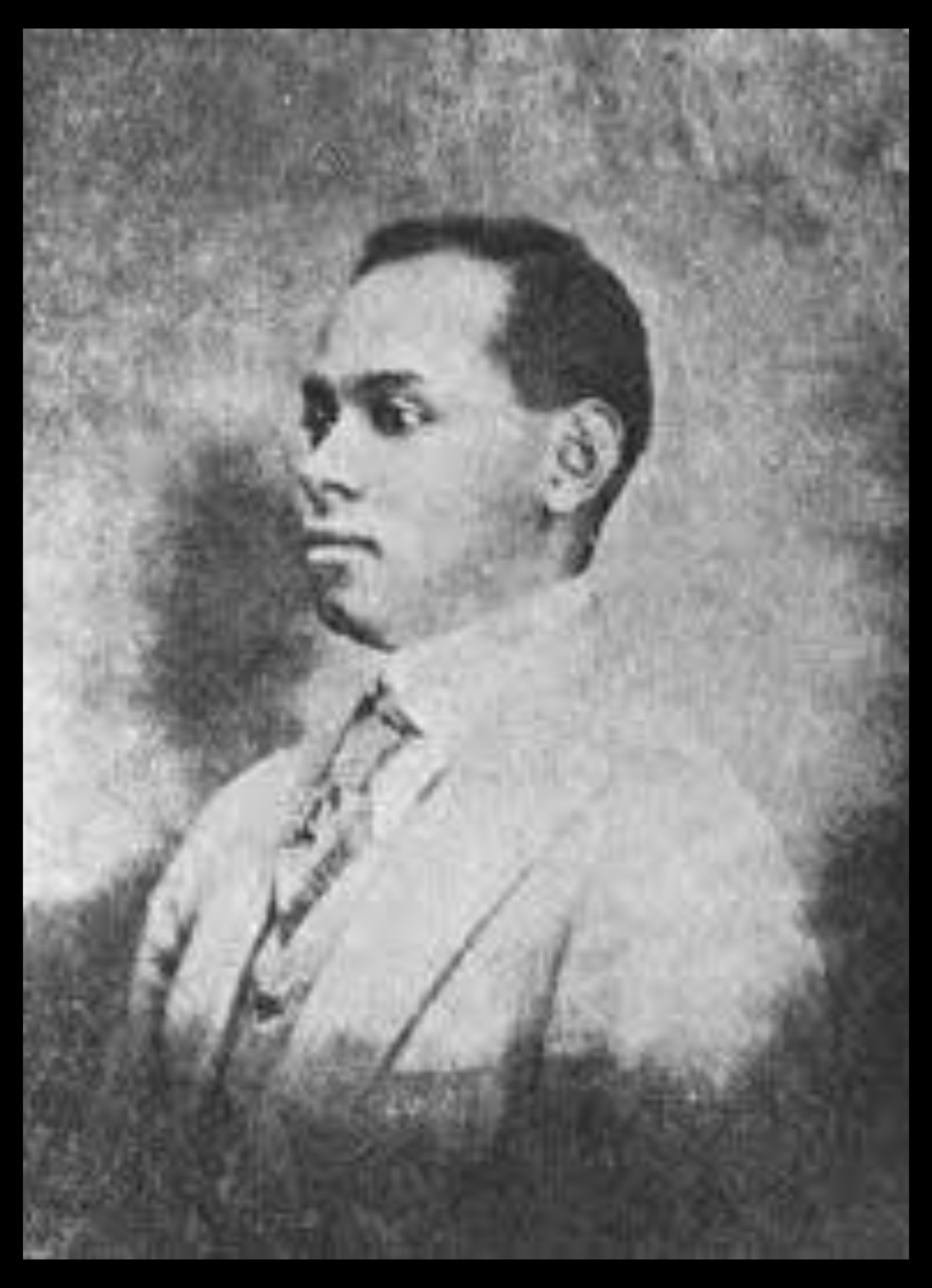
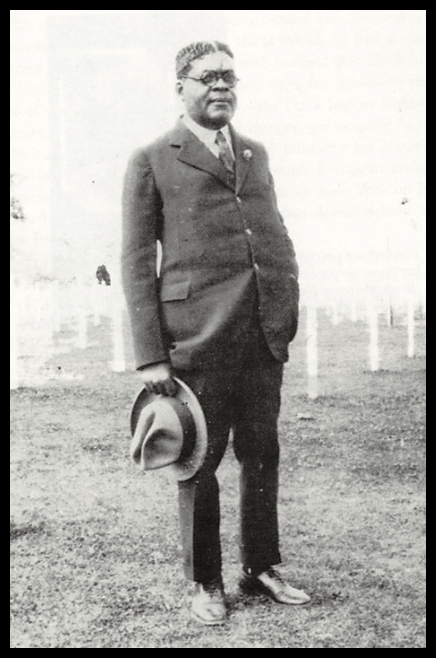
Arturo Alfonso Schomburg in New York City, 1932.

Before moving to New York City, at 17 years old, Schomburg was a leader in the secret Revolutionary Committee of Puerto Rico. This organization was created several years before Schomburg’s birth for launching the 1868 anti-slavery & pro-independence revolt known as El Grito De Lares. Although the attempt to rid Spanish colonialism failed, the Revolutionary Committee continued to exist clandestinely.

Schomburg was a firm advocate for Puerto Rico’s independence. In fact, he was the founder of Las Dos Alas (in English The Two Wings), an organization in New York City devoted to the independence cause of Puerto Rico and Cuba.

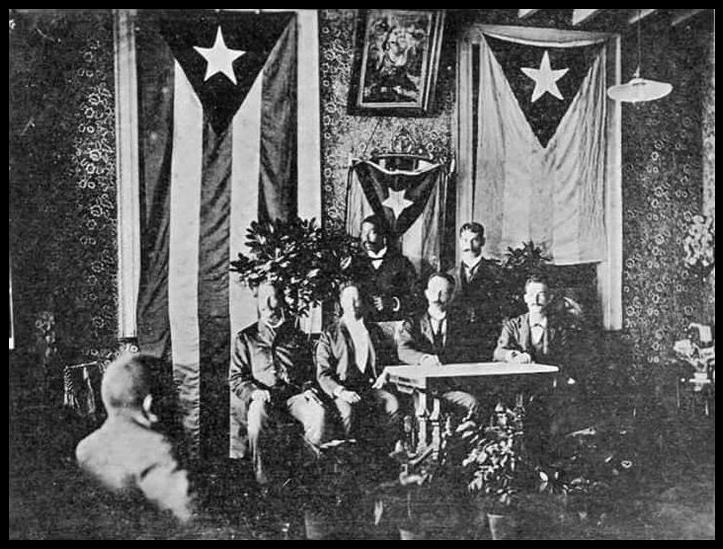
In 1895, Schomburg partook in a secret meeting held at New York City’s Chimney Corner Hall to discuss and approve by vote a proposed design for what became the official Puerto Rican Flag of today. The attendees of this meeting were mostly political fugitives being sought by the Spanish colonial authorities. Most of them became affiliated with the Cuban Revolutionary Party under the leadership of the legendary Jose Marti.

Schomburg’s shift in central focus

But as the 19th Century came to a close with the U.S. military occupation of both Cuba and Puerto Rico, caused the independence movement in both countries to enter a period of stagnation. The anti-colonial struggle was temporarily paralyzed due to many people believing the overtures of U.S. invaders who promised to grant independence. As a result, Schomburg and other like-minded activists who resided outside of Cuba and Puerto Rico, began to re-vise their activities based on the change in the climate of imperialism.

As the persecution of Black people in the United States intensified, with the extension of Jim Crow laws, lynching and white racist riots presenting a dangerous and menacing setting, coupled by Schomburg’s childhood memory of a demeaning comment made to him by a school teacher, raised his commitment to the idea of affirming the validity and truth of Black history.

Ridiculing the racist fables about the origins and history of Black people became Schomburg’s central focus. His noble quest eventually proved the extent of white supremacy’s corruption and baseless reasoning for existing.

Once in New York City, and for the remainder of his life, Schomburg collected large amounts of materials relevant to the history of Africa and the African diaspora. His work unavoidably brought to light the falsehood of white historians who interpreted the history of human social development strictly from a European perspective, thus concealing what are the African people’s pivotal role in that process.

Although Arturo Schomburg never proclaimed to be a revolutionary, his academic achievements coupled with such fervent passion to preserve and protect the historic culture of the Diaspora shows otherwise. Long after his death, Schomburg’s accomplishments continue to shatter racist myths.

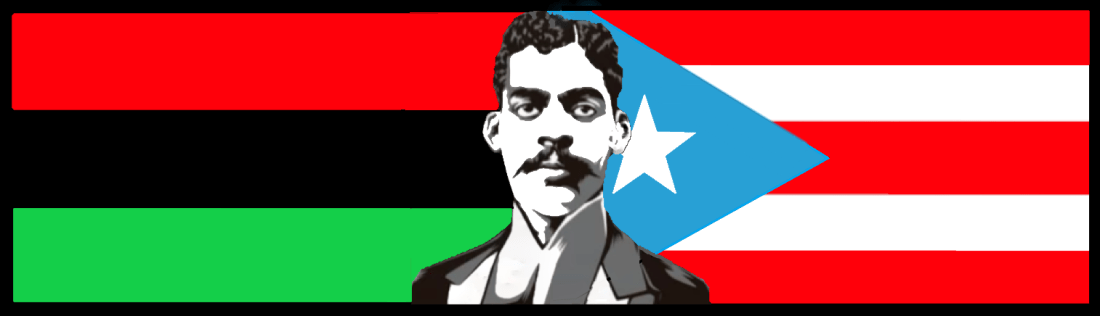
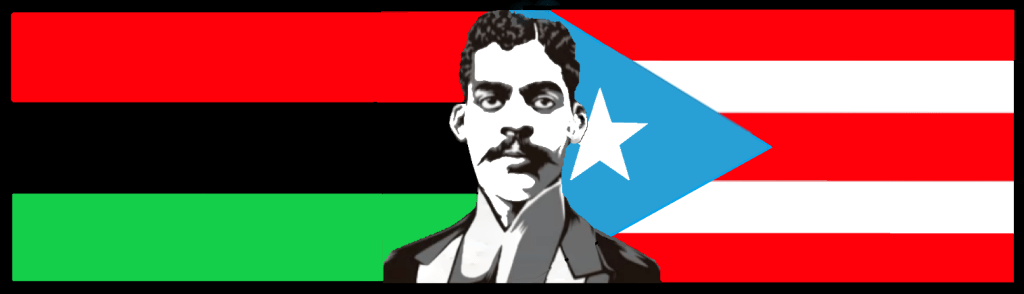
A 24″ X 30″ canvas portrait I made of Arturo Alfonso Schomberg.

His devotion to raise Black history to its rightful grandeur contributed immensely to the ideological struggle against white supremacy, thus, adding to the majestic qualities of Black nationalism.

Moreover, Schomburg was a consistent leader of debunking the dangerous narratives of racial superiority that ushered in social Darwinism and Eugenics. These world perspectives were often used by capitalists to politically hinder and divide working class people.

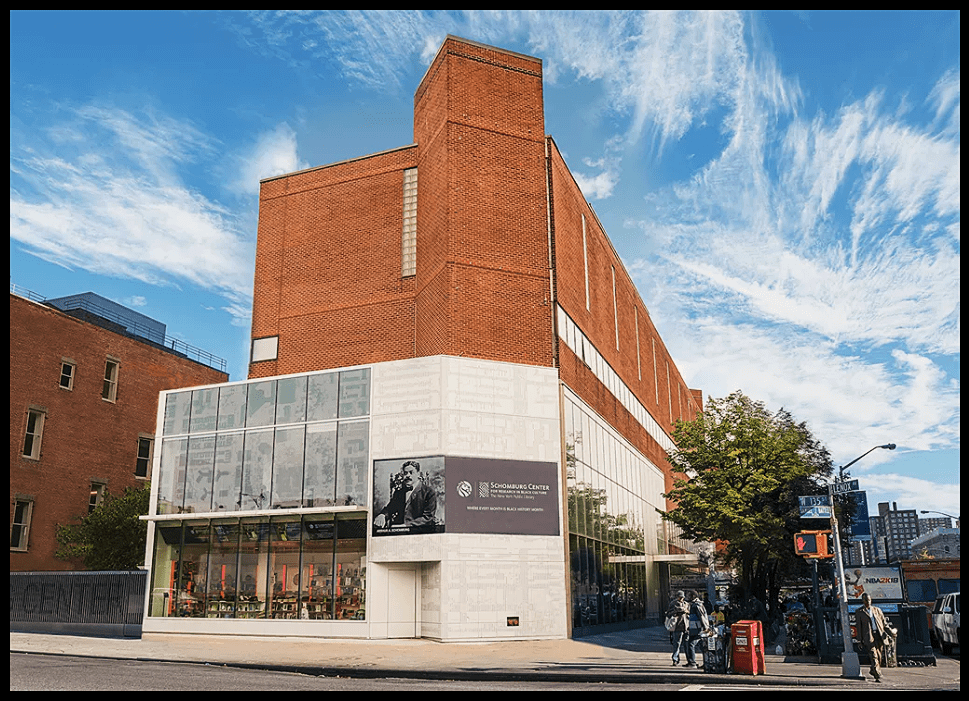
Schomburg Center for Research in Black Culture — Harlem, New York City

The vast and beautiful collection of literature and art materials he compiled throughout his life are permanently housed at the New York Public Library’s Schomburg Center For Research of Black Culture, located at 515 Malcolm X Blvd, in Harlem, NYC.

Arturo Afonso Schomburg shall be remembered for his bold intellectual defiance and as a hero of the oppressed. His lifelong contributions have strengthened the legitimacy of Puerto Rico’s independence cause as well as the historical struggle for Black liberation. Schomburg’s’ life embodied the epitome of Black & Puerto Rican solidarity.

Arturo Alfonso Schomberg – PRESENTE!

Long live Black & Puerto Rican solidarity!

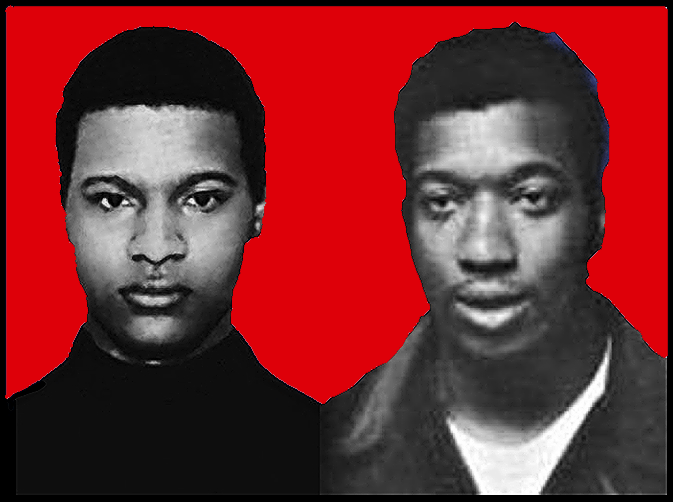
Remember FRED HAMPTON & MARK CLARK, Black Panther leaders murdered by police on December 4, 1969

______________________________________________________________________

“We say you don’t fight racism with racism. We’re going to fight racism with solidarity. We say you don’t fight capitalism with no black capitalism; you fight capitalism with socialism.” -BPP Chairman Fred Hampton

______________________________________________________________________

By Carlos “Carlito” Rovira

In a coordinated effort between the Illinois State Attorney’s Office, Cook County Police Department, the Chicago Police Department and the Federal Bureau of Investigation (FBI), in the morning hours of December 4, 1969, a heavily armed assault team launched a heinous attack on the residence of Black Panther Party, Illinois Chairman Fred Hampton.

With a vicious sense of racist hatred and no regard for human life, these law enforcement officials fired a single shotgun blast through the entrance door of the apartment instantly killing Mark Clark, by striking him to the chest. These murderers then fired their weapons at will through a wall separating the hallway from the apartment, critically wounding Fred Hampton as he laid in bed. 

According to accounts, after the police smashed through the front door entering the apartment, one of the police officers who entered Hampton’s bedroom was overheard saying “He’s still alive.” At that point the handcuffed occupants can hear from another room the kill-shot that ended the Panther leader’s life. In a matter of minutes, two inspiring revolutionaries were maliciously murdered.

MARK CLARK WAS A LOYAL PANTHER

Mark Clarke was 22 years old, an enthusiastic youth with talents in the arts. He was eager to fight against the racist oppression Black people endured since chattel slavery. That became the motive why Clark joined the Black Panther Party soon after he met Chairman Fred Hampton during a visit to the BPP national office in Oakland, California. From then on Hampton and Clark became good friends and comrades until the tragic end of their lives.

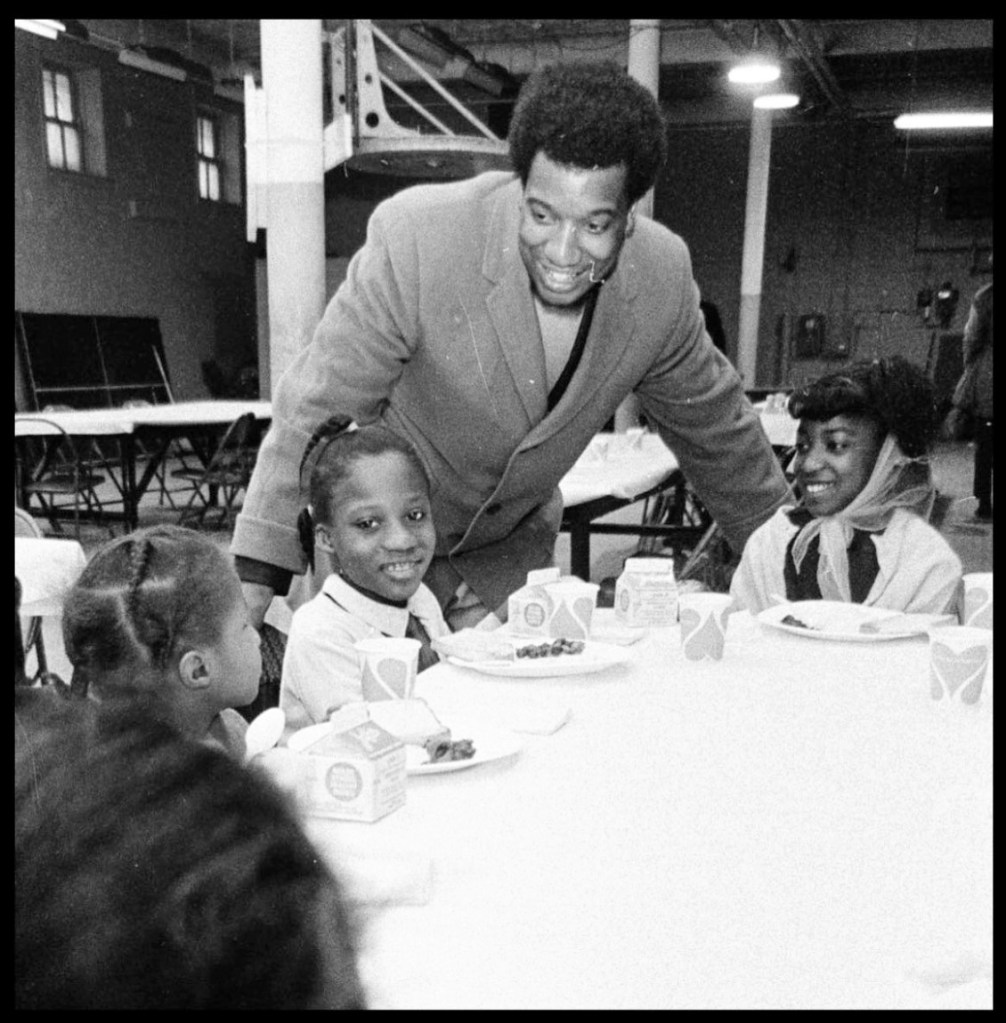
Once he embraced the BPP ideology and discipline, specifically it’s Ten Point Program and Platform, Clark organized the Peoria, Illinois chapter of the BPP with 50 recruits, including two of his siblings. Under Clark’s leadership a Free Breakfast Program was established which drew support from many residents from Peoria’s Black community. Clark was appointed by the BPP’s Central Committee the rank of Defense Captain, which he accepted and took seriously.

Mark Clark and Fred Hampton

In the days that followed, law enforcement officials were quick to reinvent the facts. They claimed that the occupants of the apartment fired guns at police. Their story never held water. Evidence gathered from the forensic investigation and other inquiries pointed exclusively to police savagery in the attack.

The shaping of Fred Hampton’s leadership

Like millions of African Americans, Hampton’s parents left the South during the Great Migration of the 1930’s to look for a better life and flee the constant threat of racist terror. They settled in Maywood, Ill., a suburb of Chicago where they worked at the Argo Starch Company.

Hampton was attracted to books and took it upon himself to read the speeches and writings of Marcus Garvey, W.E.B. Dubois, Joan Elbert, Martin Luther King Jr.,Malcolm X as well as MarxistLeninist classics. He gained a reputation for his knowledge of Black and world history which helped develop his sense of the need for struggle.

As a student at Proviso East High School, he noticed that most of the students who failed were Black. Hampton began to speak out against the school administration for not providing tutoring and remedial programs for students. He was also critical of the fact that the faculty and administration were all white when one-fourth of the student body was Black.

Hampton challenged the school’s exclusive racist practice of nominating only white girls to compete for “Miss Homecoming Queen.” He organized a protest, walk-out and school boycott. As a result, the following year Black female students were included in this contest.

Chairman Fred Hampton speaking with children at the Free Breakfast Program.

Fred Hampton was respected by white and Black students alike. The year after he graduated from Proviso East, a school administrator requested his help to calm racial tensions among students.

An event that likely affected the young Fred Hampton, much as it affected most of Chicago’s Black community, was the 1955 gruesome lynching of Emmett Till. The 14-year-old Till was visiting family in Mississippi when he was abducted and killed for allegedly whistling at a white woman. Till was the son of family friends and neighbors of the Hamptons.

While Hampton was in the NAACP, the Black Panther Party was opening chapters across the country and becoming a prominent force in the Black liberation struggle. Hampton began to absorb and understand the revolutionary content of the Panthers’ political perspective and joined. He soon demonstrated his leadership abilities and became deputy chairman of the party’s Illinois chapter.

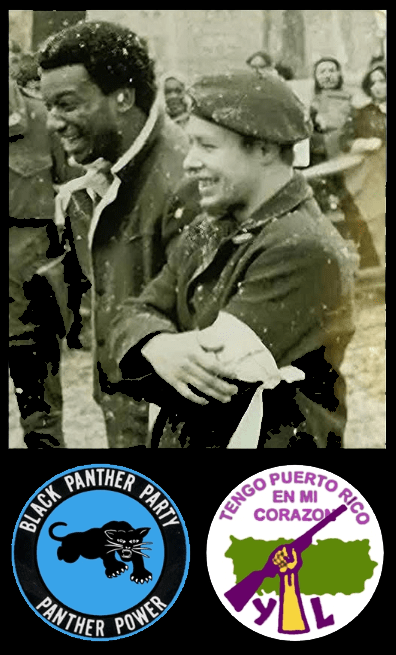
His disposition and skills as a speaker earned Hampton a moral authority. His political achievements included brokering peace with the supposed “street gangs” of Chicago, amongst them the Puerto Rican group the Young Lords. Hampton was instrumental in transforming the Young Lords into a revolutionary political organization.

BPP Chairman Fred Hampton and Young Lords Chairman Jose Cha-Cha Jimenez.

The white, racist U.S. ruling class was appalled. How dare the descendants of African slaves call themselves Socialists and aim to achieve Black people’s right to reparations! Even more daring was the Black Panther Party’s call for the overthrow of capitalism—a demand the ruling class could never tolerate. Their ability to forge unity in struggle was a threat in itself.

All this was happening while resentment for the war in Vietnam was on the rise. The men of privilege and wealth, with a stake in preserving the imperialist system, grew apprehensive the more it became apparent that a mass revolutionary movement was arising.

Hampton valued the need for a multinational revolutionary struggle, and organized the original Rainbow Coalition comprised of the I Wor Kuen of the Asian community, the Brown Berets of the Chicano-Mexican community, the poor white workers of the Young Patriots, the Young Lords and the Black Panthers. The Black Panther Party set standards for waging struggle. Their enthusiastic projection of socialism allowed many to envision its relevance to African Americans and other oppressed nationalities.

Operation COINTELPRO, an acronym for Counterintelligence Program, was established in the mid-1950’s to deter the development of any movement deemed a threat to the existing social, economic and political order. It remained secret until 1971, when courageous anti-repression/anti-war activists broke into an FBI field office in Media, Pa., and confiscated files revealing the hidden operation.

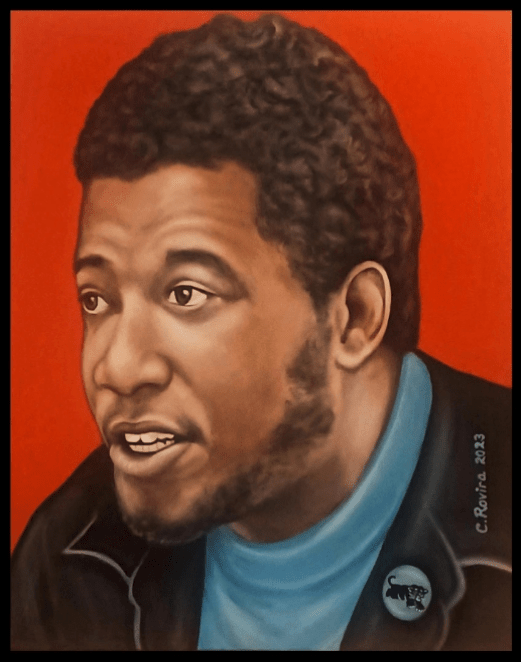
My portrait of Chairman Fred Hampton. 20″ X 24″, acrylic paint on canvas.

As the Civil Rights movement advanced—galvanizing strength from all sectors of the population, breaking the despicable Jim Crow laws and compelling the U.S. Congress to pass other progressive legislation—the FBI increasingly turned its attention to the Black liberation struggle.

The slanderous editorials against the Panthers in the capitalist-owned mass media, combined with Hoover’s frequent verbal attacks, reflected the wishes of the ruling class who sought the complete destruction of the Black Panther Party and the ideals it embodied. Internal FBI memos show that the government had a special interest in Hampton’s political activities and his associations; Chicago police were encouraged by the FBI to find a way to lock up Hampton, if not worse.

These circumstances compelled the government to carry out the horrible attack on Fred Hampton as part of their strategy to destroy the Black Panther Party and ultimately the entire revolutionary movement.

“The greatest threat to national security”

The Black Panther Party openly advocated for socialist revolution, and openly supported the Chinese and Cuban revolutions. The Panthers’ breakfast program for children, among other social programs, underlined their commitment to meet the needs of communities that received nothing but oppression and neglect from the government.

Prior to Hampton’s death, police raided the Panthers’ Chicago office on three separate occasions. William O’Neal, Fred Hampton’s bodyguard, was a police informant who was instructed to draw up a floor plan of the targeted apartment weeks earlier. Law enforcement used the information gathered by O’Neal to murder Hampton.

The staunch anti-capitalist stance of these young revolutionaries who declared themselves Marxist-Leninists made them the target of the most ruthless, racist elements in power. On numerous occasions, the notorious FBI Director J. Edgar Hoover expressed a special disdain for the Black struggle, particularly towards Dr. Martin Luther King Jr. and Malcolm X. Many were not surprised when Hoover declared the Black Panther Party “the greatest threat to national security.”

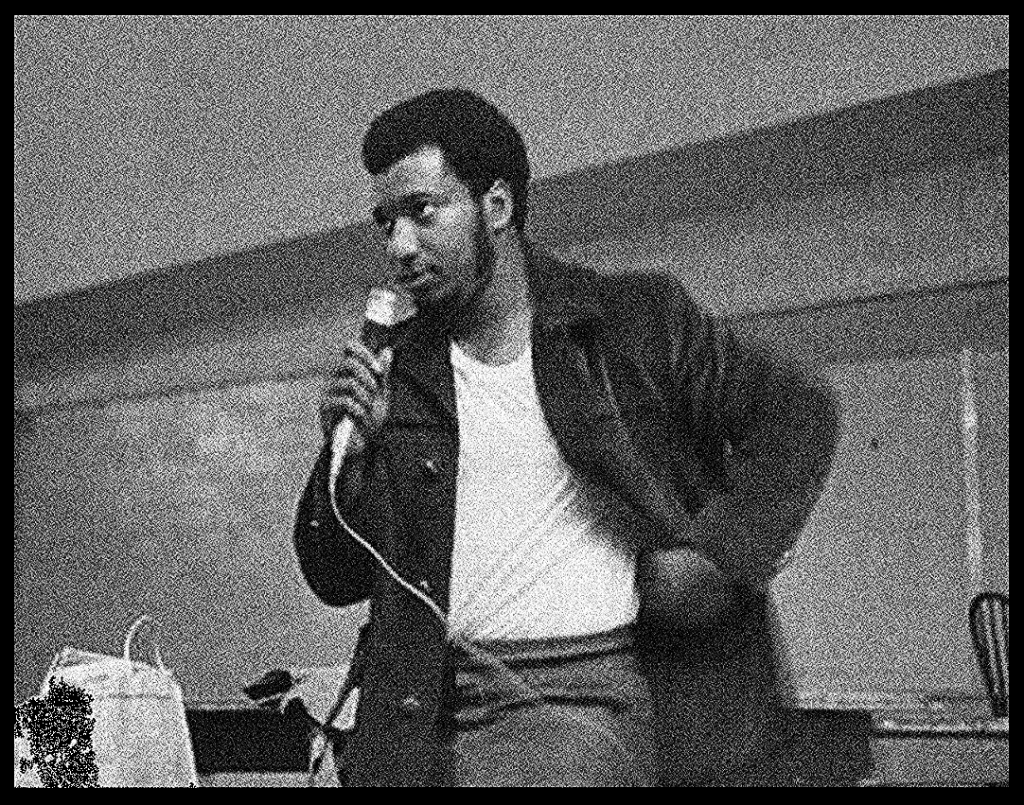
Chairman Fred Hampton was a widely respected orator.

Hampton’s murder was part of a pattern of police raids, false imprisonment and executions of Black Panthers. COINTELPRO documents proved that assassination of Black leaders was among its aims. Fred Hampton and the Black Panther Party had to be eliminated simply because they had touched upon capitalism’s greatest weakness—the decisiveness and strength that a multi-national movement has in a battle against this system.

The Black Panther Party arose from the struggles of the African American people, historically the most oppressed and exploited group in the United States. They symbolized hope and received the greatest affection. They attributed Black oppression to the capitalist system, and dared to pick up arms against the state. The militancy and defiance of these young revolutionaries deeply impacted the Civil Rights and socialist movements.

Hampton and the Black Panthers believed all would benefit if the struggle against racist oppression was taken up by the whites as their own. Hampton knew that it was possible to smash the racial barriers created by capitalism to divide and conquer the working class. His confidence was based on the strong belief that this system provides motivation for all to unite and engage in revolutionary struggle.

Long live the Legacies of Fred Hampton & Mark Clark!

Long live the Legacy of the Black Panther Party!  


Black Soldiers: A History of Valor & Resistance

By Carlos “Carlito” Rovira


THE U.S. MILITARY REFLECTS THE RACISM IN CAPITALISM

African Americans’ role in the military during the Civil War was wholly progressive. Indeed, Black soldiers had a vital stake in smashing the hideous system of slavery.

While President Abraham Lincoln often expressed his indifference to the issue of emancipation, he was forced to recognize the absolute necessity of arming African Americans.

Black soldiers soon became feared by the Southern slave-owning class. Their tenacity, skill and valor as soldiers proved decisive to the North winning the Civil War. For instance, when General Ulysses S. Grant was sent to fight Gen. Robert E. Lee’s military forces in Virginia, he requested Black regiments as his principal shock troops.

BLSO.png

Then there was Harriet Tubman. A former slave, she became an intelligence officer for the Union Army, operating behind enemy lines. Tubman’s courage made possible the capture of Confederate garrisons and by working with  the “Underground Railroad” she led hundreds of slaves to their freedom.

But Tubman’s boldest and most successful mission is when she led many Black Union soldiers on the daring raid at Combahee Ferry on June 1863. In this courageous action Tubman and Black soldiers under her command were able to free 700 slaves while under fire from charging Confederate troops.

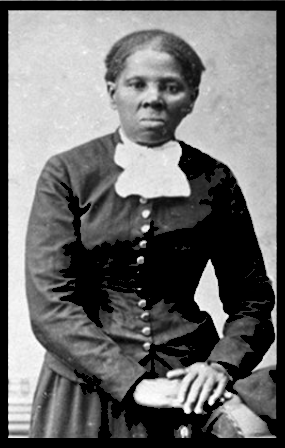
Harriet Tubman

The Civil War was the last time African Americans had a positive stake in a U.S. war’s outcome. It was the only time in U.S. history when the interest of the capitalist class coincided with the aspirations of Black people.

After the Confederacy was militarily defeated “colored” volunteer units of the U.S. military were disbanded. All told, 200,000 African Americans served in the Army and Navy while 30,000 of that number died in combat.

After African Americans were betrayed during Reconstruction, they were further undermined and impoverished when the South was overrun by capital investments in manufacturing, lumber and agriculture. The capitalist rulers began to cast their eyes abroad.

By 1870 four regiments of Black troops were re-organized, but were used for the vicious campaign to annihilate tribal Indigenous nations in the “Indian Wars” of the West and Southwest United States. In 1898 all four of these re-organized Black regiments were sent to be among the invading forces in the Spanish-American War. African American soldiers were used for conquering other oppressed people. The U.S. became a world imperialist power.

BLACK SOLDIERS IN THE IMPERIALIST ERA

The mysterious explosion of the U.S. battleship Maine in Havana, Cuba on Feb. 18, 1898, served as an excuse for Washington officials to declare war on Spain. The U.S. invaded the Spanish colonies of the Philippines, Guam, Cuba, and Puerto Rico, colonizing them anew. The Monroe Doctrine had already reserved all of Latin America and the Caribbean to be exploited exclusively by U.S. capitalists.

In 1899 under the leadership of Aguinaldo, the Filipino people furiously fought the new invaders. They inflicted many casualties on the U.S. Army, which falsely claimed to be “helping the people’s quest for freedom.” The U.S. government retaliated by slaughtering hundreds of thousands of Filipino women, men and children.

This genocide was not passively accepted inside the United States, as mainstream historians contend. The Anti-Imperialist League held many mass protests in major cities throughout this country.

Significant anti-war sentiment was also expressed widely in the Black community. The Black press as well as other representatives of the African American people vigorously denounced the war. The great historian, socialist and African American leader W.E.B. Du Bois played a notable role in this anti-war movement.

Most important, Black resistance surfaced inside the U.S. military. Four Black regiments sent to fight in the Philippines established a bond with the Native people there, who also were dark-skinned. These Black troops resented white officers and soldiers describing Filpinos with the same racist slurs applied to African Americans in the United States.

Filipino insurgents appealed to Black soldiers not to fight on the side of U.S. imperialism. Posters denouncing racist lynchings in the United States were placed throughout the islands, as a show of Filipino solidarity with African Americans. This political agitation helped lead to many Black troops deserting the U.S. military.

David Fagan of the 24th Infantry Division defected to the Filipino guerilla army.

Some of these African Americans soldiers went over to the other side, joining the Filipino guerrilla army. The most notable was David Fagan, formerly of the 24th Infantry Division. The Filipino freedom fighters so respected Fagan that he was made a commander in their army. David Fagan’s example demonstrates how unity among different oppressed people is possible.

BLACK RESISTANCE IN THE MILITARY

In the post-Reconstruction period, as Jim Crow laws re-introduced the “Black Codes” throughout the South, top military officials were contemptuous to the idea of having large numbers of African American recruits. But in 1917 President Woodrow Wilson conveniently signed the Selective Service Law. The U.S. entered World War 1.

The two world wars in Europe created circumstances that demanded the recruitment of large numbers of soldiers. African Americans were now accompanied by Puerto Ricans, Indigenous, and Mexican Americans as oppressed nationalities looked upon as cannon fodder. Military recruits from these sectors of society faced disproportionate casualty statistics while continuing to confront racist segregation, discrimination and violence, during and after their service.

African American servicemen in England prior to D-Day.

Although African Americans made an exerted effort to prove their bravery and diligence as soldiers during war they were unable to escape discriminatory practices and customs deemed “normal” in the United States.

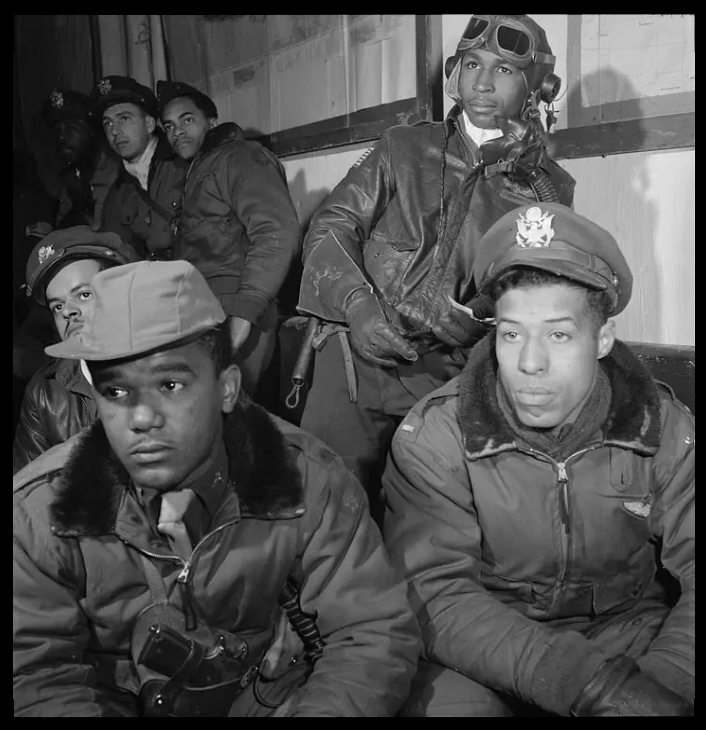
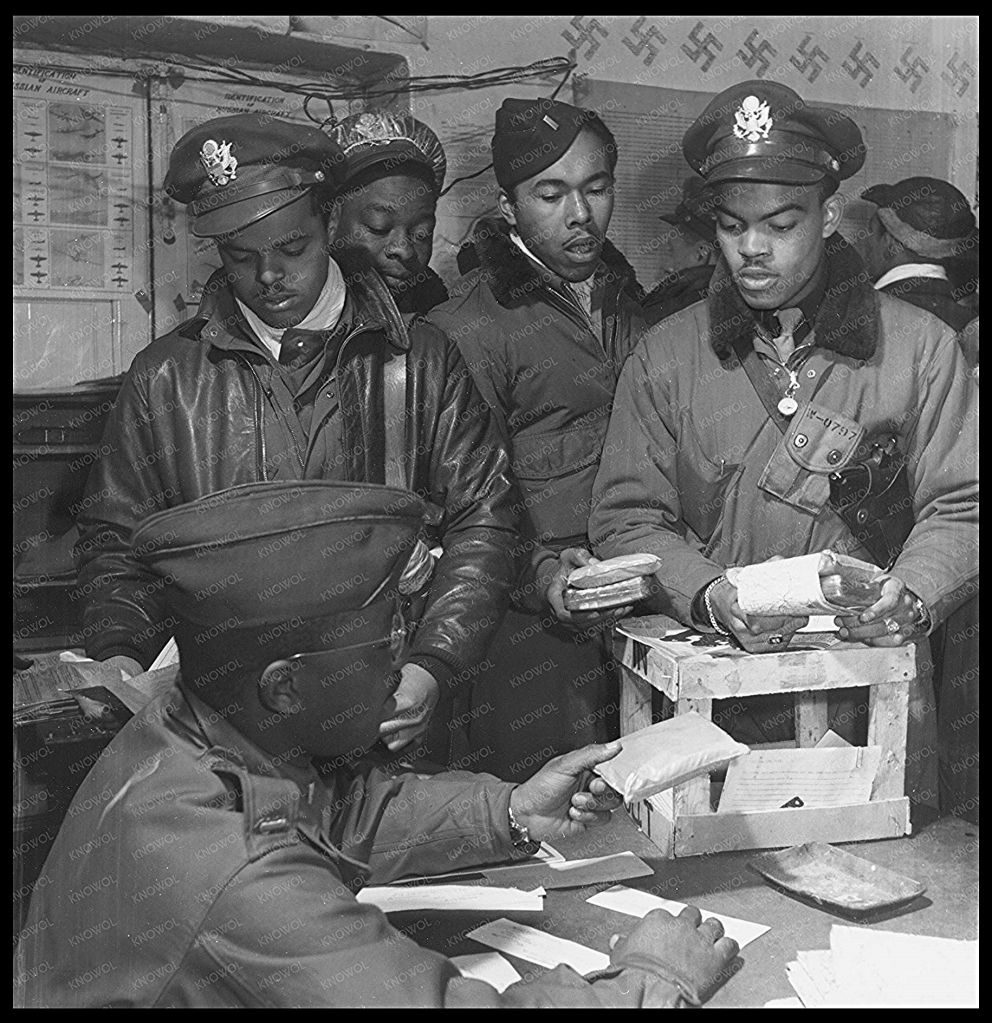
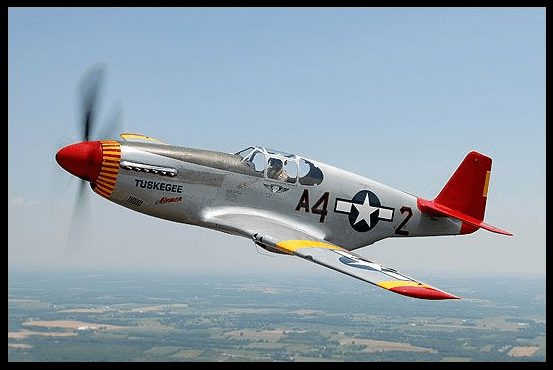
An example was the Tuskegee Airmen, known as the “Red Tails.” These African American pilots proved their bravery and high-level of skills in aerial combat with Germany’s Luftwaffe during World War II. Until the end of the war, they were denied recognition by top military and government officials to avoid acknowledging that they were Black.

A squad of the segregated, all-Black Tuskegee airmen in the Army Air Corps.
The Tuskegee Airmen primarily used the P-51 Mustang fighter planes.

On June 24, 1943 racism within the U.S. military showed its ugly head once again. But this time the dignity and defiance of Black people also showed it’s face in the form of armed resistance at the Battle of Bamber Bridge.

England did not have racist segregation laws like the United States. Black soldiers were embraced in social settings by British citizens. However, white U.S. military officers, especially those from southern states, objected to racial interactions involving Black servicemen under their command.

In one particular instance military police were sent to Bamber Bridge, in the township of Lancashire to absurdly enforce segregation laws. African American soldiers from the 1511th Quartermaster Truck Regiment were abruptly confronted by MP’s in pubs and restaurants. Before long a deadly clash ensued between Black and White men wearing the same uniform.

AFRICAN AMERICANS & THE VIETNAM WAR

By the second half of the 1960’s the Civil Rights movement began to gather widespread approval and support while anti-war sentiments grew in response to U.S. military intervention in Vietnam. Washington and Pentagon officials had unleashed a massive military campaign in an attempt to crush the Vietnamese revolution, which defeated the French in 1954.  

The outcry opposing this war increased in Black and Brown communities, due to the agitation of the Black Panther Party and Dr. Martin Luther King’s open condemnation of the war in 1968. Growing resistance to the military draft paralleled the rise of the Black power movement. Black and Brown resentment to racism was now accompanied by widespread opposition to conscription.

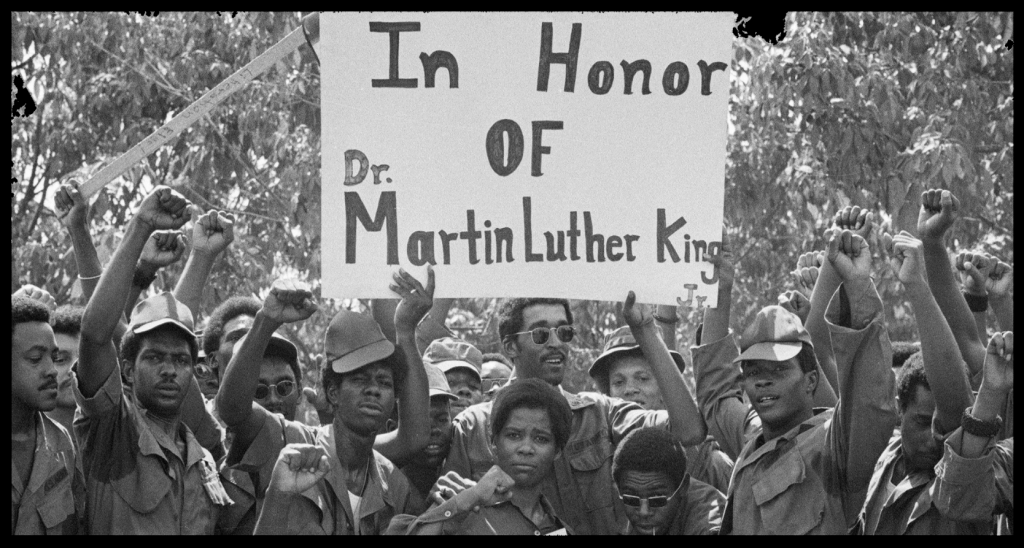
Black soldiers protesting the assassination of Dr. Martin Luther King, Jr.

The Vietnam War was the first U.S. military incursion where units were no longer racially segregated. However, white racist die-hearts among officers and enlisted soldiers continued with their traditional outlook towards Black and Brown people.

In addition to mistreatment, Black and Latino soldiers were usually ordered to carry out life threatening tasks, usually suicide missions. Although they comprised less than 30% of the U.S. population combined at the time their death toll was 3 out of 5 killed in Vietnam.

The Vietnamese understood the plight of Black people in the U.S. and sympathized with their struggles. In 1924 Vietnam’s iconic revolutionary leader Ho Chi Minh wrote his famous pamphlet titled “On Lynching and the Ku Klux Klan” which served as a condemnation of racism in U.S. society and outlined the commonalities between the Black and Vietnamese liberation struggles.

It was no coincidence when Vietnamese insurgents (National Liberation Front) released Black and Brown G.I.’s captured in battle. After having political exchanges with the prisoners Black and Brown soldiers were usually released and not held as POW’s.

Black soldiers faced disproportionate casualties in Vietnam.

As the war intensified many Black and Brown soldiers rebelled by collectively refusing to obey orders, and in many cases causing injury or death to white officers. In every objective sense the rebelliousness of Black and Brown soldiers, along with the spread of the anti-war movement at home aided the Vietnamese liberation struggle, thus weakening U.S. imperialism.

Being aware of internal friction and demoralization within the U.S. military while the Vietnamese People’s Army and the National Liberation Front gained the upper hand militarily, compelled U.S. rulers to withdraw from that war in 1975.

Throughout the history of Black people serving in the U.S. military were never free of the same racist oppression they faced in civilian life. The U.S. Armed Forces were created to preserve a system of inequality and for securing U.S. domination throughout the world. The ideological foundation of U.S. militarism is also based on white supremacy.

Since the Civil War the presence of Black people in the military has presented a paradox to U.S. rulers. Out of necessity government officials welcome the enlistment of people of color but at the same time fearing them obtaining skills that can be used against this system in revolutionary struggle.

When oppressed and exploited people find common ground in their quest for freedom unity can be established, as what occurred in the Philippines during the Spanish-American War and in other instances where Black soldiers were sent to shed blood. Social movements throughout history have proven that oppressors are only as strong as we the people allow.

Working class people of all races and nationalities in this country comprise the majority and are in the position to put a stop to the chaos that now exist. Such is what will lay the basis for ending Black oppression and the reign of U.S. imperialism. It is the only way that we can bring into existence a world without continual war and suffering.

NO TO BLACK OPPRESSION & IMPERIALIST WAR!


A SALUTE TO JOHN BROWN ON THE ANNIVERSARY OF HIS BIRTH — May 9, 1800

By Carlos “Carlito” Rovira

On May 9, 1800 one of the greatest representatives of oppressed and exploited people was born in Torrington, Connecticut. His name was John Brown.

John Brown did not perceive himself as a revolutionary, but was instead, according to him “doing the work of God”. However, his resolute stance against the widely accepted and legally sanctioned system of slavery made him in every sense a revolutionary.

Brown was a very religious man who saw the enslavement, torture and rape of Black people as an abomination of Christian beliefs and doctrine. The slave owning class used religion as an ideological pillar to justify their cruel practice, while most of organized religions were silent or supported slavery outright.

The exemplary acts of courage as well as the humanity John Brown exerted has secured him an eternal place of honor in the archives of the class struggle of the United States. His militant disposition towards the practices of this system contrasted tremendously from other abolitionists who tended to be non-threatening with their passive, reformist approach towards slavery.

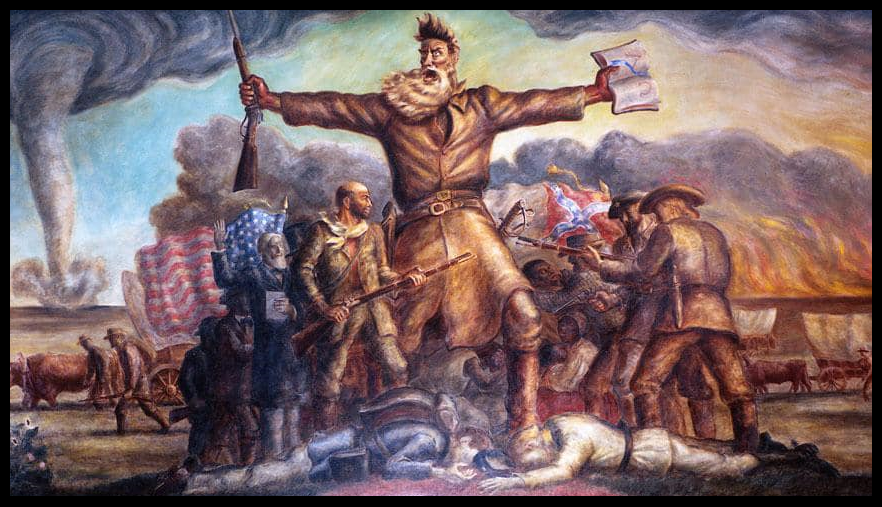
John Brown sincerely believed that since slavery was upheld with violent force it was absolutely necessary to overthrow it with the same intention. He led a number of attacks such as the Battle of Black Jack and the Battle of Osawatomie, in which slave owners and supporters of slavery were confronted for their heinous actions.

CC.png
Tragic Prelude, a mural at the Kansas State Capital. By artist John Steuart Curry. 

On October 16, 1859, Brown and a large group of men, that included two of his sons and former slaves, launched a raid at the U.S. Army Harper’s Ferry armory in Virginia. The site became known later in history as “John Brown’s Fort”. The plan was to capture the large stockpile of weapons and distribute them to Black people throughout the region in preparation for battle.

The legendary Harriet Tubman, who had intricate familiarity with the Harper’s Ferry region, provided Brown with detailed information about the armory. Harriet Tubman and John Brown had become friends and had great mutual respect for one another.  Tubman eventually helped to recruit brave and willing men for Brown’s planned raid at Harper’s Ferry. As a ode to her leadership skills, Brown gave Tubman  the nickname “General Tubman”.

Tragically, due to many tactical mistakes made by the liberators, the local white militia was allowed time to galvanized forces in response to the attack. Under the leadership of the U.S. Army Brevet Colonel Robert E. Lee, they surrounded the armory. Soon after a bloody gun battle ensued for two days. Due to Robert E. Lee’s skills in military tactics and the superior weaponry of the U.S. Army, John Brown and his men were overtaken and arrested despite many casualties on both sides.

Brown's Fort.png
An engraving depicting John Brown and his men under siege at the Harper’s Ferry Armory.
tt.png
The site of the Harper’s Ferry armory, later in history named “John Brown’s Fort”.

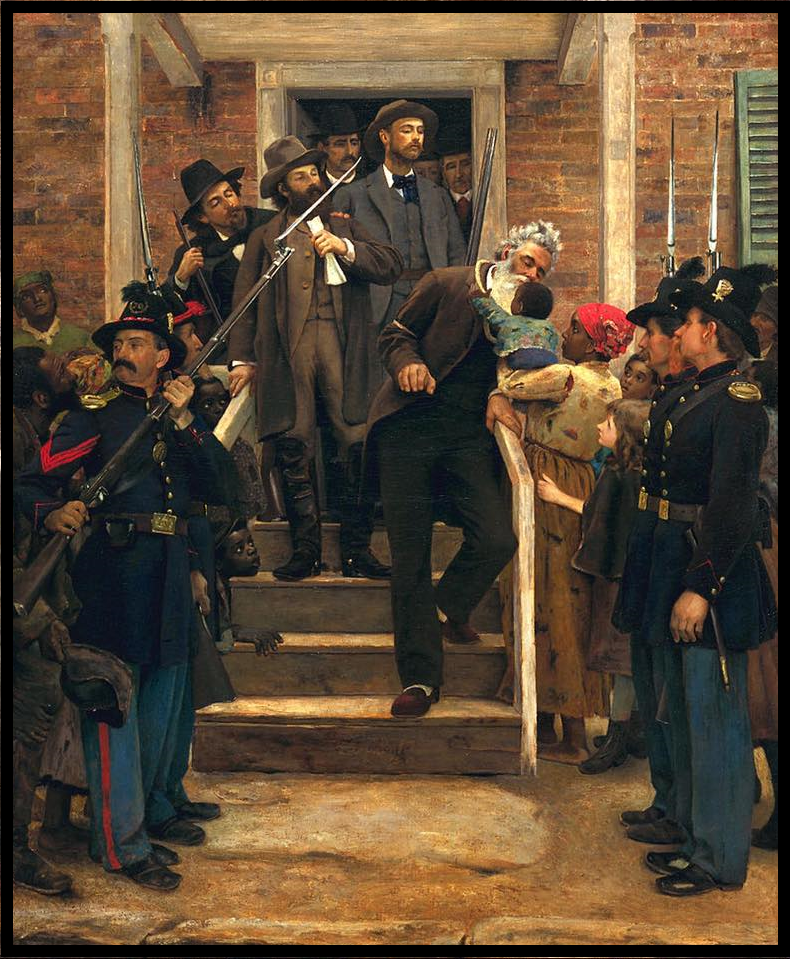
John Brown’s eventual execution by hanging ultimately proved to be the beginning of the end for slavery in the United States.  Brown succeeded in legitimizing the use of armed force as a viable option to end slavery. The story of John Brown and the Battle of Harper’s Ferry become a critical point in U.S. history, in which the country came to the opening gates of the Civil War.

Similarly, this courageous act was arguably mirrored by Cuba in the 1953 Attack on the Moncada Barracks led by Fidel Castro Ruz. Although both battles ended with the loss of many courageous fighters, each of these events ignited the flames of a revolution.

JB.png
The Last Moments of John Brown (1884) by Thomas Hovenden 

To this day, John Brown’s persona continues to be the target of vilification and ridiculed by bourgeois historians. Many historians depict Brown as fanatical and unstable. John Brown’s life is often distorted to seemingly discredit his passion for the abolitionist cause and dilute his relevance to American history, especially the circumstances of race relations today.

The ruling class in this country fear more than anything the prospect of mass rebellion. The Black struggle has inspired every oppressed and exploited sector of the population. It is no wonder why the Black Panther Party and other African American political expressions were targets of repression whenever they became recognized among broad sectors of the population.

It makes sense why the ruling class today would continue to dread the memory of John Brown as they would with revolutionaries like Malcolm X, Ernesto Che Guevara, Harriet Tubman, Lolita Lebron, Fidel Castro or V.I. Lenin.

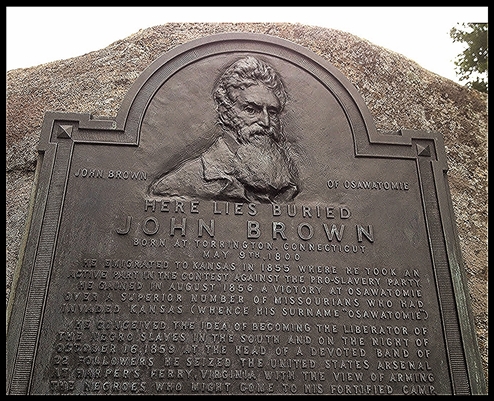
John Brown tomb in North Elba, New York, at the John Brown Farm State Historic Site. 

John Brown was never critical nor was he defensive about the emancipation aspirations and self-identity of Black people. These sentiments which developed to become the ideological pillars of Black nationalism were deeply rooted in the horrific experiences of slavery. By all historical accounts, John Brown did his part to defend and enhance these sentiments.

Brown set the bar for White people to embrace their obligation to the fight for Black emancipation, if they were to honestly consider themselves revolutionaries or socialists. White privilege also existed during John Brown’s lifetime in the form of slavery. Although conditions have somewhat changed from that era, the obligations of white progressives to fight white supremacy has not.

Claiming to be “anti-racist” is not enough if there is not action to match. In other words, being anti-racist today means engaging in an uncompromising struggle against all forms of white privilege. Because of historical circumstances, there cannot be equal responsibility among the races.

In order for the first steps to be taken against racism in the U.S., the white population must raise the anti-racist banner as their very own. This disposition is precisely what John Brown was committed to live by. The standards required for white progressives in the struggle for fundamental change do not have to be re-created but updated based upon the blueprint established long ago by John Brown.

 LONG LIVE THE REVOLUTIONARY LEGACY OF JOHN BROWN!
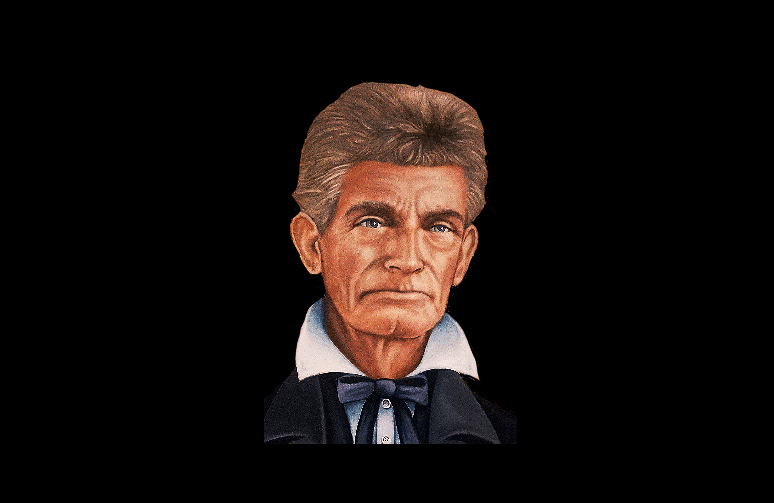
My portrait of John Brown. 24″ X 36″, acrylic paint on canvas.

Remembering the BLACK PANTHER PARTY

An example of revolutionary defiance and militancy

By Carlos “Carlito” Rovira

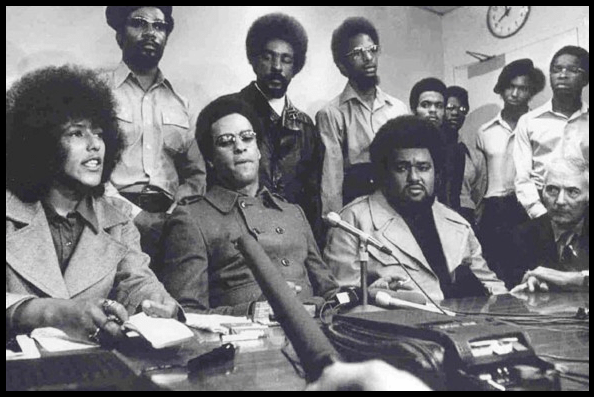
On October 15, 1966, the Black Panther Party was born. It is one of the highlights in the history of the U.S. revolutionary movement, and the Black liberation struggle in particular.

Young African Americans dared to stand up and challenge the reins of the capitalist state, to the point of arming themselves to demand an end to Black oppression. Their vision of Black emancipation evolved into a vision of the liberation of all oppressed people and the smashing of the capitalist system.

The U.S. government, terrified by the potential for revolution and the influence these Black leaders and freedom fighters were gaining, resorted to the most extreme violence to destroy the BPP. It is a campaign that is still felt today.

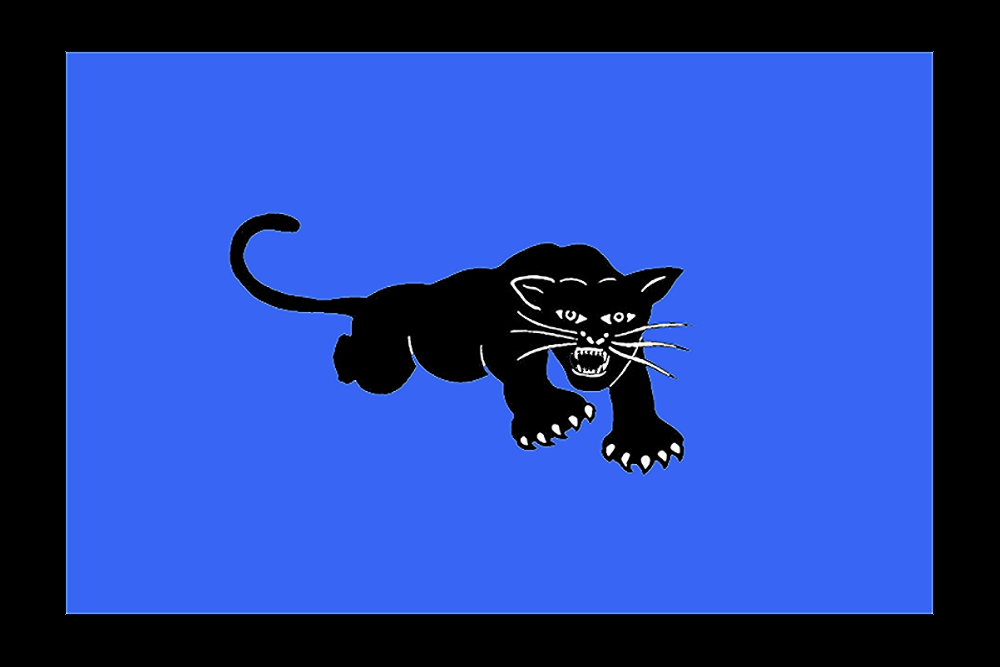
The Black Panther Party for Self-Defense, as the party was first called, was formed in Oakland, Calif., by Huey P. Newton and Bobby Seale. The name—and the famous panther logo—came from the Lowndes Country Freedom Organization in Alabama, that which organized for independent Black political action with the help of Stokely Carmichael and the Student Nonviolent Coordinating Committee.

BPP Chairman Bobby Seales and Minister of Defense Huey P Newton

The formation of the Black Panther Party was the culmination of a resistance over a long history that characterizes the oppression of African Americans in the United States, from the lashes of slavery to the beatings and murders by the police in modern times.

The BPP grew up in the aftermath of the 1965 assassination of Malcolm X — a powerful voice for militant Black self-determination and liberation. It drew inspiration from the Deacons for Defense and Justice, organized for African American self-defense against racist Klan and police terror in the South.

The Panthers recognized the need for an organization that was capable of addressing the racist violence that the Black masses faced. Every gain made by the Civil Rights movement was being matched by violence and lynching by racist cops and the Ku Klux Klan, in the North and South alike.

The Right to Armed Self-Defense

The Panthers won respect and admiration for their militancy and defiance in the face of the racist police state. For example, less than a year after their founding, on May 2, 1967, a group of 30 Black Panthers walked into the California state capitol building armed with shotguns and automatic rifles. The armed but peaceful demonstration was to protest the Mulford Act, aimed at prohibiting citizens from carrying firearms on their persons or in their vehicles.

The Black Panthers aspired to become a discipline revolutionary vanguard entity with military structure.

As the Panthers walked towards the entrance of the capitol building, they were approached by television and other news media. They used the occasion to call upon African Americans everywhere to arm themselves against the systematic brutality and terror practiced by the power structure.

But the party’s efforts went far beyond their call for armed self-defense and their patrols of racist cops. They also carried out consistent community work, gaining the confidence of the people not only in the Black community but among other oppressed nationalities as well.

Panther chapters sprung up in the African American communities of major cities from coast to coast. Wherever they established branches, they tried to set up outreach programs like free breakfast for children and free clothing drives. They used every one of these opportunities to expose the avaricious nature of the rich and powerful who exist at the expense of the poor.

The Panthers were influenced by Malcolm X’s rejection of “turn the other cheek” pacifism for the Black liberation struggle, as well as by the socialist movement in the United States and around the world. Their “Black Power” salute combined with street corner sales of Mao Zedong’s “Little Red Books” of quotations.

The international situation during this period also contributed to the birth of the Panthers. The 1949 Chinese Revolution, the 1959 Cuban Revolution, the Vietnamese Revolution and the heroic struggle of south Vietnam’s National Liberation Front against U.S. imperialism, along with the other national liberation struggles in Africa, Latin America and Asia had a great impact in inspiring revolutionaries in the United States, including the Black Panthers.

Women of the Black Panther Party.

Their militancy and revolutionary politics quickly put them in the center of the African American liberation struggle, as well as in the growing mass movements that were sweeping the country.

Capitalism is the Problem

More and more, the party put the blame for the plight of the African American people on the capitalist system. It rejected the view that the problems of racism could be solved within the confines of the exploitative system, or that it was possible to accumulate enough capital in the Black community to rival capitalism with “Black capital.” Instead, Panther speakers called for socialist revolution within the context of the Civil Rights era.

Their uncompromisingly revolutionary and anti-capitalist stance was the most prominent in what became a new trend within the Black liberation struggle of the 1950s and 1960s.

Black Panther Party co-founder and Chairman Bobby Seale.

As part of the political training of its membership, the BPP studied Marxist literature like the Communist Manifesto and the writings of Mao Zedong.

The Black Panther Party was a disciplined and organized revolutionary political entity. The Panthers put forward the need for professional, organizational sophistication in building a revolutionary political party.

While the party’s Ten-Point Program reflected its political views and line of march, it was the membership rules that ensured the internal discipline of the organization. Membership rules touched a range of matters, including mandatory collective study of revolutionary theory; respect for women inside and outside the BPP; and respect for the property of the poor.

Revolutionary Multinational Alliances

The Panthers advocated a united front of revolutionary organizations to guarantee the success of a struggle in the United States. Their organizing efforts extended to Puerto Ricans, Chicanos, Asians, other nationally oppressed people, and the white working class.

They forged alliances of various kinds, such as with the American Indian Movement as well as Cesar Chavez and the farm workers’ movement. The Panthers stood in solidarity with the struggle for women’s equality, especially supporting those sectors of the women’s movement that were anti-imperialist and anti-racist. To the surprise of many, on the heels of the Stonewall rebellion, Panther leader Huey P. Newton publicly supported the struggle to end LGBTQ oppression.

The Panthers perspective was toward building a multinational alliance. Their most notable effort was the Rainbow Coalition, organized in June 1969 in Chicago by Panther leader Fred Hampton, which consisted of the Black Panther Party; the Young Lords, a U.S. organization of Puerto Rican revolutionary youth; and organizations representing Chicanos, Asians, and poor whites. Hampton’s vision was to eventually merge these allied organizations into a single entity, to forge a revolutionary organization with representation from the full spectrum of the working class.

Wherever their agitation work was conducted, on the streets, on campuses, or at public events, the Panthers upheld the principle of solidarity with the liberation movements in the oppressed and colonized countries. At the height of the Vietnam War, the Black Panther leadership made an open gesture of internationalism by offering to send party members to fight alongside the National Liberation Front in their struggle against U.S imperialism.

Fierce U.S. Repression

Faced with the Black Panther Party’s tremendous growth and revolutionary orientation, the U.S. government struck back. It organized a massive political-military campaign, involving the FBI and police departments around the country, to destroy the Panthers’ leadership.

In a now-well-documented campaign called “Operation: COINTELPRO,” the FBI orchestrated covert operations—personally overseen by FBI Director J. Edgar Hoover—to provoke conflicts between Black Panthers and other organizations. They employed a network of infiltrators and provocateurs to disrupt the party’s discipline and leadership.

Police attacks were common. Cops routinely raided party offices and the homes of Panther members. Dozens of Panthers were killed outright, often in cold blood. The most notable of these cop assassinations was the December 4, 1969, murder of Fred Hampton and Mark Clark in Chicago while they slept. Hampton was 21 and Clark was 22 years old.

Black Panther leaders Mark Clark (left) and Chairman Fred Hampton.

Dozens more Panther members and leaders spent years in prison. The campaign to jail Panther leaders and activists long outlived the organization itself. Mumia Abu-Jamal, who at 16- years -old had been the Minister of Information in the party’s Philadelphia branch, was framed up and sentenced to death in 1981. He has been in prison ever since despite a worldwide effort calling for his release.

The Black Panther Party ultimately could not withstand the government onslaught. The combined police attacks and covert operations compounded internal differences. Unable to withstand the tremendous repression, by the mid-1970s the Black Panther Party was essentially defunct.

Ericka Huggins (far left) next to Huey P Newton.

Lessons for today

Bourgeois historians often try to downplay the role of the state in the destruction of the Panthers. At best, they point to the Panthers as a lesson to revolutionaries, especially from the oppressed nationalities: “Do not dare to struggle, you cannot stand up to the power of the capitalist state.”

However, the rulers were not then and are not now invincible. The fact that the U.S. government relentlessly attacked the Panthers before they had a chance to steel the discipline of their rank & file only points to the need for a disciplined organization of professional revolutionaries today.

As long as capitalist oppression exists, the rise of movements, like the one that gave rise to the Black Panther Party, is a historical inevitability. The Panthers showed that revolutionary ideology and organization, embraced by the most oppressed sectors of the working class, is what the ruling class fears the most.

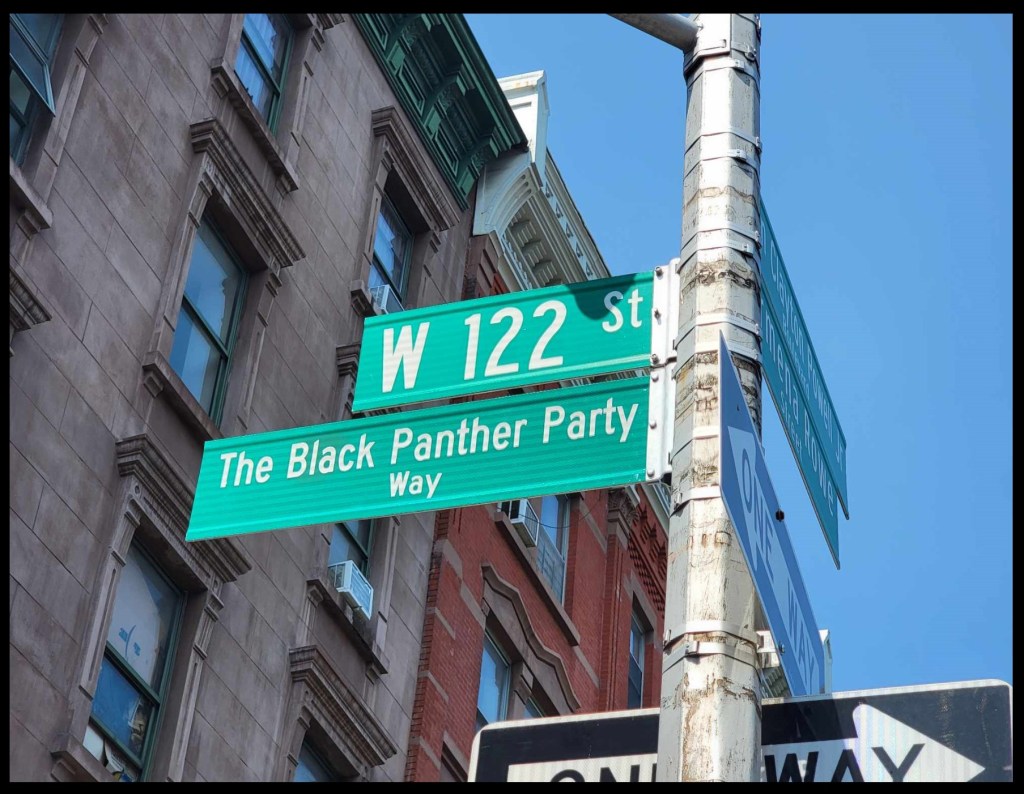
On August 20, 2023, a street in Harlem, New York City was co-named to honor the legacy of the BPP.

Everything they did and sacrificed will not be in vain. Eventually, those who aim in the sincerest sense, for socialism, Black emancipation and the liberation of all oppressed people in the United States must strive to embrace and emulate the revolutionary spirit of the Black Panther Party.

LONG LIVE THE LEGACY OF THE BLACK PANTHER PARTY!

Impact of the African American Struggle on Puerto Ricans

Para la version en español: https://carlitoboricua.blog/?p=7385&preview=true&_thumbnail_id=7386

by Carlos “Carlito” Rovira

Racist Oppression Gives Rise to Solidarity

The historical struggle of the African American people was the inevitable consequence of the introduction of slavery by capitalists in the Western Hemisphere. The collective experience of the African American people over the course of many generations ran parallel to the development of U.S. capitalism at every stage. Their plight, from the era of the slave trade to the present day, reveals inherent oppression within capitalism.

Racist terror, degradation, and discrimination were the objective circumstances that compelled into existence the militant traditions of resistance among the African American masses. Their steadfastness in many key moments in history proved exemplary to the U.S. working-class movement, and particularly to other oppressed nationalities. African American history is replete with displays of genuine solidarity with other liberation struggles.

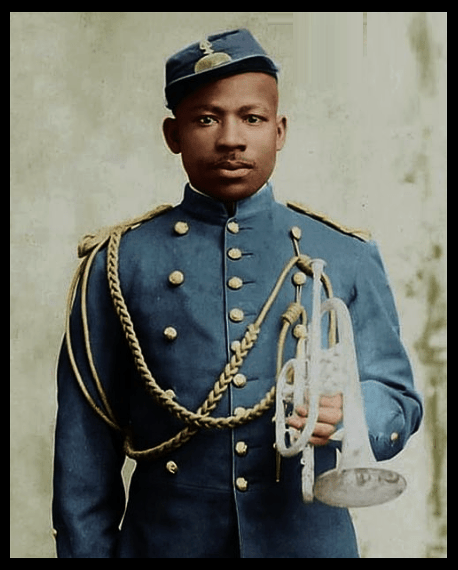
The Spanish-American War had a significant impact on African Americans, especially Black soldiers who were sent to wage colonial conquest on behalf of U.S. imperialism. Black troops resented their white officers using racial slurs against Filipino people, which were reminiscent of their own experience in the United States. Many Black soldiers defected to join the anti-colonial Filipino guerrilla army. The most notable of them was David Fagan, of the 24th Infantry Division. Fagan won the admiration and respect of the Filipino people and was made a commander in their guerrilla army.

David Fagan, of the 24th Infantry Division

The Black press, the Black church and outspoken African American figures such as W.E.B. DuBois, openly condemned the motives behind the 1898 Spanish-American War. The U.S. government and giant banking enterprises sought military conflict with Spain to win colonial control of Guam, the Philippines, Cuba, and Puerto Rico.

Black Puerto Rican scholar Arturo Alfonso Schomburg devoted his entire life to compiling vast collections of writings documenting significant events in Black history. Before moving to New York City’s Harlem community, Schomburg was a member of the clandestine Revolutionary Committees of Puerto Rico, which organized the famous 1868 Grito de Lares uprising — a revolt that called for the abolition of slavery and the independence of Puerto Rico. Schomburg eventually became a prominent figure during the Harlem Renaissance, which challenged the ideological facets of white supremacy through the literary, visual and performing arts.

Arturo Alfonso Schomburg

At many of his performance appearances, renowned African American singer, actor and Communist Paul Robeson would call upon his audience for a moment of silence to express solidarity for the incarcerated Puerto Rican revolutionary Nationalist leader, Dr. Pedro Albizu Campos.

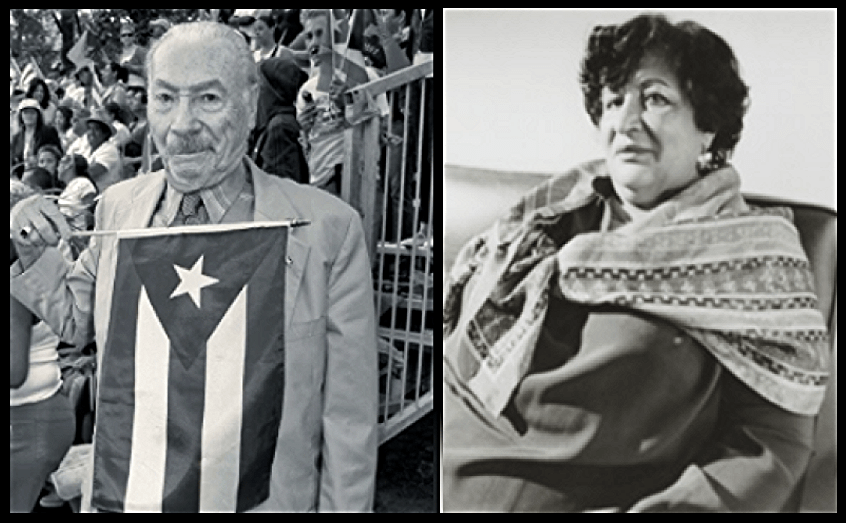
The young Pedro Albizu Campos gained recognition among African American figures for being very critical of the racism in the United States. Campos’s mother was Black, which gave him first-hand insight into the impact of racist oppression. Campos’s outspoken oratory against the “racist practices in the house of the empire” caught the attention of renown Pan-Africanist leader Marcus Garvey, who traveled to Puerto Rico to meet the Puerto Rican Nationalist leader.

Despite their differences in goals and tactics, this meeting was highly symbolic for that period in history. The Russian Revolution emboldened workers’ struggles and nationalist movements throughout the world, including the United States and Puerto Rico, and instilled a sense of vulnerability in the U.S. capitalist class.

Black Struggle Inspires Puerto Rican Militancy

Puerto Ricans have migrated to New York City and surrounding counties since the mid-1800s—in most cases, to escape Spanish colonial persecution. But in the years after World War II and well into the 1960s, Puerto Ricans migrated to U.S. industrial centers at an annual average rate of 63,000 due to economic hardships caused by U.S. colonial policy.

What the Puerto Rican migrants encountered was not what they expected when uprooting in search of a better life. In addition to the agony of coming to a strange land where an unfamiliar English language was spoken, the Puerto Rican experience now included greedy racist landlords, housing and job discrimination, cultural stigma by the mass media, police brutality and the terror of racist white gangs.

While Puerto Ricans began their exodus in the late 1940s African Americans were already in their “Great Migration” from southern states where they had been historically concentrated. Fleeing racist Jim Crow laws and Ku Klux Klan terror, more than 5 million Black people migrated to the North, Northeast and California between the 1920s and the 1960s.

The instinct of any oppressed people is to seek allies and find ways to resist. Puerto Ricans facing the realities of colonialism and impoverishment were able to relate to the demands of the Civil Rights movement and became attracted to its boldness.

The experiences of these two distinct oppressed communities came together in the social and cultural realms as well, especially in the performing arts. This phenomenon was most notable among Black and Puerto Rican musicians. No one can dispute the African American influence in the rise of Latino musical genres which the Puerto Rican diaspora of New York City developed during the 1960s & 70s, like Latin Jazz, Boogaloo, and Salsa. The affinities the two ethnicities had for each other was also attributed to their mutual historic connections to African culture.

The Nation of Islam, under Malcolm X’s leadership, began to approach the newly arrived immigrants with the aim of politicizing them. And when the Black Panther Party began organizing in the Puerto Rican community of Chicago, it transformed a street “gang” known as the Young Lords.

The Young Lords were the first Puerto Rican revolutionary organization to rise up based on the concrete circumstances of oppression in this country. They were a decisive factor in the spread of militancy in Puerto Rican communities of various U.S. cities. Like the Black Panthers, they advocated for a multinational revolution in the United States.

As this movement gained momentum, Puerto Ricans gained a sense of hope and became inspired to fight for their political and economic rights. By the second half of the 1960s, Puerto Ricans in the United States had become much more politically adept, thanks to the struggles of the African American masses.

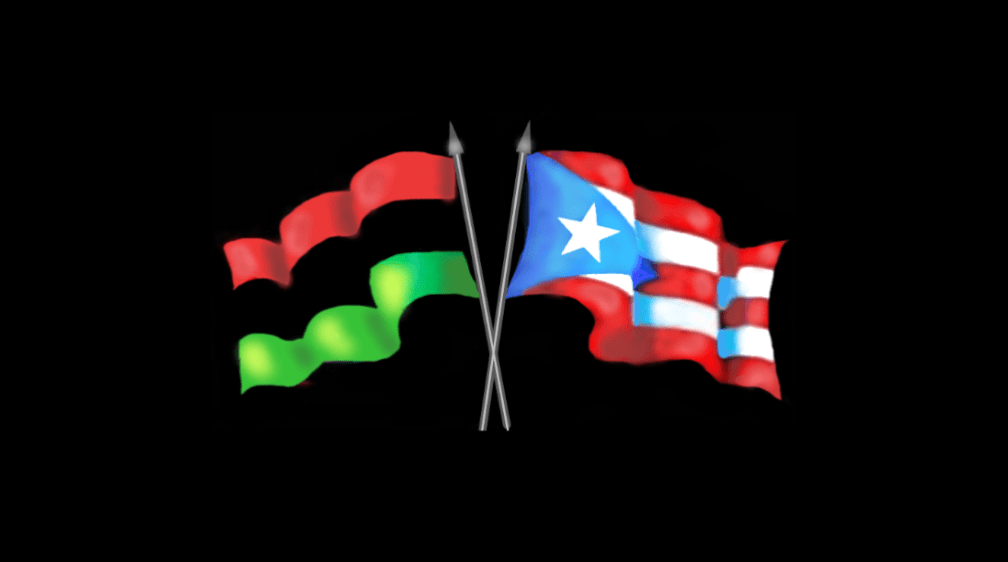
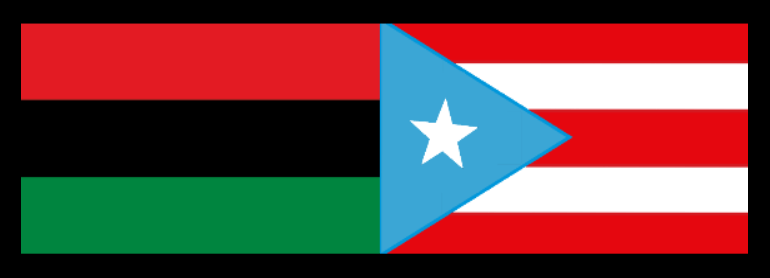
African Americans and Puerto Ricans gained affinity to one another based on resistance to racist oppression. In cities like Chicago, Philadelphia and New York, at street demonstrations and on college campuses, African American and Puerto Rican masses instinctively aligned in common struggle. It was not unusual for the Black liberation flag (red, black & green) to be accompanied by the Puerto Rican flag.

A significant example of this solidarity that alarmed the ruling class, was the April 1969 student takeover of City College in Harlem, New York City and renamed it “University of Harlem.” Black and Puerto Rican students shocked many throughout the U.S. by defiantly uniting to seize control of 17 campus buildings to demand free tuition for all in the City University system. To further demonstrate their boldness, these students lowered the U.S. flag from a flagpole and hoisted the Black Liberation Flag and the Puerto Rican Flag. It was an imagery of resistance never before seen in this country.

Black and Puerto Rican students seized control of 17 buildings at City College in Harlem, NYC.

The great lessons gained from these experiences are still relevant today. Black oppression was instrumental in the economic rise of U.S. capitalism, and African Americans have confronted it head-on. The Black liberation struggle will continue to be a source of inspiration to all working people and shall be instrumental in forging genuine unity required for the fight against this system.

LONG LIVE BLACK & PUERTO RICAN SOLIDARITY

Y!