Melba Hernandez’s life is filled with many fascinating stories which reflect the courage, strength and resilience of Cuban women who made overthrowing the U.S.-puppet regime of Fulgencio Batista a reality. Melba was a combatant and leader in the Rebel Army of the July 26 Movement. She became an important and symbolic political figure of the 1959 Cuban Revolution.
During the armed struggle Hernandez fought gallantly alongside of Comandante Fidel Castro Ruz. She was a confidant of the revolutionary leader and after the seizure of power this heroine became part of his executive staff. Melba played a pivotal role during the critical period of consolidating the Cuban state apparatus.
Melba was introduced to politics by her parents who partook in Cuba’s War for Independence of 1895, led by the legendary Jose Marti. She was a lawyer who was affected by witnessing first-hand the disturbing social and economic inequality in Cuba. From the time she completed her education the young Melba was empathetic with the plight of poor peasants and exploited workers whom she represented as legal counsel.
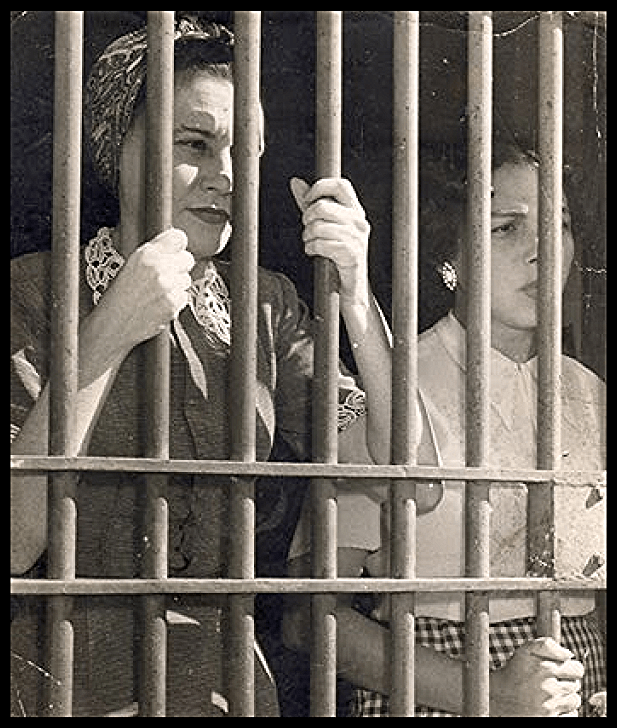
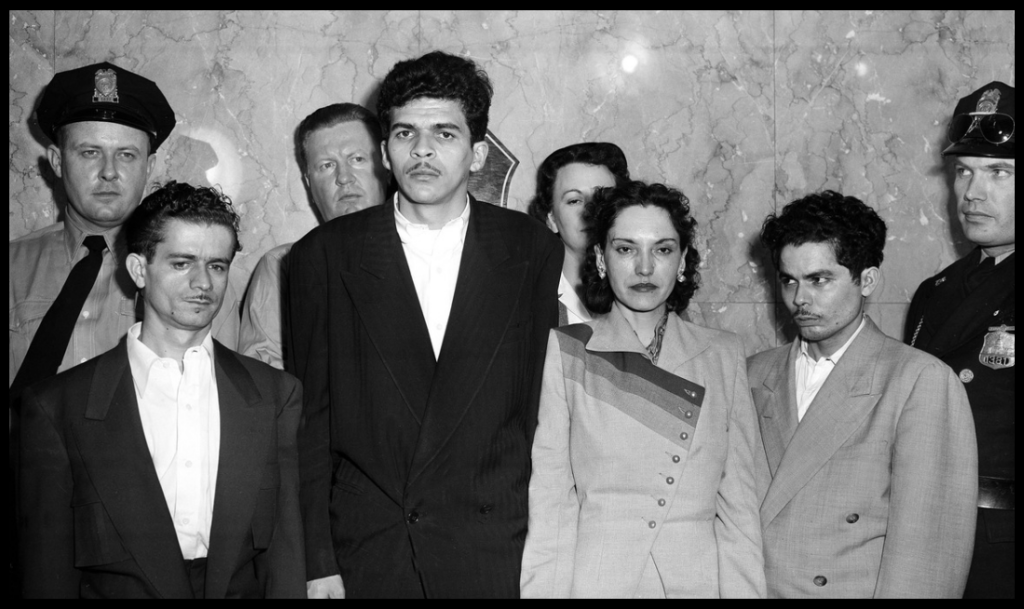
Melba Hernandez (right) and Haydee Santamaria in custody following the attack on Moncada Barracks.
Melba Hernandez and Haydee Santamaria were the only two women that partook in the July 26, 1953, attack on the Moncada Barracks in Santiago, the event that sparked the Cuban Revolution. Part of Fidel Castro Ruz’s plan was for the revolutionary insurgents to enter the surrounding restricted zone at Moncada dressed in the same uniforms as government soldiers. It was Melba who illegally obtained the uniforms. She convinced a military official who supported the rebel cause to assist with her mission.
The attack on Moncada was bloody and ended in failure. By the time it ended most of the insurrectionists were wounded and killed. Many of these revolutionaries died as by torture at the hands of sadistic henchmen of the Batista regime. Some, like Fidel Castro Ruz managed to escape and hide in the jungle until they negotiated a surrender days later through an intermediary.
Hernandez and Santamaria were arrested, convicted and given shorter prison sentences in comparison to their male counterparts who were released two years later. During their incarceration, Hernandez and Santamaria experienced humiliating abuse by Batista’s prison officials.
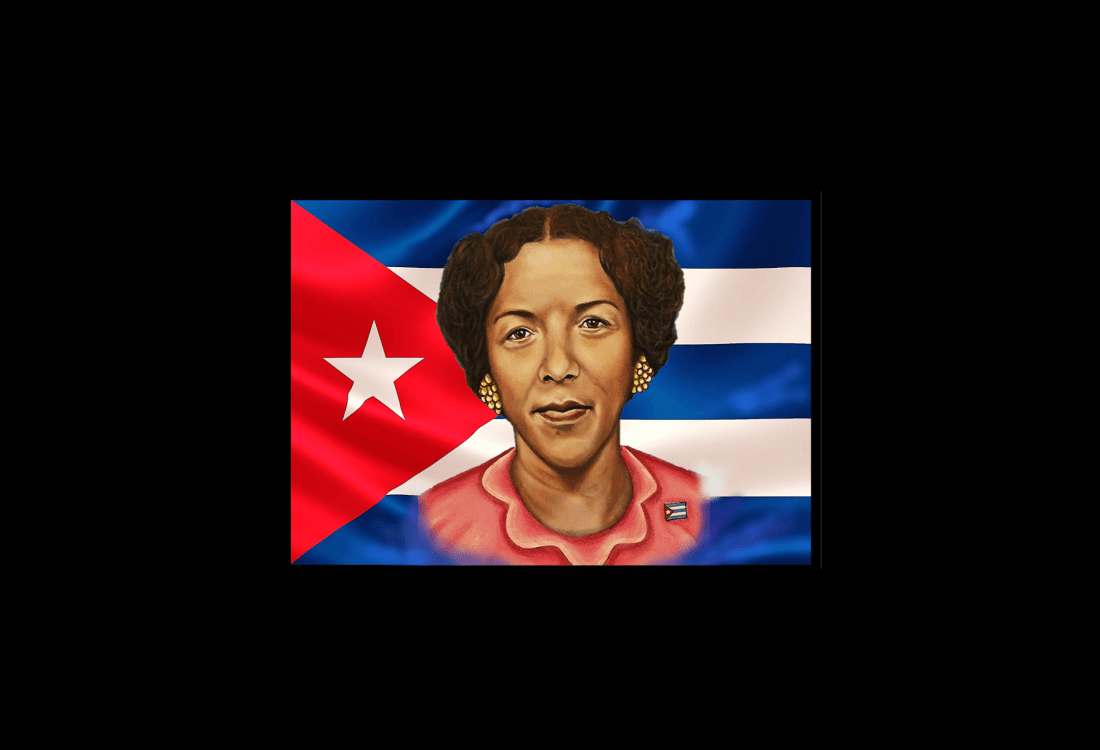
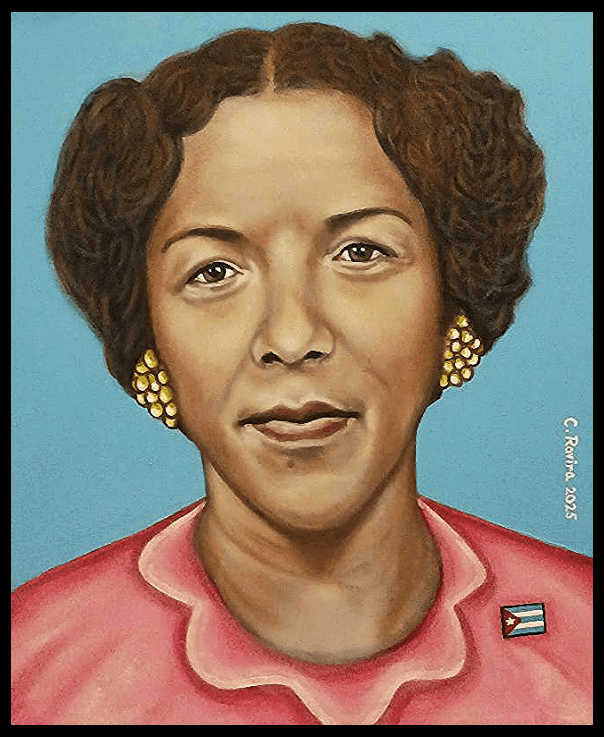
My portrait of Melba Hernandez. 20″ X 24″, acrylic paint on canvas.
After these heroines were released, they were determined to carry out the work of building a mass movement and the clandestine network that would eventually topple the Batista government. Melba was instrumental in smuggling out of the prison where Fidel Castro was held a draft of his famous courtroom speech when he was tried “History will Absolve Me”, one of the most important documents of the Cuban Revolution.
After the seizure of power on January 1, 1959, Hernandez was assigned to several important roles in the government. In 1960, she was placed in charge of women’s prisons in Cuba. For Hernandez, a top priority was to spearhead prison reform to align with the humane principles of the revolution.
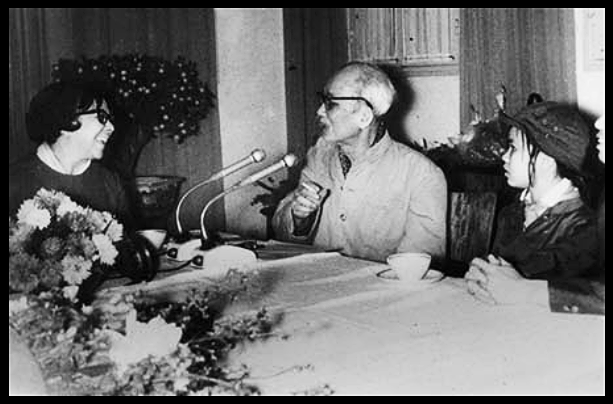
Melba Hernandez meeting with Vietnamese leader Ho Chi Minh.
Melba Hernández and Vilma Espín welcomed Vietnam‘s General Nguyễn Thị Định, during her visit to Cuba
During the late 1960s – 1970s, at the height of the vicious colonial war the U.S. was waging against the Vietnamese people, Hernandez risked danger to herself by traveling frequently to the war-torn country as head of the Cuban Committee in Solidarity with Vietnam. She also served as Secretary General of OSPAAAL, the Organization of Solidarity with the Peoples of Asia, Africa and Latin America.
In the 1980s, Hernandez earned Cuba’s Ambassadorship to Vietnam and Cambodia due to her diligent work of solidarity with the Vietnamese Revolution. This heroine also served the Cuban government as a Deputy in the country’s National Assembly of People’s Power.
Melba Hernandez with Comandante Fidel Castro Ruz.
Sadly, on March 9, 2014, Melba died of natural causes. Having lived her life as a diplomat and high-ranking official of a revolutionary government, her legacy shall inspire revolutionaries for generations to come, especially women who will be duty-bound to confront backward traditions that perpetuate women’s oppression.
Hernandez was among other iconic female figures who were decisive in that revolutionary experience, such as Vilma Espin, Celia Sanchez, Aleida March, Haydee Santamaria, and others. Their selflessness and loyalty to the revolution surmounted of of what many would have expected.
Thanks to the Cuban Revolution Melba Hernandez, dared to be amongst those to set standards for challenging the greatest tyrant in human history.
Julio Pinto Gandia was someone whom I remember during my childhood visiting our family home on the Lower East Side, New York City. I knew him as Don Pinto. My parents and other family members were affiliated with a secret committee of the Nationalist Party of Puerto Rico that operated in New York City, of which Don Pinto was leader.
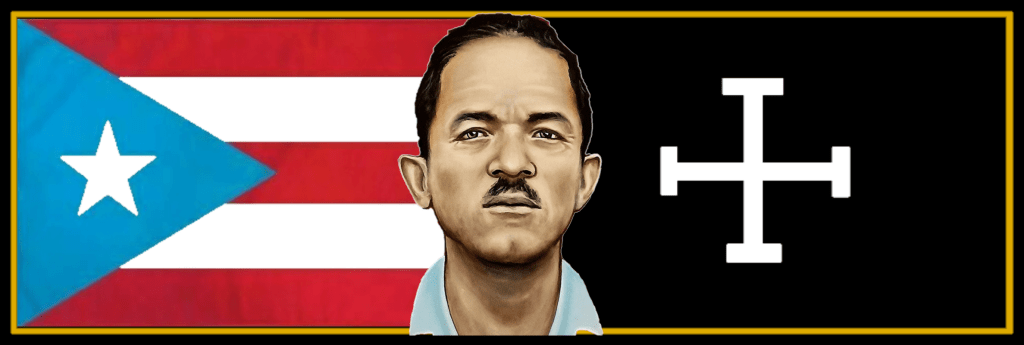
Born in Manati, Puerto Rico on July 9, 1908, Gandia was one of the most outspoken advocates for the independence of Puerto Rico from U.S. colonialism throughout most of his life. He became a close and trusted confidant of the iconic Nationalist leader Dr. Pedro Albizu Campos and became known as his “right-hand man.”
Pedro Albizu Campos, Gilberto Concepción de Gracia and lawyer Julio Pinto Gandía, in the San Juan courthouse, Puerto Rico (1936)
When Campos was incarcerated in the 1930s for seditious conspiracy to overthrow the U.S. government in Puerto Rico, Gandia was asked to fill in as Interim President of the Nationalist Party.
And because Don Pinto Gandia was a legal attorney himself he worked closely with the Socialist Congressman Vito Marcantonio who represented New York’s East Harlem community. They both collaborated for several years to fight for Campos’ release from prison while using his legal case to expose the criminality of U.S. colonialism in Puerto Rico.
My portrait of Don Julio Pinto Gandia. 20″ X 24″, acrylic paint on canvas.
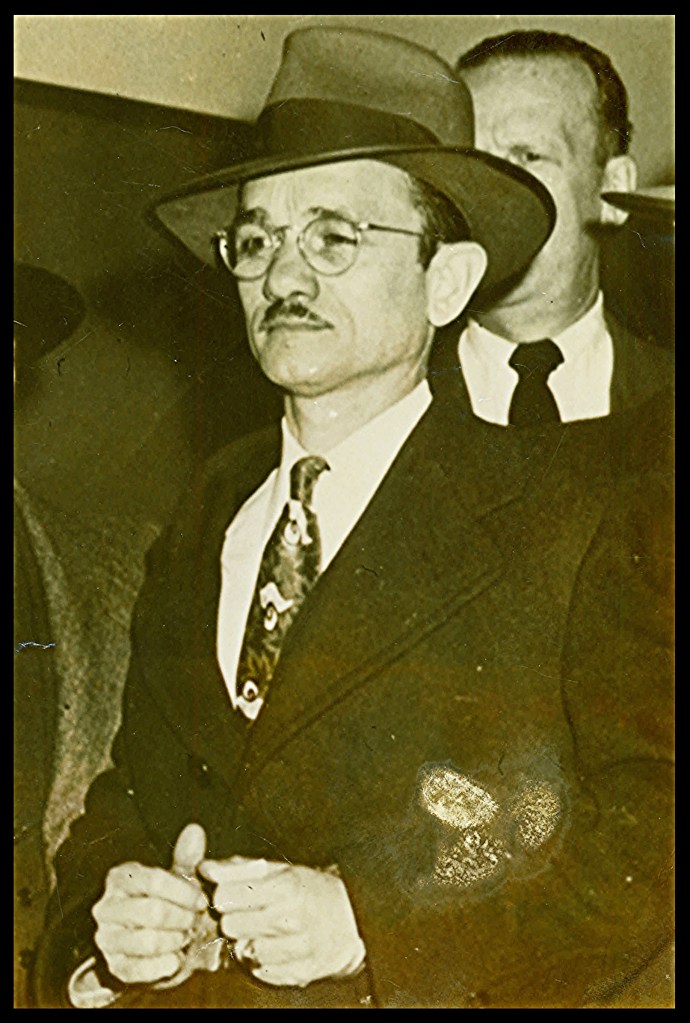
But Gandia was himself under the watchful eye of the Federal Bureau of Investigation (FBI), especially during the repressive McCarthy Era (1947-1957) of which in Puerto Rico it was more fascistic. He was constantly arrested by the FBI and other colonial authorities. And to interfere with his livelihood and cause further personal harm, in 1937 Gandia was disbarred from the practice of law in Puerto Rico.
Gandia was also accused of being the “mastermind” of the March 1, 1954, Nationalist armed attack on the U.S. House of Representatives. Lolita Lebron, Rafael Cancel Miranda, Irvin Flores Rodriguez, and Andres Figueroa Cordero staged that daring act to bring attention to the plight of the Puerto Rican people. From that point on Gandia was frequently arrested for questioning.
His refusal to answer questions by FBI and court judges about the attack on the U.S. Congress usually landed Gandia jail time for contempt of court. His stubbornness and complete loyalty to the Puerto Rican cause was recognized by his comrades and enemies of the independence movement alike.
In many of his conversations with Dr. Pedro Albizu Campos, Don Pinto Gandia raised the importance of aggressively bringing the case of Puerto Rico before the United Nations. Pinto Gandia was then assigned the task of meeting with delegates of countries belonging to the United Nations Special Committee on Decolonization to discuss Puerto Rico’s status.
Gandia’s skillful diplomatic work paid off when in 1978 the U.N. Special Committee officially declared Puerto Rico an occupied colony, despite infuriating outbursts made by U.S. delegates and the mainstream mass media. Washington officials reacted by launching a campaign that falsely showcased Puerto Rico as a success story of U.S. imperialism in Latin America.
However, two years prior to the political embarrassment the U.S. Government faced at the United Nations, in September 1976, after leaving his apartment in Puerto Rico, Julio Pinto Gandia vanished forever without a trace.
Don Julio Pinto Gandia in FBI custody.
Considering that Operation COINTELPRO was taking place with the Puerto Rican independence movement as one of its main targets, it is believed by many that the U.S. government was directly responsible for Gandia’s disappearance. The work this revolutionary was perceived as a threat to U.S. interest in its highly valued colonial possession.
Although we will never know what tragedy occurred to Julio Pinto Gandia his legacy has secured a special place in the archives of that historic liberation struggle. His resilience, sacrifice, and courageousness, under the most difficult circumstances reflect the moral strengths of the Puerto Rican people.
Vietnam’s General Võ Nguyên Giáp is one of the most outstanding revolutionary figures in history to provide military leadership in modern times. Thanks to Giáp’s superior strategy, poor village peasants were transformed into a formidable guerilla army called the Viet Minh which became the People’s Army of Vietnam (PAVN). Against often seemingly insurmountable odds, the PAVN went on to defeat two imperialist powers, France in 1954 and the United States in 1975.
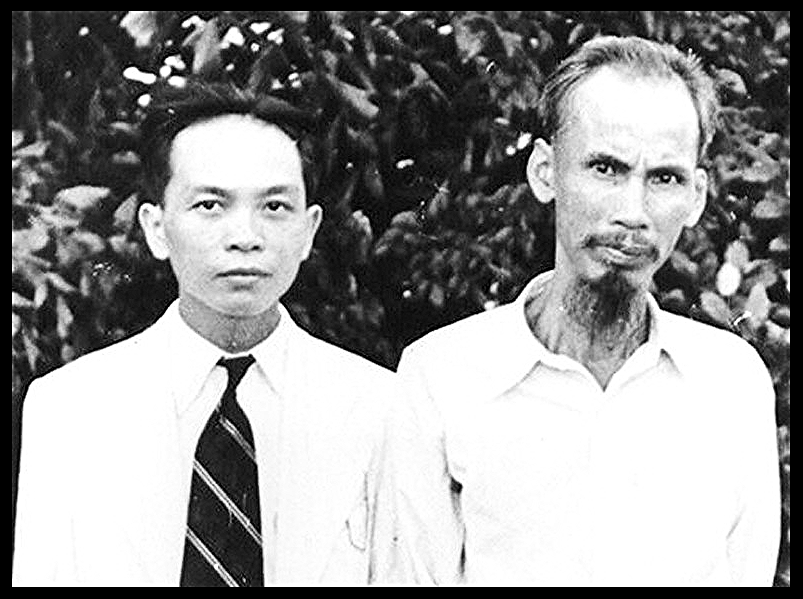
The young Võ Nguyên Giáp and Ho Chi Minh.
General Giáp was a most trusted confidant of the iconic Vietnamese leader Ho Chi Minh. Giáp was a firm believer that doing the impossible was not impossible, when it came to waging struggle to end tyranny and human suffering.
In May 1941, under the occupation of both French and Japanese imperialism, Giáp became leader of the Viet Minh, the military component of the League for the Independence of Vietnam, organized by Ho Chi Minh. Giáp’s leadership in the tactics of conventional and guerilla warfare was decisive in defeating Japanese, French, and U.S. imperialism.
Personal tragedies resulting from horrors caused by French colonialism profoundly affected Giáp which played a big role in molding his fury, resilience and revolutionary disposition. In 1938, he fled North to China to avoid arrest by pursuing colonial authorities.
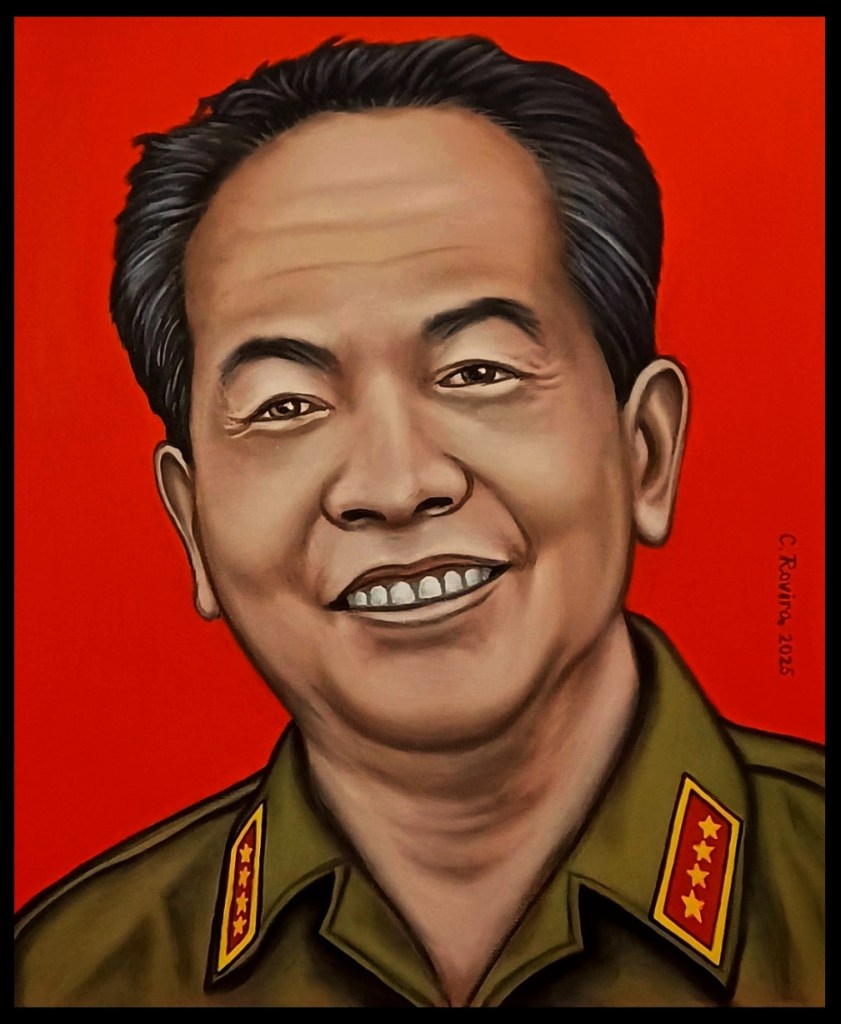
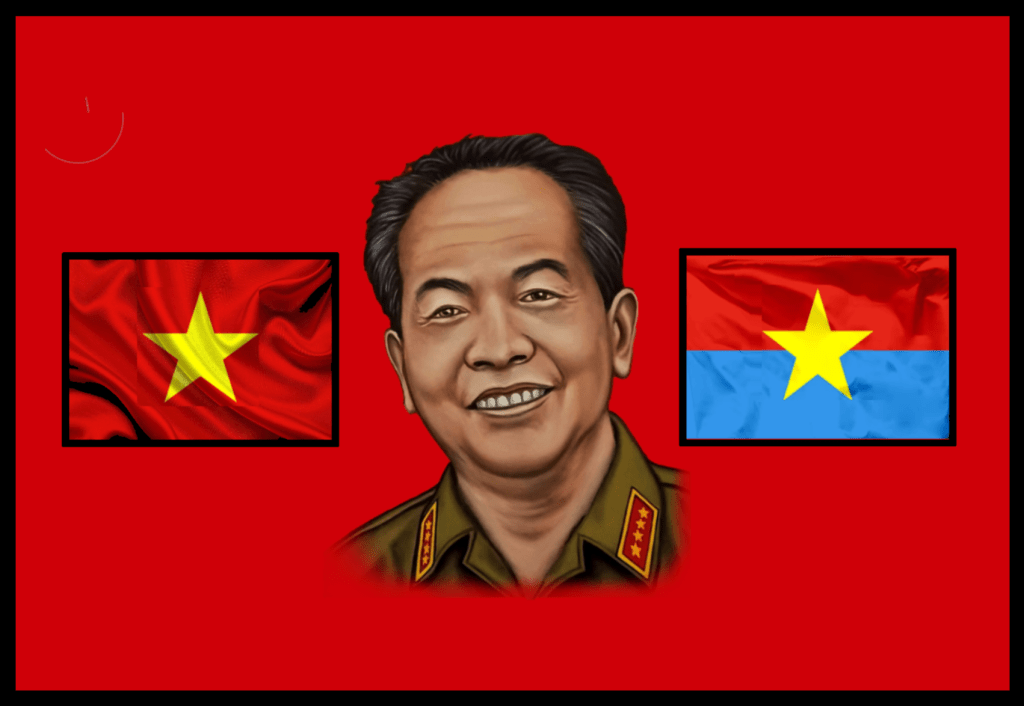
My portrait of General Võ Nguyên Giáp. 20″ X 24″, acrylic paint on canvas.
In 1940, his wife Nguyen Thi Quang Thai, also a leader in the Communist Party of Vietnam, was arrested. She experienced extreme torture including being forced to watch the murder of her parents and other family members. Nguyen eventually died while in the Hoa Lo Prison. Her sister also arrested was tortured and guillotined.
General Giáp’s military talents and skill were developed without any formal military schooling or training. He became attracted to military science by studying the history of warfare in different countries, the military writings of China’s Communist leader Mao Zedong and the classic Art of War by Sun Tzu.
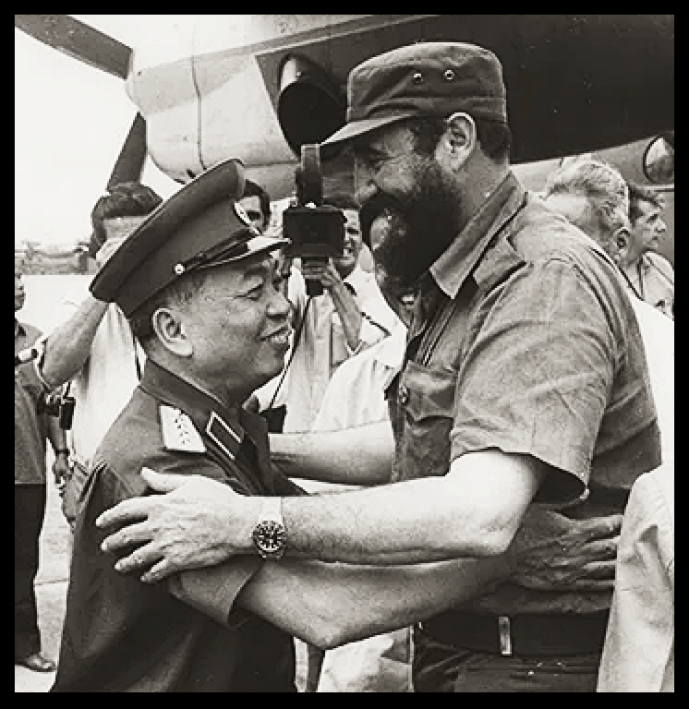
In September 1973, Cuba’s President Fidel Castro Ruz made a secret and symbolic trip to Vietnam where he was warmly greeted by General Giap. Fidel Castro was the only head of state to visit Vietnam during the war.
General Giáp’s skillfulness in strategy and tactics proved decisive on March 13, 1954, at the Battle of Dien Bien Phu. Vietnamese combatants humiliated and painfully stunned the better trained and equipped French Army by smashing their ability to fight.
Giáp masterfully developed guerilla tactics which he passed on to other leading combatants for applicability like the iconic Nguyễn Thị Định, an exemplary fighter who became the country’s first female ranking military general.
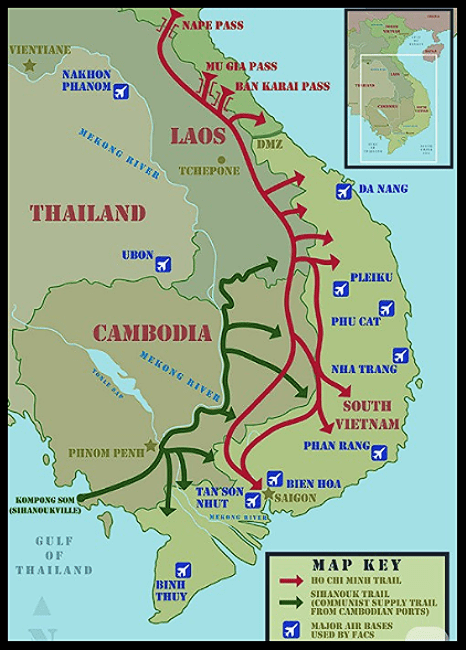
General Giáp was the leading figure of the People’s Army during the war against U.S. imperialism and their South Vietnamese puppets. He was the architect and organizer of the famous Ho Chi Minh Trail which served as a secret supply route for guerilla fighters in the Southern occupied portion of the country.
The Ho Chi Minh Trail.
The Ho Chi Minh Trail went through the jungles and tunnels of neighboring countries Laos and Cambodia. This network was used as a secret thruway to transport weapons and supplies. The engineering of this project was so sophisticated that the U.S. Air Force and Special Forces failed to detect its locations in order to destroy them.
In 1968, General Giáp masterminded the famous Tet Offensive. Under Giap’s command this military offensive achieved the desirable political outcome once it was launched on January 30, 1968. The revolutionary Vietnamese forces created extreme turmoil to counter false claims made by Washington officials that the National Liberation Front of Vietnam (NLF) was losing the war.
However, the opposite proved to be the case when U.S. casualties increased dramatically as a result of the fury the NLF unleashed with immense firepower throughout Vietnam. The growing number of body bags containing remains of American G.I.s could no longer be concealed from the mass media.
And when Dr. Martin Luther King, Jr. presented his famous speech at Riverside Church in New York City, titled “Beyond Vietnam: A Time to Break Silence“ it added to a major shift in public opinion. Opposition to the war ignited everywhere in society, especially among the youth who were distressed about being drafted for military service. Once the Tet Offensive began young men of age were increasingly refusing to enlist or evading the draft.
The country was consumed in protests. Many people who never attended a demonstration were now compelled to take a stance against the hypocritical politics of the War in Vietnam, especially in Black and Brown communities who were disproportionally the ones to be killed.
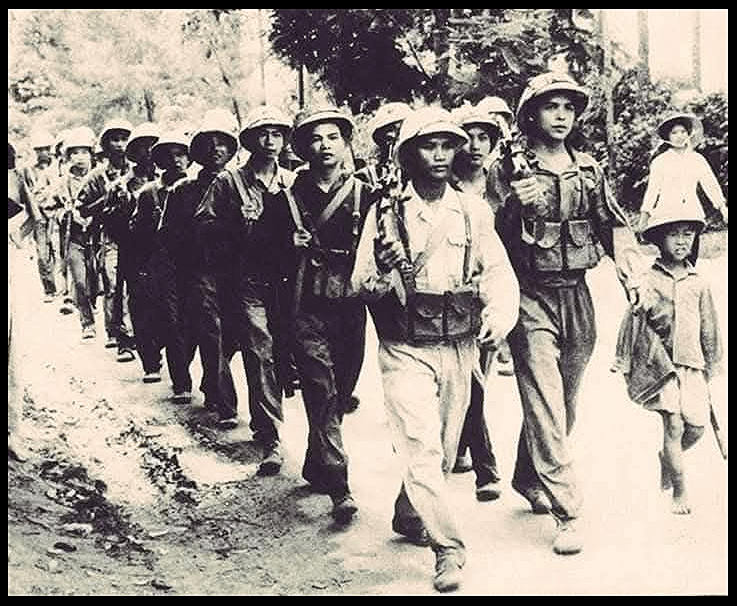
Units of the People’s Army of Vietnam (PAVN).
The Tet Offensive caused havoc for war planners at the Pentagon, as U.S. military forces became demoralized and resentful to the military brass. Many who were already in uniform serving in Vietnam staged acts of insubordination or rebellion. The Tet Offensive had a psychological affect on combat soldiers there and U.S. military personnel everywhere.
General Giap’s achievements for the liberation of his people are tremendous and continue to inspire millions throughout the world. His wisdom in strategy and tactics also serve as inspiring lessons for other oppressed people. Giap’s leadership in battle against a more powerful foe reaffirmed that colonizers, tyrants and white supremacists are not invincible.
Long live the legacy of General Vo Nguyen Giap and the heroic Vietnamese people!
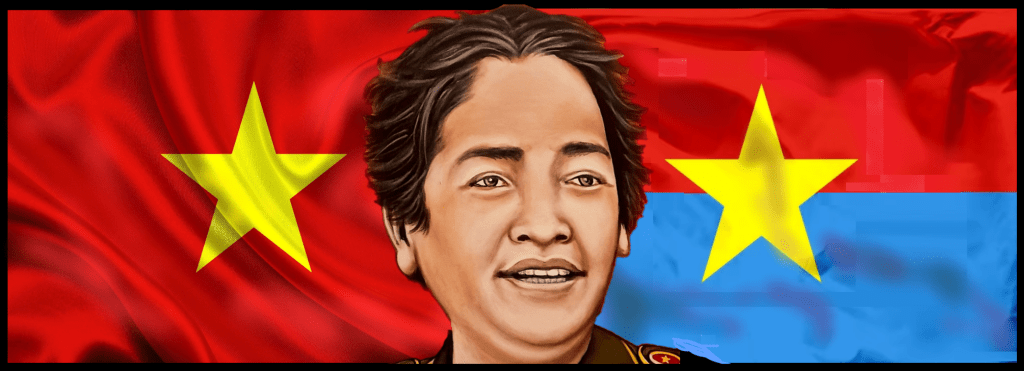
As a salute to the 50th anniversary of Vietnam’s triumph over U.S. imperialism, I was inspired to paint a 20” X 24”, acrylic paint canvas portrait of Major General Nguyễn Thị Định. Her legacy symbolizes the resilience of the heroic Vietnamese people, first against the French and then the United States.
Nguyễn Thị Định joined Vietnam’s liberation struggle by coming into the ranks of the Viet Minh at just 16 years of age. In 1938 she joined the Indochinese Communist Party which eventually became the Communist Party of Vietnam.
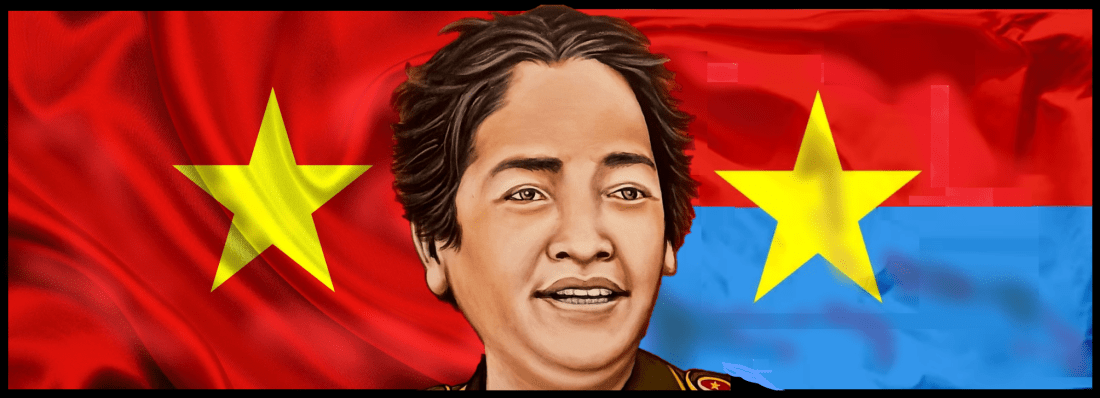
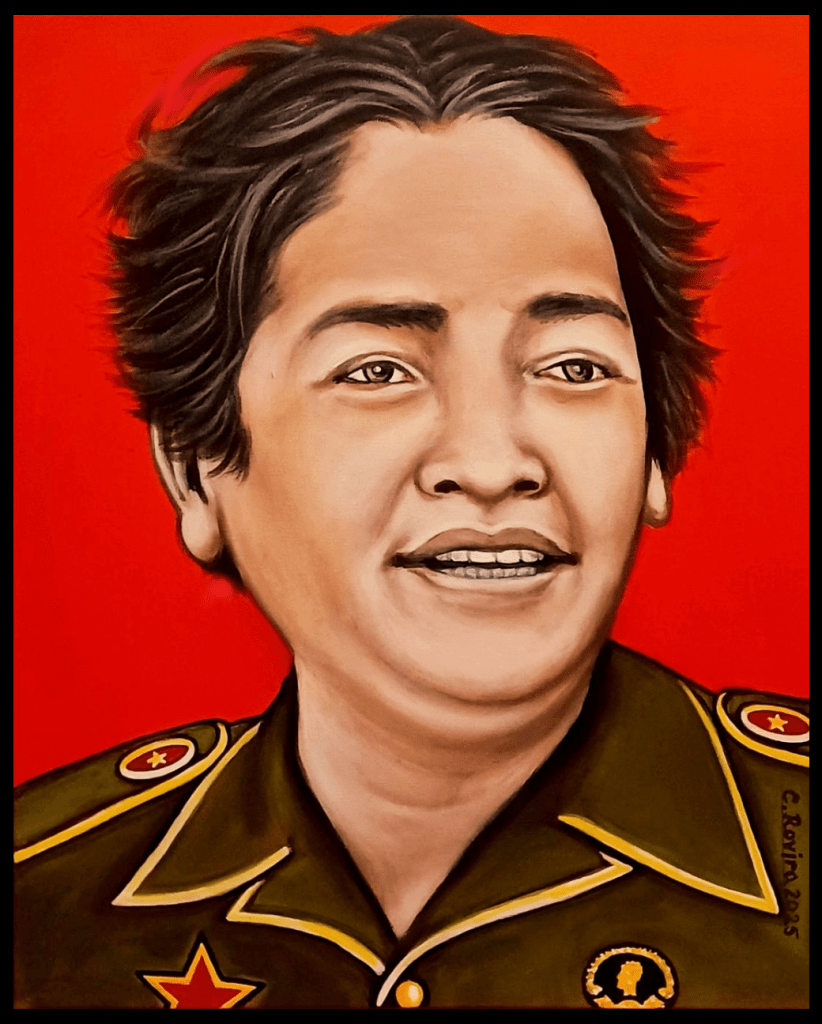
A piece I made to honor General Nguyễn Thị Định. 20″ X 24″, acrylic paint on canvas.
She was arrested by the French colonizers and imprisoned between 1940-1943. Dinh’s husband was also captured by French authorities and sent to a torturous facility in Con Dao Island. It was there where he was killed. Dinh always promised to avenge his death.
During the Vietnam War Định commanded the all-women guerilla force which became known as the “Long-Haired Army”. She is remembered for her brilliant leadership in the 1960 Dong Khoi uprising in the Ben Tre Province, the turning point in the Vietnam War.
General Nguyễn Thị Định and Comandante Fidel Castro Ruz in a visit to Cuba.
As the conflict intensified Dinh developed necessary strategies and tactics in guerilla warfare that resulted in inflicting many casualties on U.S. military personnel and their puppet soldiers in the South Vietnamese Army.
Nguyễn Thị Định was a co-founder of the National Front for the Liberation of Vietnam (also known as the Viet Cong). She became a prominent political figure in the People’s Liberation Armed Forces of South Vietnam.
General Nguyễn Thị Định cherishing a moment with her comrades at a guerilla base.
In April 1974, due to her unique leadership capabilities, Dinh was promoted to become Vietnam’s first female military general, earning her the rank of Major General.
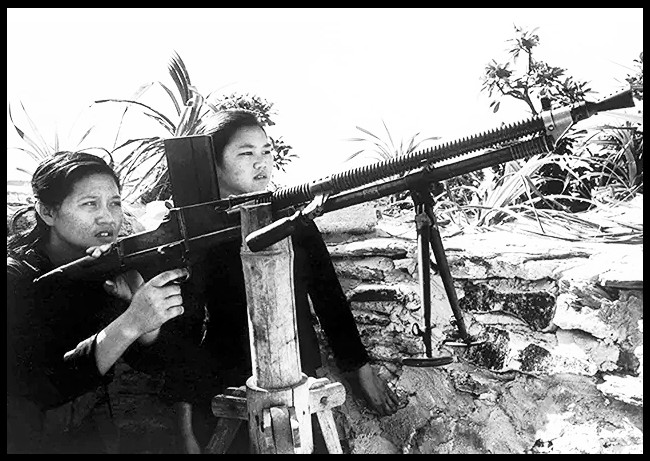
This significant development in Vietnamese history reflects the pivotal role women played during that country’s liberation struggle. Most combatants of the NLF were women.
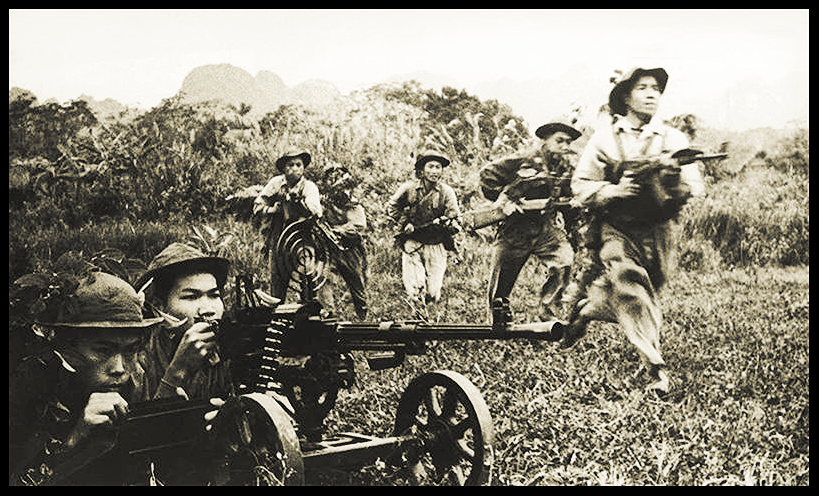
Vietnamese women played a significant role as combatants during the military struggle.
Men and women comprised the guerilla fighters of the National Liberation Front.
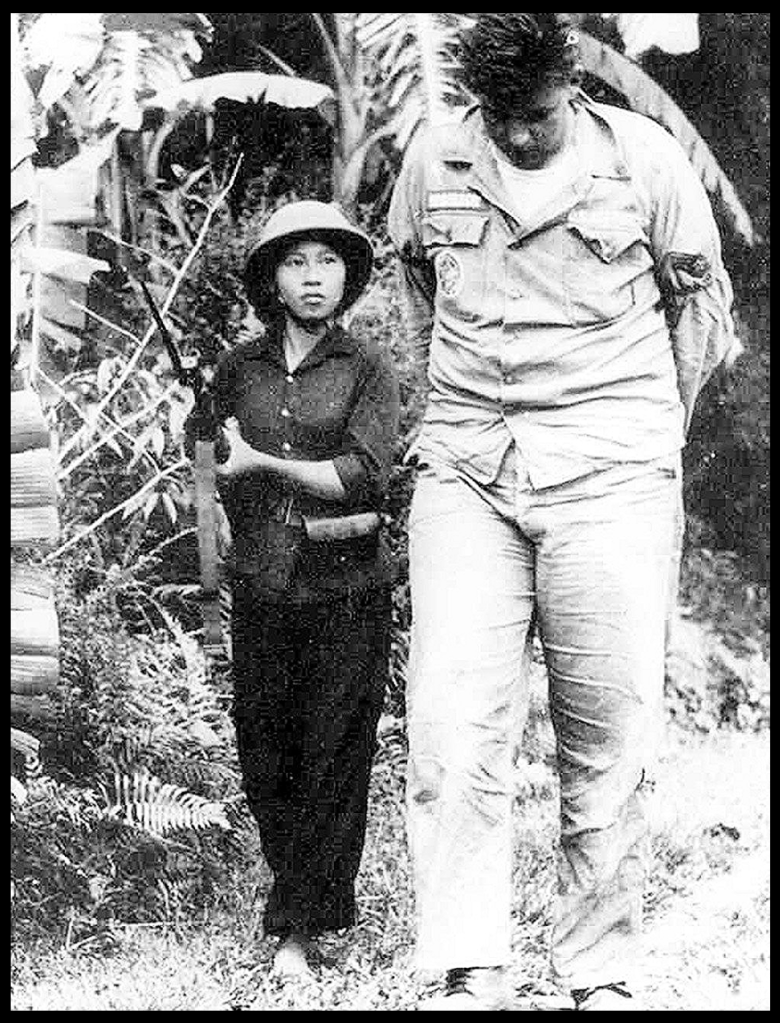
The gender of these fully capable women combatants became psychologically disturbing for imperialist troops trained to further adopt the views of male dominance. Many of these U.S. troops were guilty of terrorizing the Vietnamese civilian population.
A U.S. combat pilot shot down and taken as prisoner of war.
The lessons the Vietnamese struggle provided the world are numerous. The steadfast and courage of the Vietnamese people impacted the intensity of the 1960s-70s mass upsurge in this country. Thanks to the Vietnam’s war for liberation Black and Brown people in the U.S. were given another point of reference for their own struggles.
And when a mighty anti-war movement rose up in this country it became decisive with its opposition to stop the colonial war the U.S. was waging in Vietnam.
Today, Nguyễn Thị Định is remembered for inspiring the Vietnamese people to do the impossible, defeating in battle the greatest tyrant ever known in human history. What this heroine proved is that oppressors are never invincible.
LONG LIVE THE HEROIC EXAMPLE OF THE VIETNAMESE PEOPLE!
LONG LIVE THE LEGACY OF MAJOR GENERAL NGUYEN THI DINH!
“¿Qué ofreció la revolución triunfante a nuestras mujeres? Una nueva vida, llena de posibilidades y perspectivas, donde sus sueños más profundos podrían hacerse realidad. Una sociedad donde lo más preciado para todos nosotros —el futuro de nuestros hijos— estaría asegurado. Una sociedad diferente, donde las personas serían dueñas y dueñas de su propio destino, donde ejercerían plenamente sus derechos, donde surgirían nuevos valores. El triunfo ofreció a nuestras mujeres la oportunidad de estudiar y trabajar, les brindó seguridad económica, poniendo fin así a la opresión y las penurias. Abrió perspectivas de atención médica y seguridad social. Para las mujeres, la revolución significó la oportunidad de alcanzar la dignidad humana.” -Vilma Espin
Homenaje a Vilma Espín, heroína de la Revolución Cubana
7 de abril de 1930 – 18 de junio de 2007
Por Carlos “Carlito” Rovira
Uno de los momentos más destacados de la Revolución Cubana de 1959 es el papel de las mujeres. Entre las heroínas de este acontecimiento histórico se encontraba Vilma Lucila Espín Guillois, más conocida como Vilma Espín. Nació el 7 de abril de 1930 en Santiago de Cuba, en el seno de una familia relativamente adinerada que le inculcó valores progresistas. Fue durante sus años de formación cuando desarrolló una fuerte afinidad con los pobres.
Espín se involucró políticamente a temprana edad, mientras estudiaba ingeniería química en la Universidad de Oriente, en Santiago de Cuba. Allí organizó manifestaciones estudiantiles contra el golpe militar de 1952 y la dictadura del infame títere estadounidense Fulgencio Batista. En un país donde prevalecían la pobreza, la miseria y la agitación, la joven Vilma se vio obligada a cuestionar las causas de los sucesos desagradables que presenciaba.
Aunque el estatus político de Cuba se disfrazaba hábilmente con apariencias de “independencia”, en realidad se encontraba bajo un dominio colonial estadounidense. Cuba fue invadida y colonizada militarmente junto con Filipinas, Guam y Puerto Rico como consecuencia de la Guerra Hispano-Estadounidense de 1898.
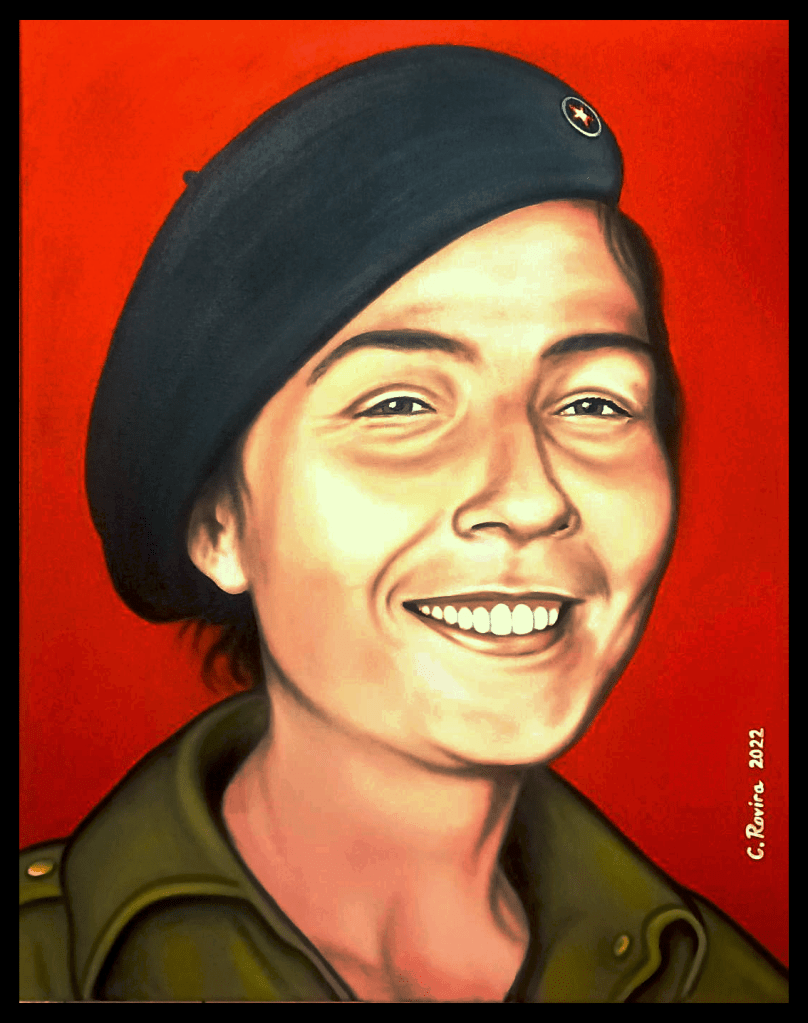
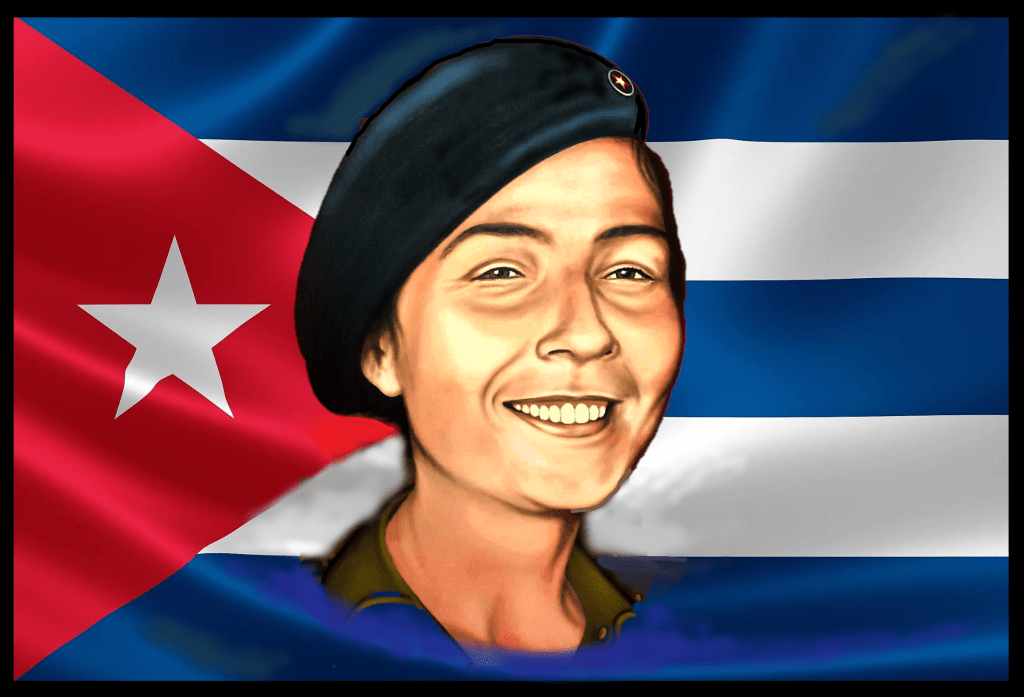
Mi retrato de Vilma Espin. 24″ X 30″, pintura acrílica sobre lienzo.
Tras completar sus estudios de posgrado en el Instituto de Tecnología (MIT) de Cambridge, Massachusetts, Vilma Espín se convirtió en una de las primeras cubanas en obtener un título en ingeniería química. A su regreso a Cuba, conoció al revolucionario cubano Frank País, de 22 años. Poco después, participó con entusiasmo en la organización del Movimiento 26 de Julio.
Vilma Espín comenzó a trabajar como mensajera entre los sobrevivientes del fallido asalto al Cuartel Moncada de 1953, exiliados en México, y el movimiento anti-batista en Cuba. Tras la desastrosa llegada a Cuba del yate Granma, que transportaba combatientes revolucionarios que se enfrentaron en un tiroteo con tropas batistianas, Vilma Espín se unió a Fidel y Raúl Castro en la Sierra Maestra. Para entonces, Espín ya era guerrillera.
Tras demostrar su lealtad a la causa revolucionaria con el cumplimiento diligente de sus deberes, Espín alcanzó un rango de liderazgo en el Ejército Rebelde, junto a figuras como Ernesto Che Guevara, Fidel Castro Ruz, Raúl Castro Ruz, Celia Sánchez, Haydée Santamaría, Melba Hernández, Camilo Cienfuegos, Teté Puebla y otros.
Con el tiempo, las circunstancias de su actividad política influyeron en la vida personal de Vilma Espín y del líder del Ejército Rebelde, Raúl Castro Ruz. Ambos revolucionarios iniciaron una relación romántica y contrajeron matrimonio poco después del derrocamiento del régimen de Batista. Formaron una familia con cuatro hijos: tres mujeres y un varón. Sus nombres son Déborah, Mariela, Nilsa y Alejandro (Castro Espín).
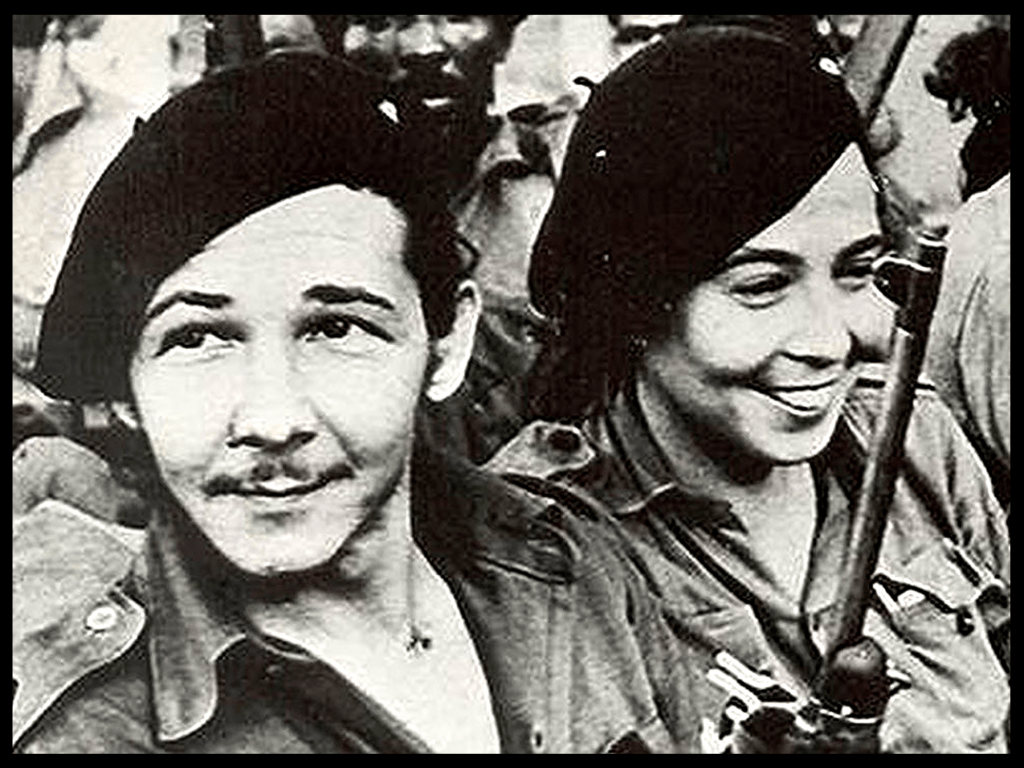
Raul Castro Ruz y Vilma Espin.
Además de ser figura política en el gobierno cubano y el Partido Comunista, Espín desempeñó un papel ejemplar en su campo profesional como ingeniera química. Lideró el camino para establecer la industria química del país, en sectores como bio-farmacéuticos, gases industriales y medicinales, fertilizantes, pesticidas y más.
Las contribuciones de Vilma Espín en este campo científico resultaron valiosas para la investigación médica cubana en vacunas y tratamientos para enfermedades infecciosas como la COVID-19, el VIH/SIDA, el ébola, así como para el cáncer, entre otras. Mucho después de su muerte, los logros de su labor siguen desempeñando un papel vital en la lucha contra el vengativo bloqueo económico estadounidense.
De izquierda a derecha: Vilma Espín, Fidel Castro Ruz, Raúl Castro Ruz y Celia Sánchez.
A medida que se acercaba el momento de la toma del poder, la labor de Vilma Espín como destacada agente de inteligencia de la red clandestina de espionaje del Movimiento 26 de Julio resultó decisiva para desmoralizar y neutralizar a las tropas enemigas. Espín también fue responsable de mantener un flujo constante de armas, alimentos y suministros médicos para las fuerzas revolucionarias en la Sierra Maestra.
Conocida en los entresijos de la organización, Espín desempeñó un papel fundamental en la creación del nuevo gobierno revolucionario. Fue miembro del Comité Central del Partido Comunista de Cuba de 1965 a 1989. Fue presidenta de la Comisión de Prevención Social de 1967 a 1971, directora de Desarrollo Industrial del Ministerio de Alimentación en 1971, presidenta del Instituto de Puericultura y miembro del Consejo de Estado de Cuba en 1976. Además, Vilma Espín fue representante de Cuba en la Asamblea General de las Naciones Unidas.
Es lógico que la hija de Vilma Espín y Raul Castro Ruz, Mariela Castro Espín, se viera influenciada ideológicamente por los ideales de la revolución durante su infancia. Hoy, Mariela es conocida mundialmente como una destacada portavoz de los derechos LGBTQ+ en Cuba, como directora del Centro Nacional de Educación Sexual de Cuba.
La Federación de Mujeres Cubanas
Y como Vilma Espín fue un baluarte de las ideas revolucionarias, defendiendo el socialismo. Ella se propuso como misión de vida desafiar las tradiciones retrógradas establecidas desde hace tiempo por la Iglesia Católica Romana, especialmente aquellas que justificaban la opresión de género. Por ello, Espín fue una firme defensora de la igualdad de género y en 1960 se propuso crear la Federación de Mujeres Cubanas (FMC).
Miembras de la Federación de Mujeres Cubanas (La Federación de Mujeres Cubanas)
La FMC es una fuerza organizada con el propósito de empoderar a las mujeres en Cuba. A lo largo de su existencia, la organización ha presentado y defendido la promulgación de decretos que protegen los intereses de las mujeres. Vilma Espín presidió la FMC hasta su fallecimiento el 18 de junio de 2007.
La FMC sigue siendo un órgano vital de la Revolución Cubana. Sigue el lema de que sin la participación de las mujeres se obstaculizarían los objetivos de la revolución. Por eso, el apoyo del Partido Comunista a la FMC es de suma importancia.
La FMC abordó temas de suma importancia para las mujeres, como:
• Un pronunciamiento general a favor de la igualdad de derechos de las mujeres.
• Integración de las mujeres en la política y la administración pública.
• Integración completa de las mujeres en la economía.
• Atención médica adecuada para las mujeres.
• Cuidado infantil para los más pequeños.
• Acceso de las mujeres a la educación.
• Reorganización de los hogares que mantienen a las mujeres en posiciones de subordinación.
• Creación de clases de defensa personal para mujeres con el fin de erradicar el maltrato físico.
Durante la invasión de Bahía de Cochinos, la FMC se alzó en armas en defensa de su país.
Durante la invasión de Bahía de Cochinos, organizada por la CIA, en 1961 y, de nuevo, durante la Crisis de los Misiles de Cuba en 1962, el papel de Vilma Espín en la Federación de Mujeres Cubanas fue vital. Esta poderosa organización de masas movilizó a mujeres de todas las edades para la batalla en un momento amenazante, cuando la intervención estadounidense parecía probable. Se mantuvieron listas como parte de una infraestructura armada que abarcaba a toda la sociedad cubana.
En los días previos a la invasión de Bahía de Cochinos, la CIA llevó a cabo actos de sabotaje contra el suministro de alimentos del país. Muchos campos de cultivo fueron incendiados brutalmente. El gobierno cubano decretó el estado de emergencia. El Ejército Revolucionario Cubano y las diversas organizaciones de masas, incluida la FMC, se movilizaron. Miles de mujeres armadas, en contingencias organizadas, fueron enviadas a los campos de cultivo de toda Cuba.
A pesar de las dificultades que enfrenta Cuba a causa del bloqueo económico estadounidense, la FMC sigue siendo la parte más profunda del legado de Vilma Espín. Lo que ella simboliza es una gran fuente de energía para la resiliencia del pueblo cubano.
Su nombre sigue inspirando a quienes aman la libertad en todo el mundo, especialmente a quienes siguen sus pasos en la defensa de la patria cubana. Los innumerables ejemplos de valor y altruismo de Vilma Espín sin duda demuestran su noble carácter, pero al mismo tiempo ponen de relieve la fuerza moral y la legitimidad de la Revolución Cubana.
“What did the triumphant revolution offer our women? A new life, filled with possibilities and prospects, in which their deepest dreams might become reality. A society in which that which is most precious to us all-our children’s future-would be assured. A different society, where the people would be masters and mistresses of their own destiny, where they would exert their rights fully, where new values would come into being. The triumph offered our women the opportunity to study and to work, it offered them economic security, thereby putting an end to oppression and hardship. It opened prospects of health care, of social security. For women, the revolution meant the opportunity to attain human dignity.” —Vilma Espin.
Salute to Vilma Espin, heroine of the Cuban Revolution
April 7, 1930 – June 18, 2007
By Carlos “Carlito” Rovira
One of the greatest highlights of the 1959 Cuban Revolution is the role played by women. Among the heroines of this historic event was Vilma Lucila Espin Guillois, better known as Vilma Espin. She was born on April 7, 1930, in Santiago De Cuba to a relatively wealthy family that taught her progressive values. It was during her formative years when she developed affinities for the poor.
Espin became politically active at a young age during her studies for chemical engineering at the University of Oriente, in Santiago de Cuba. She organized student demonstrations there against the 1952 military coup and dictatorship of the notorious U.S.-puppet Fulgencio Batista. In a country where poverty, misery, and turmoil prevailed compelled the young Vilma to question what the causes were for unpleasant things she witnessed.
Although the political status of Cuba was cleverly disguised with semblances of “independence” it was actually under a colonial-type domination by the United States. Cuba was militarily invaded and colonized along with the Philippines, Guam and Puerto Rico, the consequence of the 1898 Spanish-American War.
My portrait of Vilma Espin. 24″ X 30″, acrylic paint on canvas.
After completing her post-graduate studies at the Institute of Technology (MIT) in Cambridge, Massachusetts Vilma Espin became one of the first Cuban women to earn a degree in chemical engineering. When Espin returned to Cuba, she met with the 22-year-old Cuban revolutionary Frank Pais. Soon after, she eagerly participated in organizing the July 26 Movement.
Vilma Espin began working as a messenger between survivors of the failed 1953 Moncada Barracks attack who were exiled in Mexico and the anti-Batista movement in Cuba. After the disastrous arrival to Cuba of the Granma yacht carrying revolutionary combatants who engaged in a gun battle with pro-Batista troops, Vilma Espin joined Fidel and Raul Castro in the Sierra Maestra. By then Espin was a guerilla fighter herself.
After Espin proved her loyalty to the revolutionary cause by diligently performing her duties, she earned a leadership rank in the Rebel Army, alongside other staunch leadership figures like Ernesto Che Guevara, Fidel Castro Ruz, Raul Castro Ruz, Celia Sanchez, Haydee Santamaria, Melba Hernandez, Camilo Cienfuegos, Teté Puebla, and others.
Eventually, the circumstances of political activity influenced the personal lives of Vilma Espin and Rebel Army leader Raul Castro Ruz. The two revolutionaries developed a romantic relationship and married shortly after the overthrow of the Batista regime. They established a family with four children, three daughters and a son. Their names are Deborah, Mariela, Nilsa, and Alejandro (Castro Espin).
Raul Castro Ruz and Vilma Espin.
In addition to serving as a political cadre in the Cuban government and Communist Party, Espin played an exemplary role in her professional field as a chemical engineer. She led the way to establish the country’s chemical industry, such as in biopharmaceuticals, industrial and medicinal gases, fertilizers, pesticides, and more.
Vilma Espin’s contributions in this scientific field proved valuable for Cuba’s medical research in vaccines and treatments for infectious diseases like Covid-19, HIV/AIDS, Ebola, as well as for cancer and so on. Long after her death, the achievements of her work continue to play a vital role pushing back on the vindictive U.S. economic blockade.
From left to right: Vilma Espin, Fidel Castro Ruz, Raul Castro Ruz, and Celia Sanchez.
As the moment for the seizure of power approached, Vilma Espin’s work as a leading intelligence operative for the underground spy network of the July 26 Movement proved decisive for demoralizing and neutralizing enemy troops. Along with another Cuban revolutionary heroine Celia Sanchez, Espin was responsible for maintaining a steady flow of weapons, food, and medical supplies for revolutionary forces in the Sierra Maestra Mountains.
Being well-versed in the intricacies of organization, Espin played a pivotal role in the creation of the new revolutionary government. She served as a member of the Central Committee of the Cuban Communist Party from 1965 to 1989. She was chair of the Commission for Social Prevention from 1967 to 1971, director of Industrial Development in the Ministry of Food in 1971, President of the Institute of Childcare, and member of the Cuban Council of State in 1976. In addition, Vilma Espin served as Cuba’s representative on the United Nations General Assembly.
No one can ever dispute that Vilma Espin’s and Raul Castro Ruz’s daughter, Mariela Castro Espin, took after both her parents. It is evident that she was ideologically influenced by the ideals of the revolution during her childhood rearing. Today, Mariela is known throughout the world as a leading voice for LGBTQ+ rights in Cuba, as director of the Cuban National Center for Sex Education.
The Federation of Cuban Women
Espin was a bulwark for revolutionary ideas, upholding Socialism. She made it her life-mission to challenge backward traditions long established by the Roman Catholic Church, especially, that which justifies gender oppression. This is why Espin was an outspoken advocate for gender equality and in 1960 she set out to create the Federation of Cuban Women (La Federación de Mujeres Cubanas, FMC).
Members of the Federation of Cuban Women (La Federación de Mujeres Cubanas)
The FMC is an organized force with the purpose of empowering women in Cuba. Throughout its existence the organization has introduced and argued for enacting decrees that protect the interest of women. Vilma Espin served as president of the FMC until her death on June 18, 2007.
The FMC continues to be a vital organ of the Cuban Revolution. It follows the motto that without the participation of women would pose a hinderance to the aims of the revolution. This is what made the Communist Party’s support for the FMC a matter of supreme importance.
The FMC addresses issues of the utmost concern to women, such as:
A general pronouncement for women’s equal rights.
Intergration of women in politics and government administration.
Complete integration of women into the economy.
Adequate healthcare for women.
Childcare for the very young.
Women’s access to education.
Reorganizing households that keep women in subservient positions.
Creating self-defense classes for women to end physical abuse.
During the Bay of Pigs invasion, the Federation of Cuban Women picked up arms in defense of their country.
During the CIA-organized Bay of Pigs invasion in 1961 and the Cuban Missile Crisis of 1962, Vilma Espin’s role in the FCW was vital. This powerful entity mobilized women of all ages for battle during a threatening moment when U.S. intervention seemed likely. They stood ready as part of an armed infrastructure composed of all mass organizations in Cuban society.
In the days leading up to that crisis, the CIA conducted acts of sabotage on the country’s food supply. Many crop fields were viciously set ablaze. A state of emergency was called by the Cuban government. The Revolutionary Cuban Army and the various mass organizations, including the FMC, were mobilized. Thousands of armed women in organized contingencies were dispatched to protect farming fields throughout Cuba.
Despite the hardships Cuba faces caused by the U.S. economic blockade the FMC continues to be the most profound part of Vilma Espin’s legacy. What she symbolizes provides a big energy source for the continual resilience and valor of the Cuban people. Her countless examples of selflessness surely point to her noble character, but at the same time sheds light on the moral strength and legitimacy of the Cuban Revolution.
This heroine’s name continues to inspire freedom-loving people throughout the world, especially those following in her footsteps in defense of the Cuban homeland. That alone should serve as a warning to any imperialist power foolishly contemplating on using military force to re-colonize Cuba.
“A nation that continues year after year to spend more money on military defense than on programs of social uplift is approaching spiritual death.” – Dr. Martin Luther King, Jr.
______________________________________________
By Carlos “Carlito” Rovira
Dr. Martin Luther King, Jr. was among a number of significant Black religious figures whose actions and leadership in the 1950s-1960s propelled the fury of the Civil Rights movement. The Southern Baptist Church for the most part served as a vehicle for expressing the wishes of Black people. But with the advent of the 1960s mass upsurge nothing was exempt from the political storm that created a potential for revolution in the United States, including the Black Church.
The momentum consumed most of society, as the outcry for Black emancipation gained support even outside the African American community. This phenomenon provided favorable conditions for the Black struggle to play an exemplary and leadership role in the intensifying political climate.
Other oppressed sectors of the population yearning for freedom as well began to follow suit. The Civil Rights movement which started as an expression for Black freedom was now a factor in a mass upsurge which had a profound impact on the spectrum of politics in this country.
Photos taken of Dr. King while in custody by Birmingham, Alabama police.
Dr. Martin Luther King’s empathy for the historic suffering of Black people, heightened his contempt for the legacy of slavery, racist Jim Crow laws. It instilled in his character a defiance and resilience that would inspire millions of people from all nationalities and races to take part in his quest.
Figures like Evelina Antonetty and Gerena Valentin from the Puerto Rican community as well as Cesar Chavez and Dolores Huerta, representing Mexican/Chicano migrant workers, aligned with Dr. King, thus adding to the strength of the Civil Rights movement.
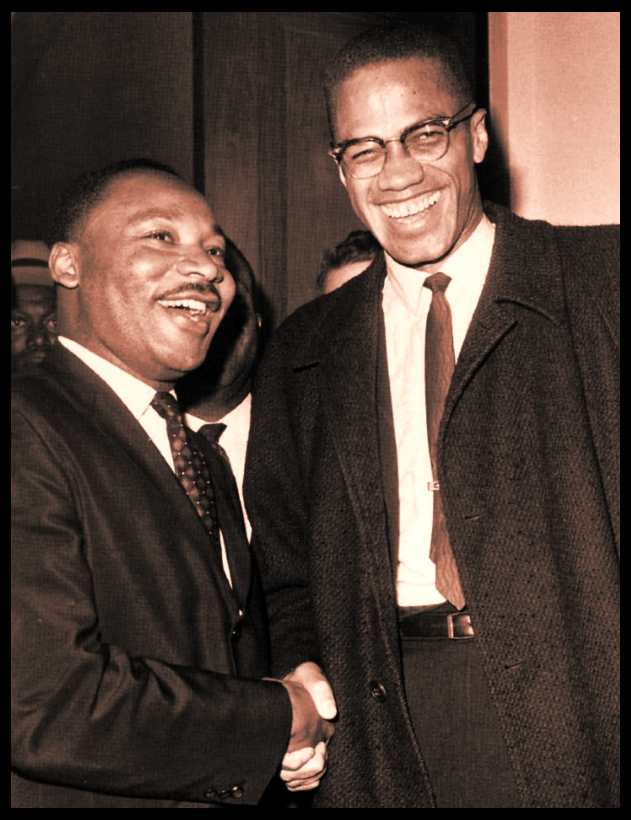
Dr. Martin Luther King, Jr. and Malcolm X, March 26, 1964, in Washington, DC.
Despite differences among Black leaders, the February 21, 1965, assassination of Malcolm X impacted Dr. King. There is indisputable evidence in his speeches that he was becoming radicalized, a reflection of the political militancy that was evolving among Black and Brown people in this country. Malcolm X’s assassination naturally brought to the open what was already being felt in the hearts and minds of millions of people, including Dr. Martin Luther King, Jr., himself.
Contrary to assertions made by bourgeois historians, which depict MLK as nonaggressive and passive, he supported and boldly encouraged civil disobedience. He was also an outspoken critic of the U.S. political and economic system.
Civil Rights activists demonstrated dignity and were not afraid of white supremacist attacks.
Although MLK never identified himself as revolutionary, by traditional definition, objective circumstances compelled him to side with radical views. Towards the end of his life, Dr. King showed signs of gravitating towards an anti-capitalist analytical conclusion to the human suffering he witnessed.
During a speech he gave on August 16, 1967, at a Southern Christian Leadership Conference in Atlanta, Georgia, Dr. King boldly stated: “The evils of capitalism are as real as the evils of militarism and evils of racism.”
And when Dr. King gave his April 4, 1967, speech at Riverside Church in Harlem, New York City, titled: “Beyond Vietnam: A Time to Break Silence” the rulers of this country became infuriated. Considering the history of political reaction and racist hatred in the United States, it cannot be ruled out that delivering this speech sealed Dr. King’s death.
Washington officials were defensive due to the Vietnamese anti-colonial struggle gaining momentum while receiving massive support throughout the world, as the U.S. anti-war movement added to the pressure.
When Dr. Martin Luther King, Jr. articulated the relevance of Civil Rights with the fight to end the war in Vietnam U.S. officials experienced political embarrassment on a global scale. It was no coincidence or surprise that the notorious J. Edgar Hoover had ordered intensifying COINTELPRO activities against Dr. King to seek ways to ruin his reputation and discredit the politics of the movement.
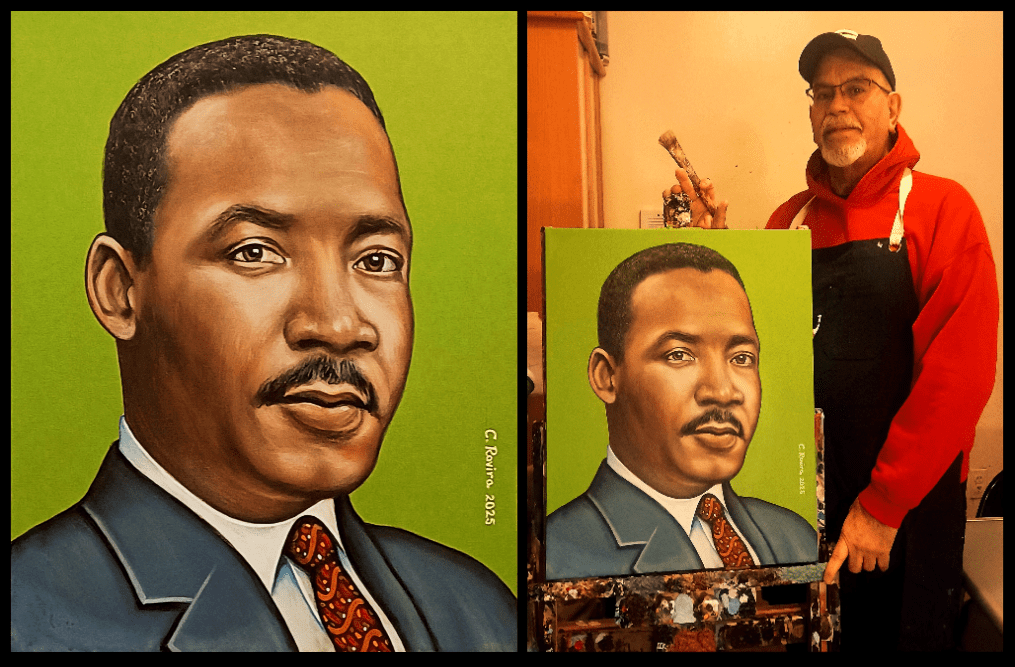
My portrait of Dr. Martin Luther King, Jr. 20″ X 24″, acrylic paint on canvas.
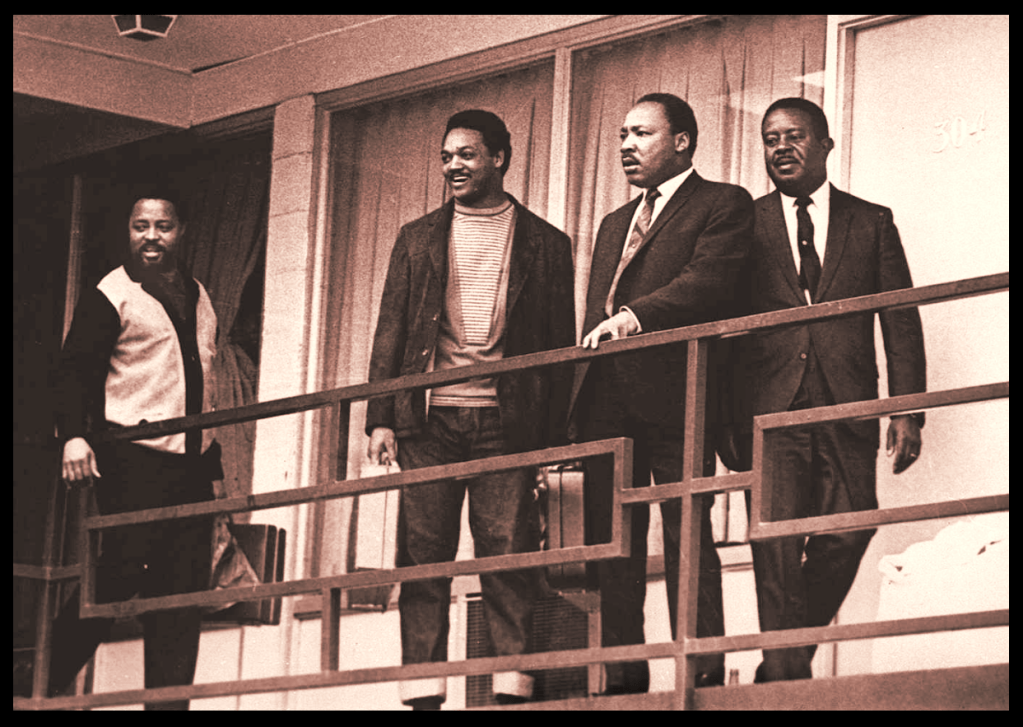
Exactly a year after the Riverside Church speech, Dr. King was assassinated. He was shot while speaking to an audience from a hotel balcony in Menphis, Tennessee. The assailant was a white supremacist named James Earl Ray, who used a high-power rifle from a distance away to kill the renown Black leader.
African Americans reacted justifiably with indignation and rebelled on the streets of major cities throughout the country. The killing of Dr. King was reminiscent of the terror Black people experienced throughout the history of this country since chattel slavery.
Moments before Dr. Martin Luther King, Jr. was fatally shot by sniper.
There are many apologists in the mainstream who will distort the critical role Dr. Martin Luther King, Jr. played in the Civil Rights movement. They will also present sanitized narratives that focus solely on his “peaceful, non-violent” tactics while avoiding mention of the vicious police terror unleashed on Dr. King and that entire movement.
What we today must always raise is the tenacious resistance Black and Brown people demonstrated then and will continue until freedom prevails, as Dr. King and the Civil Rights movement had envisioned.
LONG LIVE THE LEGACY OF DR. MARTIN LUTHER KING, JR.
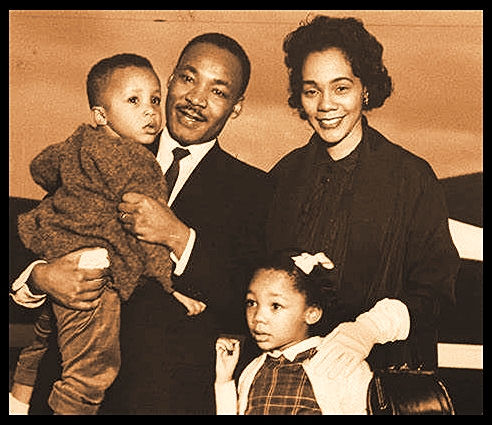
Dr. Martin Luther King, Jr., Coretta Scott-King and their children.
“We must fight for one Arab nation, for unity, for freedom, for socialism. We must defeat enemy number one, America, the supplier of Hawk missiles to Israel, and we must seize our own oil resources. We must learn to emulate our Algerian brethren in order to liberate Palestine.” -Leila Khaled
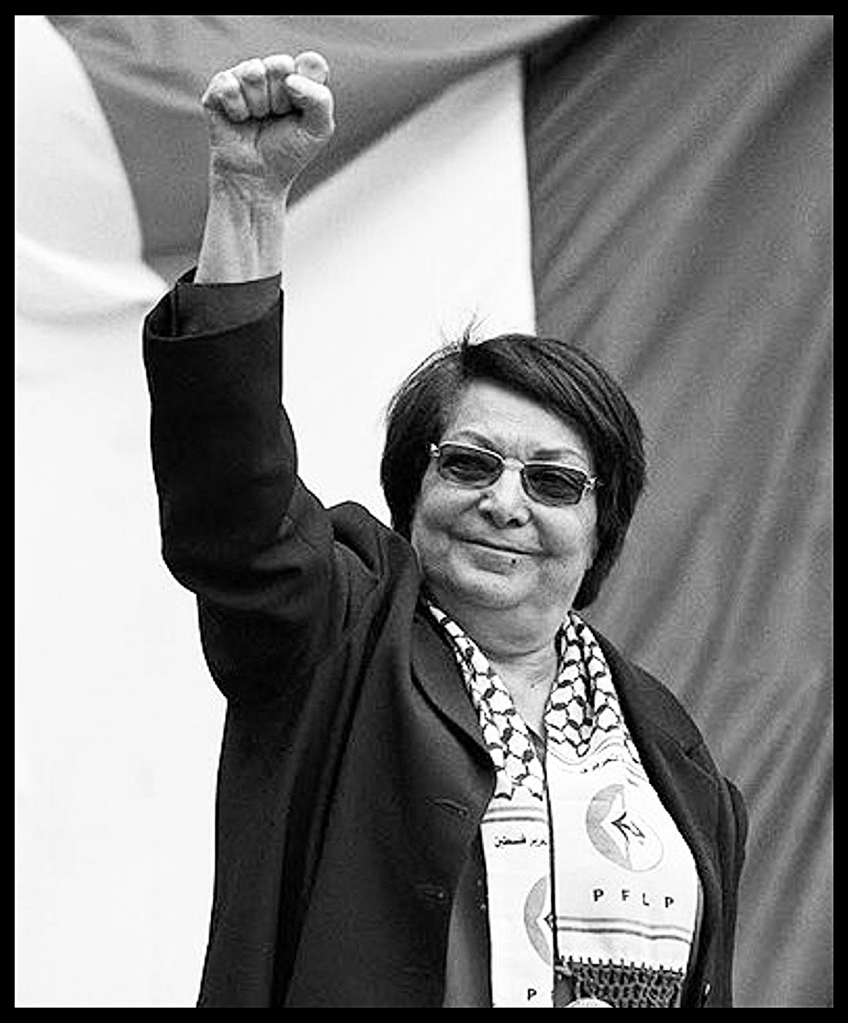
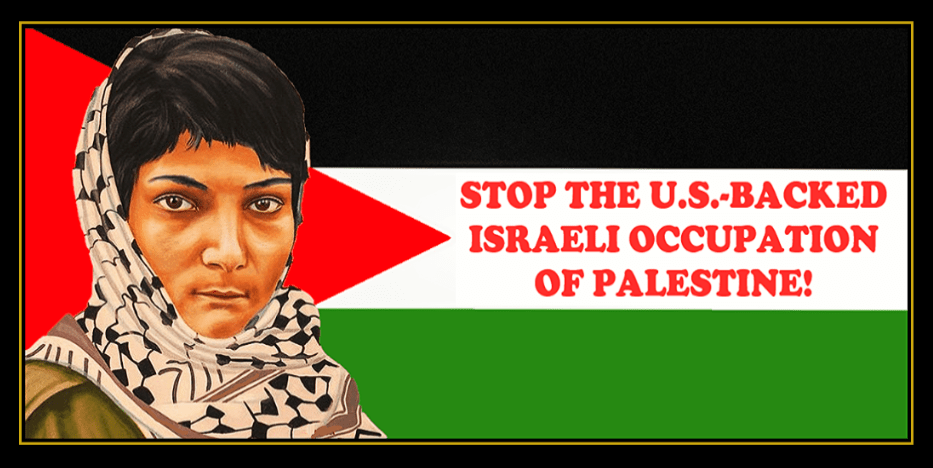
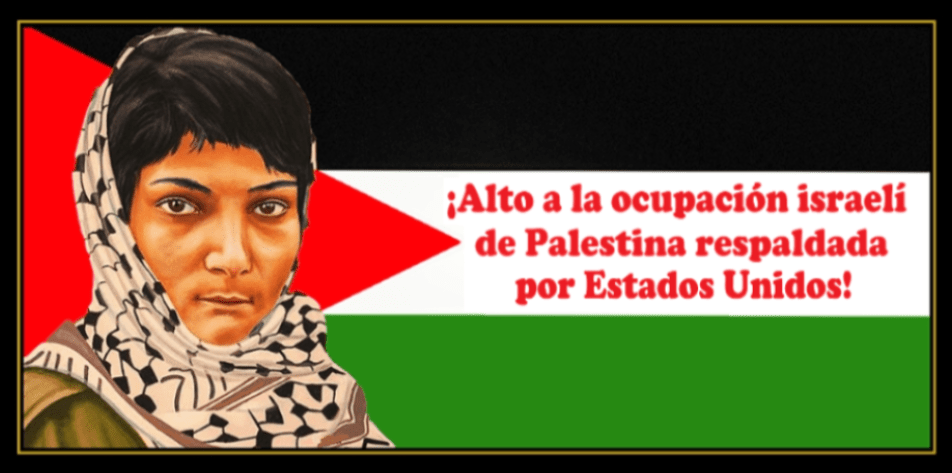
On April 9, 1944, in the Palestinian municipality of Haifa, Leila Khaled was born. She is a symbolic figure that represents the liberation struggle of the heroic Palestinian people, fighting the vicious U.S.-backed Israeli occupation.
Leila Khaled’s militancy developed due to horrors she as a child and her family endured because of Israeli abuses. These terrifying experiences occurred during the Nakba (catastrophe in Arabic) of 1947-1948, when all Palestinians were impacted by the blatant criminality of Zionists.
With all the suffering and death experienced by so many Palestinian families should explain why Leila Khaled grew up developing a strong desire to be part of the armed resistance. Eventually, she joined the Popular Front for the Liberation of Palestine (PFLP)
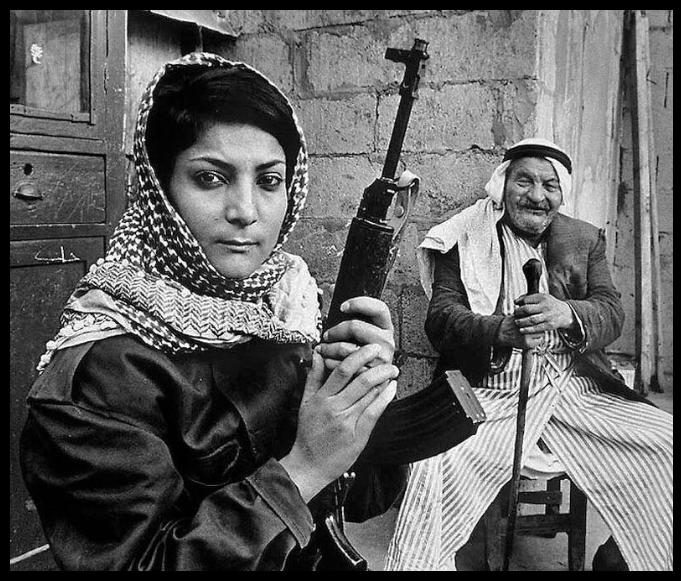
Leila Khaled with an elder compatriot.
Historically, most resistance movements amplify the skillful fighting prowess of a select few of male fighters. However, when women like Leila demonstrate the same fury and fiery conviction as her male comrades, it has powerful psychological effect on the opposition.
Oppressors everywhere are aware that their greatest vulnerability is unity among the oppressed, especially if it involves them exerting the right to use any means of struggle for liberation.
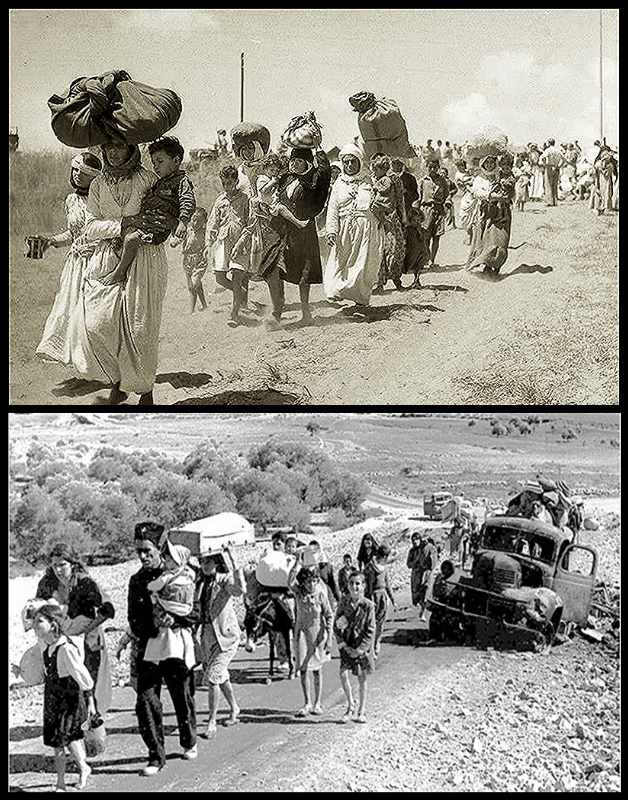
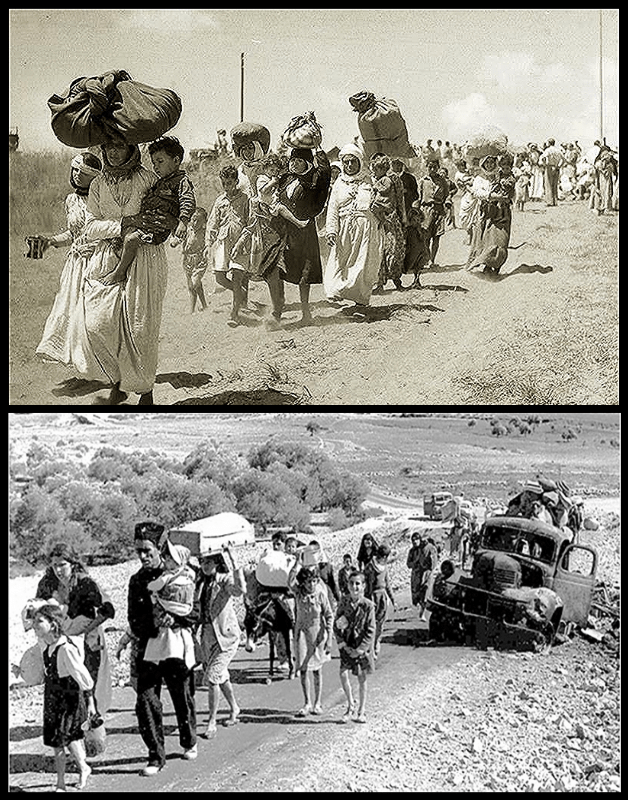
Palestinian families being driven to refugee camps in their own country during the Nakba.
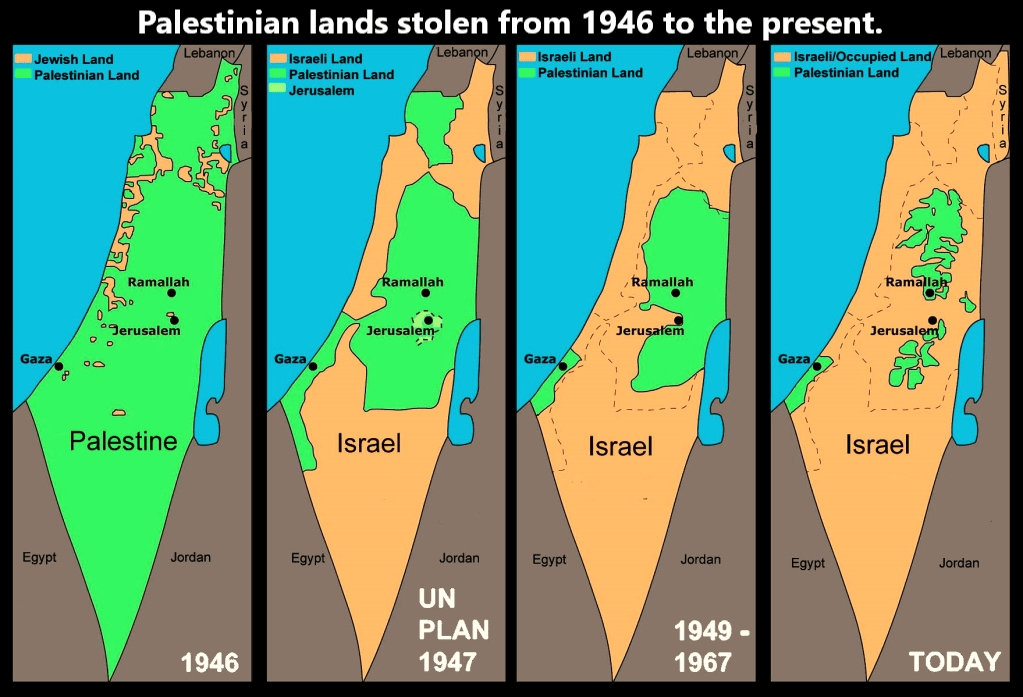
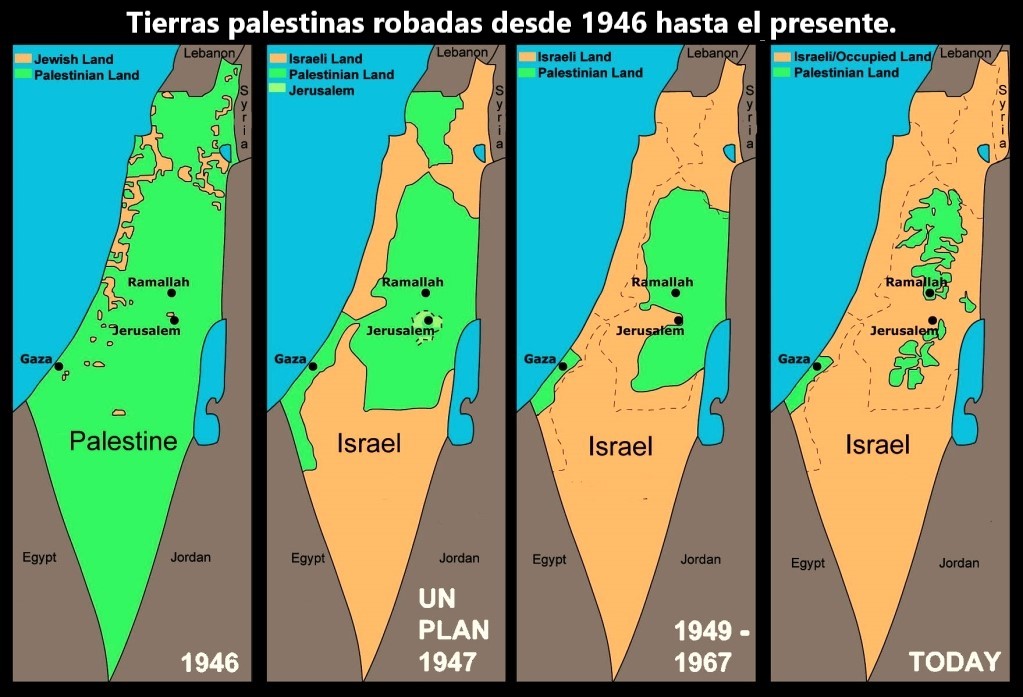
During the Nakba, a million Palestinians were forcibly displaced and dispossessed. The native people had their homes, property and land confiscate. About 600 villages were burned, destroyed or targeted with biological weapons to make way for the newly imposed Israeli state.
In addition, men, women, and children were beaten, murdered, and raped with impunity by cowardly Israeli armed thugs. The forced removal of Palestinians from their homeland by the combined endorsement of most imperialist powers is one of the greatest war crimes in history. The rulers of Great Britain, France and the United States were blatantly carrying out this plan out in the open for the world to witness.
The genocide committed by Israeli soldiers occurred while foreign imperialist powers manipulated a United Nations General Assembly vote on November 29, 1947, to approve the passing of Resolution 181. This document adopted the so-called Partition Plan of Palestine, which divided the territory into two states, one Jewish and one Arab. In other words, using the legitimacy of this international organization to carry out land theft.
As we know today, this partitioning was the initial step in a plan designed by Theodor Herzl, founder of modern-day Zionism. Herzl envisioned the gradual elimination of Arabs from land “promised to Jews by God.”
Although Herzl was not Jewish nor a religious leader, he was an admirer of rising imperialist powers in the second half of the 19th Century, when England, France, Belgium, Germany, Italy, Japan and the United States engaged in feverish competition to establish colonies throughout the globe.
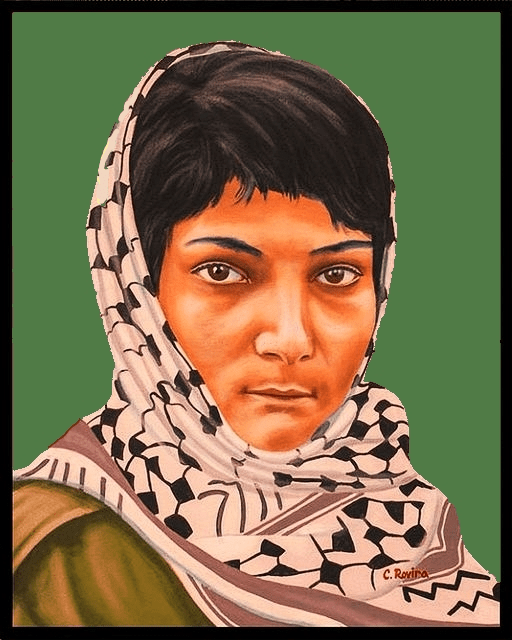
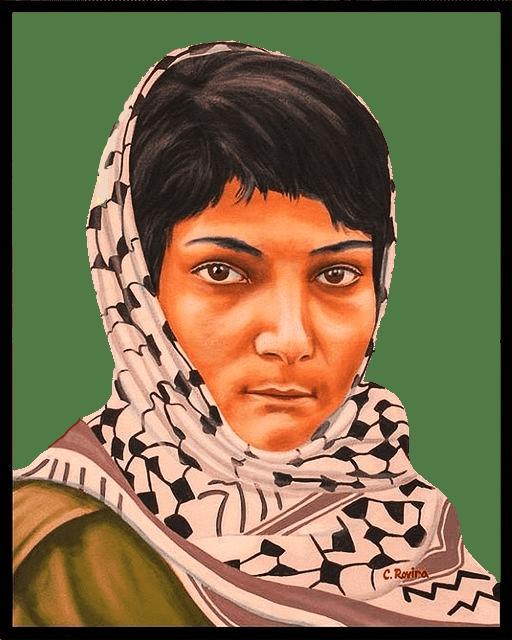
A portrait I made in 2021 of Leila Khaled. 24″ X 30″, acrylic paint on canvas.
However, British imperialism had colonized Palestinian lands since 1917. Throughout that time, British rulers courted Zionist leaders who lobbied the idea of creating a “Jewish state.” Numerous tyrannical figures supported this idea, including the notorious Adolf Hitler.
The campaign to create the “State of Israel” with the intention of eliminating the Palestinian population continued to gain momentum. In 1948, it was created at the expense of Palestinian suffering, needless to mention how it was done without their input or approval.
The same sadistic methods used to usher in the Israeli state during the Nakba continues to this day as seen in Gaza. The U.S. and its lacky states continue to supply the Zionist war criminals with weapons, logistical support, financial and political backing. Consequently, U.S. foreign policy is just as complicit as ever in the genocide and massive destruction of Gaza.
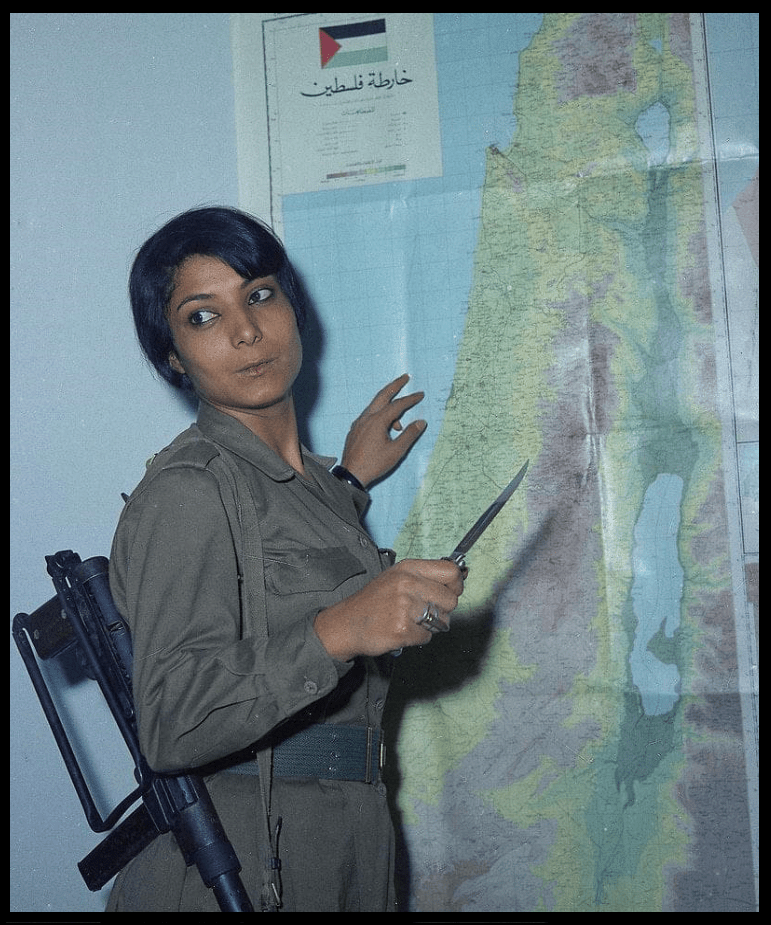
Leila Khaled in front of a huge map of Palestine.
Leila Khaled became widely known for her role in the August 29, 1969, hijacking of TWA Flight 840 traveling from Rome to Tel Aviv. The plane was diverted to Damascus, mistakenly thought that Israeli ambassador to the U.S., Yitzhak Rabin, was on board. With her weapon at hand, Leila Khaled ordered the pilot to fly over the city of Haifa. She wanted to see the town that was once her birthplace and home to her beloved family before it was forcefully taken by Israeli occupiers.
On September 6, 1970, Khaled attempted but failed to commandeer an El Al flight 219, traveling from Amsterdam to Tel Aviv then New York City. In order to thwart attempts by the guerillas entering the cockpit, the pilot made a sudden nosedive in the air which caused a device to explode. At that point Leila’s comrade Patrick Arguello, a Nicaraguan activist, was fatally shot by an air marshal on the plane. Laila Khaled was then arrested.
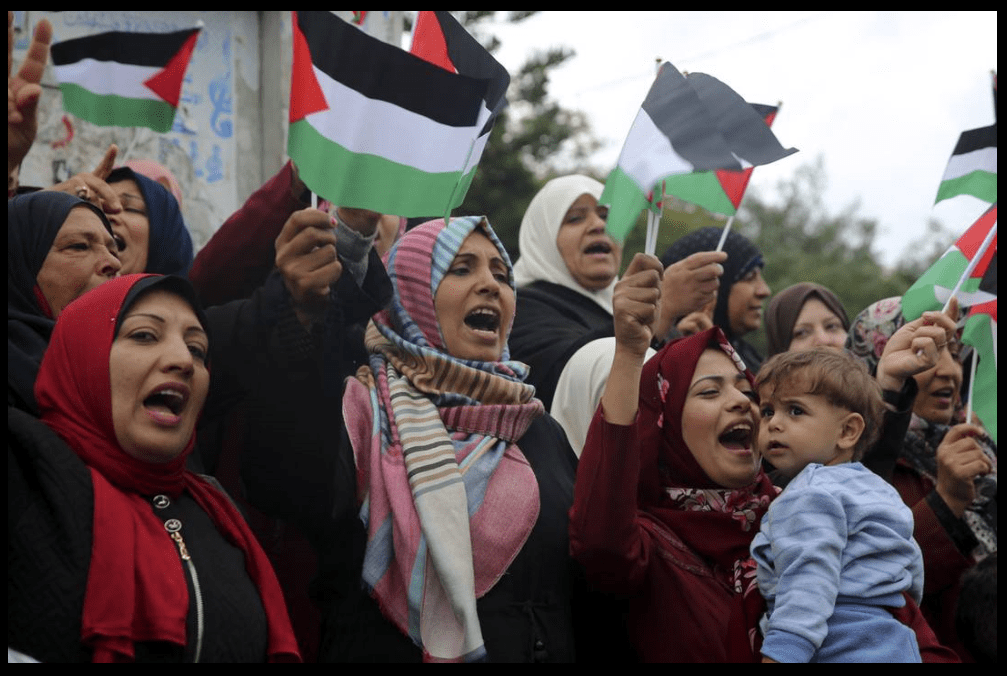
A show of Palestinian resilience and resistance.
After Khaled’s capture, she became the central focus of a crisis that began in September 1970 by PFLP’s seizure of five commercial airliners. Strenuous efforts were made by U.S. officials to have a prisoner swap. The concern was that American and British passengers were held in the multiple aircraft hijacking.
To demonstrate that they were serious and willing to die for their cause, as news media television cameras recorded, PFLP combatants blew up three of the five aircrafts on a Jordanian airstrip. 56 U.S., British and other European passengers held were used to bargain for the release of seven Palestinian prisoners including Khaled.
After being held prisoner by British authorities for three weeks and released in a prisoner swap, Leila Khaled moved on continuing to serve as a political representative for the Palestinian struggle, making speaking appearances throughout the world.
Today, Laila Khaled continues to do her part in the quest for a free Palestine.
It is so inspiring to know that no matter what the U.S.-backed Israeli state has done to the Palestinian people they continue to resist despite deplorable circumstances. Their strong resilience assures us that as the occupation of Palestine continues to exist, the need for strong activism and global resistance to oppression remains.
“Debemos luchar por una nación árabe, por la unidad, por la libertad, por el socialismo. Debemos derrotar al enemigo número uno, Estados Unidos, el proveedor de misiles Hawk de Israel, y debemos apoderarnos de nuestros propios recursos petroleros. Debemos aprender a emular a nuestros hermanos argelinos para poder liberar a Palestina”. -Leila Khaled
______________________________________________
Por Carlos “Carlito” Rovira
El 9 de abril de 1944, en el municipio palestino de Haifa, nació Leila Khaled. Ella es una figura simbólica que representa la lucha de liberación del heroico pueblo palestino, que lucha contra la cruel ocupación israelí respaldada por Estados Unidos.
La militancia de Leila Khaled se desarrolló debido a los horrores que ella y su familia experimentaron cuando era niña debido a los abusos israelíes. Estas aterradoras experiencias ocurrieron durante la Nakba (catástrofe en árabe) de 1947-1948, cuando todos los palestinos se vieron afectados por la flagrante criminalidad de los sionistas.
Con todo el sufrimiento y la muerte infligidos al pueblo palestino durante la infancia de Leila Khaled debería explicarse por qué creció desarrollando el deseo de ser parte de la resistencia armada. Finalmente, se unió al Frente Popular para la Liberación de Palestina (FPLP).
Leila Khaled con un compatriota mayor.
Históricamente, la mayoría de los movimientos de resistencia amplifican las habilidades de lucha de unos pocos luchadores varones seleccionados. Sin embargo, cuando mujeres como Leila demuestran la misma furia y convicción ardiente que sus camaradas masculinos, tiene un poderoso efecto psicológico en la oposición.
Los opresores de todo el mundo son conscientes de que su mayor vulnerabilidad es la unidad entre los oprimidos, especialmente si implica que ejerzan el derecho a utilizar cualquier medio de lucha por la liberación.
Familias palestinas siendo conducidas a campos de refugiados en su propio país durante la Nakba.
Durante la Nakba, un millón de palestinos fueron desplazados y desposeídos tras la confiscación de sus hogares, propiedades y tierras. Unas 600 aldeas fueron quemadas, destruidas o atacadas con armas biológicas para dar paso al Estado de Israel. Además, hombres, mujeres y niños fueron golpeados, asesinados y violados impunemente por cobardes matones armados israelíes.
La expulsión forzada de palestinos de su patria por la complicidad combinada de la mayoría de las potencias imperialistas es uno de los mayores crímenes de guerra de la historia. Los gobernantes de Gran Bretaña, Francia y Estados Unidos estaban ejecutando descaradamente este plan abiertamente para que el mundo fuera testigo.
El genocidio cometido por soldados israelíes fue avalado por potencias extranjeras que manipularon una votación de la Asamblea General de las Naciones Unidas el 29 de noviembre de 1947 para aprobar la Resolución 181. Este documento adoptó el llamado Plan de Partición de Palestina, que dividió el territorio en dos estados, uno judío y otro árabe. Es decir, utilizar la legitimidad de esta organización internacional para realizar robos de tierras.
Como sabemos hoy, esta partición fue el paso inicial de un plan diseñado por el fundador del sionismo moderno, Theodor Herzl, que había previsto la eliminación gradual de los árabes de la tierra “prometida a los judíos por Dios”.
Aunque Herzl no era judío ni un líder religioso, era un admirador de las potencias imperialistas en ascenso en la segunda mitad del siglo XIX, cuando Inglaterra, Francia, Bélgica, Alemania, Italia, Japón y Estados Unidos competían febrilmente por establecer colonias en todo el mundo.
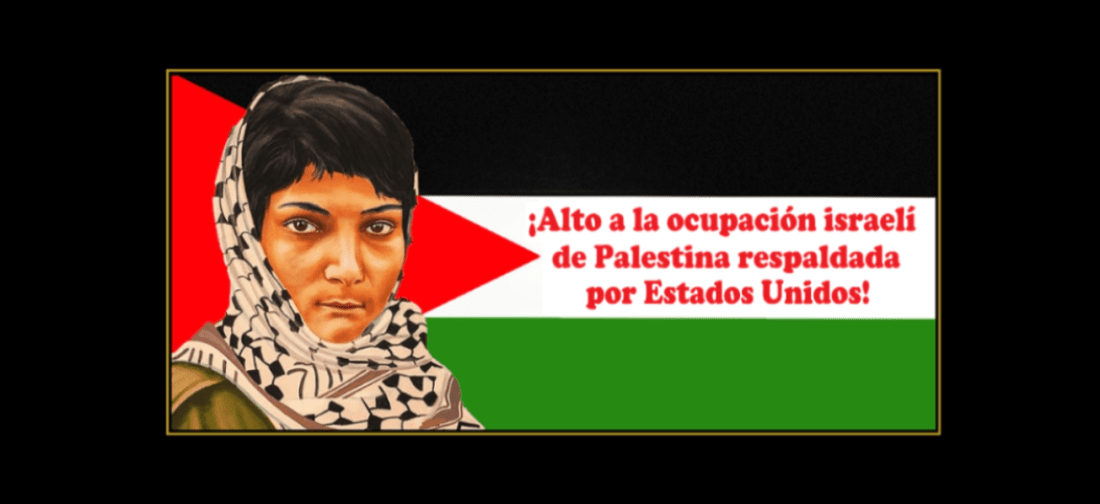
Un retrato que hice en 2021 de Leila Khaled. 24″ X 30″, pintura acrílica sobre lienzo.
Sin embargo, el imperialismo británico había colonizado tierras palestinas desde 1917. Durante todo ese tiempo, los gobernantes británicos cortejaron a los líderes sionistas que presionaron por la idea de crear un “Estado judío”. Numerosas figuras tiránicas apoyaron esta idea, incluido el notorio Adolf Hitler.
La campaña para crear el “Estado de Israel” con la intención de eliminar a la población palestina siguió cobrando impulso. En 1948, se creó el “Estado de Israel” a expensas del sufrimiento palestino sin su participación ni aprobación.
Los mismos métodos sádicos utilizados para inaugurar el Estado de Israel durante la Nakba continúan hasta el día de hoy con el suministro de armas, apoyo logístico y respaldo político y financiero de Estados Unidos. La política exterior de Estados Unidos es tan cómplice como siempre de la horrible destrucción masiva de propiedades y vidas humanas en Gaza.
Leila Khaled frente a un enorme mapa de Palestina.
Leila Khaled se hizo ampliamente conocida por su papel en el secuestro del vuelo 840 de TWA el 29 de agosto de 1969, que viajaba de Roma a Tel Aviv. El avión fue desviado a Damasco, creyendo erróneamente que a bordo se encontraba el embajador de Israel en Estados Unidos, Yitzhak Rabin. Con su arma en mano, Leila ordenó al piloto que sobrevolara la ciudad de Haifa. Quería ver la ciudad que alguna vez fue su lugar de nacimiento y el hogar de su amada familia antes de que los ocupantes israelíes la tomaran por la fuerza.
El 6 de septiembre de 1970, Khaled intentó, pero no logró, comandar un vuelo 219 de El Al, que viajaba de Ámsterdam a Tel Aviv y luego a la ciudad de Nueva York. Para frustrar los intentos de los guerrilleros de entrar en la cabina, el piloto realizó una repentina caída en picada en el aire que provocó la explosión de un dispositivo. En ese momento, el camarada de Laila, Patrick Argüello, un activista nicaragüense, fue asesinado a tiros por un oficial del aire en el avión. Luego arrestaron a Leila.
Una muestra de resiliencia y resistencia palestina.
Después de la captura de Khaled, ella se convirtió en el foco central de una crisis que comenzó en septiembre de 1970 con la incautación de cinco aviones comerciales por parte del FPLP. Los funcionarios estadounidenses hicieron denodados esfuerzos para lograr un intercambio de prisioneros. La preocupación era que los pasajeros estadounidenses y británicos fueran retenidos en el secuestro de múltiples aviones.
Para demostrar que eran serios y estaban dispuestos a morir por su causa, como grabaron las cámaras de televisión de los medios de comunicación, los combatientes del FPLP hicieron estallar tres de los cinco aviones en una pista de aterrizaje jordana. 56 pasajeros estadounidenses, británicos y otros europeos retenidos fueron utilizados para negociar la liberación de siete prisioneros palestinos, incluido Khaled.
Después de haber sido mantenida prisionera por las autoridades británicas durante tres semanas y liberada en un intercambio de prisioneros, Leila Khaled continuó sirviendo como representante política de la lucha palestina, dando conferencias en todo el mundo.
Hoy, Laila Khaled continúa haciendo su parte en la búsqueda de una Palestina libre.
Es muy inspirador saber que no importa lo que el Estado de Israel, respaldado por Estados Unidos, le haya hecho al pueblo palestino, éste continúa resistiendo a pesar de circunstancias deplorables. Su fuerte resiliencia nos asegura que mientras la ocupación de Palestina continúa existiendo, persiste la necesidad de un activismo fuerte y una resistencia global a la opresión.
“There is no need to fear, Puerto Ricans, the roar of the cannon; saving the nation is the duty of the heart. They will also know how to fight. We no longer want despots; tyranny shall fall now; the unconquerable women also will know how to fight. We want liberty, and our machetes will give it to us.” -Lola Rodríguez De Tió
_____________________________________________
By Carlos “Carlito” Rovira
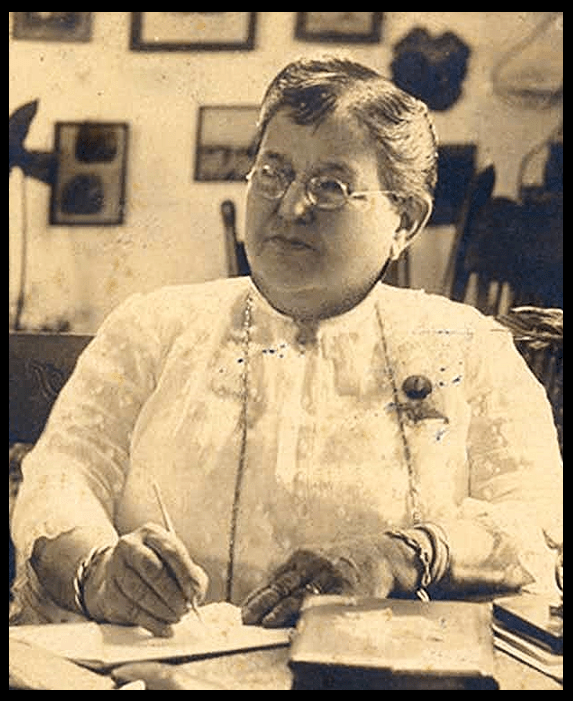
Lola Rodríguez De Tió was born in San German, Puerto Rico on September 14, 1843. She grew up to become the country’s first woman to establish herself as a renown literary scholar who was recognized throughout Latin America. De Tió’s work reflects her outspoken beliefs on critical issues during her young life, African chattel slavery and Spanish colonialism in Puerto Rico.
Lola Rodríguez De Tió was a feminist, a poet, a literary scholar and a devoted advocate for the independence of Cuba and Puerto Rico. As a free minded woman, she frequently expressed contempt for backward traditions rooted in Catholicism, specifically its views discouraging the advancements of women.
Most women in the Spanish colonies were illiterate, especially among the poor. Women were restricted from developing intellectually, due to taboos and the corrupt doctrine of the Roman Catholic Church. But despite oppressive social “norms” Lola Rodriguez rebelliously set out to become a female literary genius.
At just seventeen years of age, Lola Rodríguez was courageously exertive about her thoughts. She had the utmost disdain for anti-women cultural expectations on physical appearance. Although underage, Lola Rodriguez defiantly demanded to be allowed having short hair, which became her life-long personal trademark.
Lola Rodriguez De Tio
As she became an adult, De Tió wanted to use her talents as a writer and poet to voice her critical views on Spain’s repressive hold in its two remaining Western Hemispheric colonies – Cuba and Puerto Rico.
Her admiration for the Cuban struggle and the Haitian Revolution’s vision of uniting the Caribbean nations into one mighty force to repel the intentions of colonizing powers, may have been what inspired her to create the famous metaphor “Two Wings of the Same Bird.”
De Tió’s affiliation with Puerto Rico’s Revolutionary Committees made possible her close collaboration with Dr. Ramon Emeterio Betances, a central figure of Puerto Rico’s anti-colonial movement who was highly respected throughout the Caribbean. De Tió also played a significant role in the struggle which culminated on September 23, 1868, with El Grito De Lares, an uprising that called for an end to the enslavement of African people and Spanish colonialism.
Although De Tió became known for authoring many beautiful renditions, she is best remembered for writing the original and revolutionary lyrics of Puerto Rico’s National Anthem, La Borinqueña. De Tió composed the song in 1868 as the tremors of the Lares uprising approached. It was a moment in time when the general desire for nationhood was widely sensed as Boricuas eagerly prepared their weapons for battle.
One of the most outrageous acts of disrespect by U.S. colonizers was imposing a distorted version of the Puerto Rican National Anthem. Adding insult to injury, that distorted version was also named “La Borinqueña.” The original militant lyrics were replaced by a sanitized, non-revolutionary composition. Today, it is used by the U.S.-puppet colonial government as the “official” version. Ramon Collado is the composer who shamefully betrayed his people by re-writing the lyrics in 1952 on behalf of U.S. colonialism.
After the failure at Lares in 1868, De Tió lived for a while in Havana, Cuba. But in 1891 she was deported by Spanish authorities for her activism and outspokenness. She moved to New York City where she joined Cuban and Puerto Rican revolutionaries living in exile.
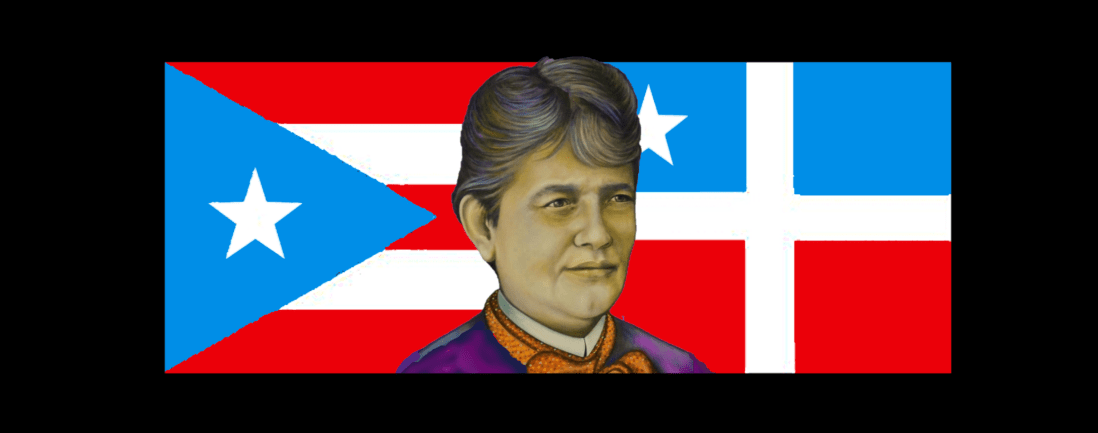
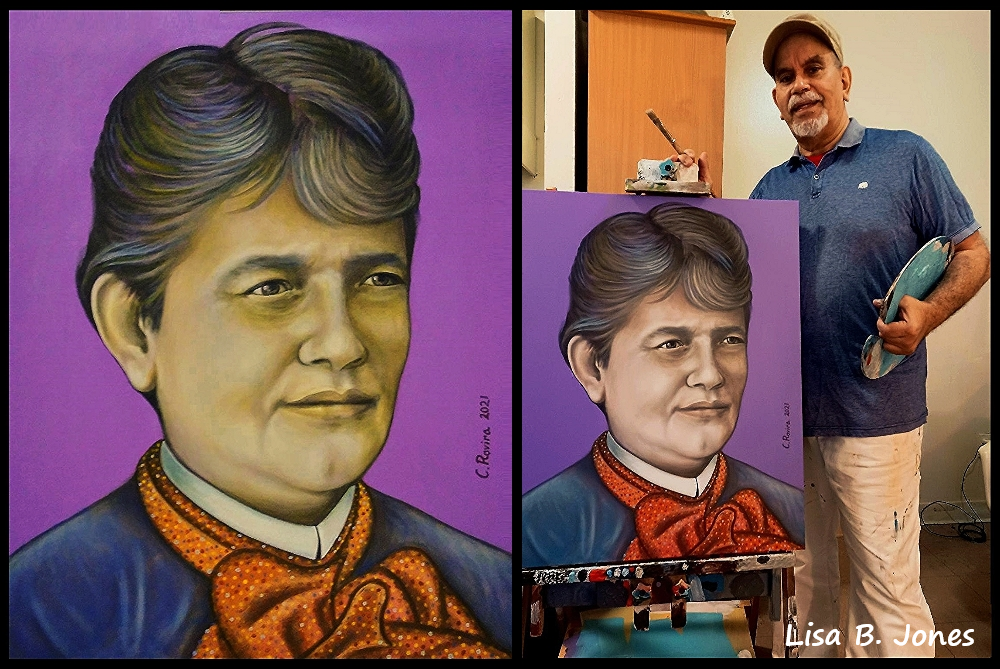
My artist tribute to Lola Rodriguez De Tio. 24″ X 30″, acrylic paint on canvas.
Gatherings of exiled revolutionaries from both countries was a customary practice dating back to the mid 1850s. They congregated mainly in the area known today as El Barrio (East Harlem) to escape the brutal enforcement of Spain’s decrees.
The more pro-active individuals from this community secretly met at a hotel on Broome Street in the Lower East Side where they formed the Society for the Independence of Cuba & Puerto Rico. Many returned to their respective homelands to serve as combatants in Cuba’s Grito De Yara and Puerto Rico’s Grito De Lares.
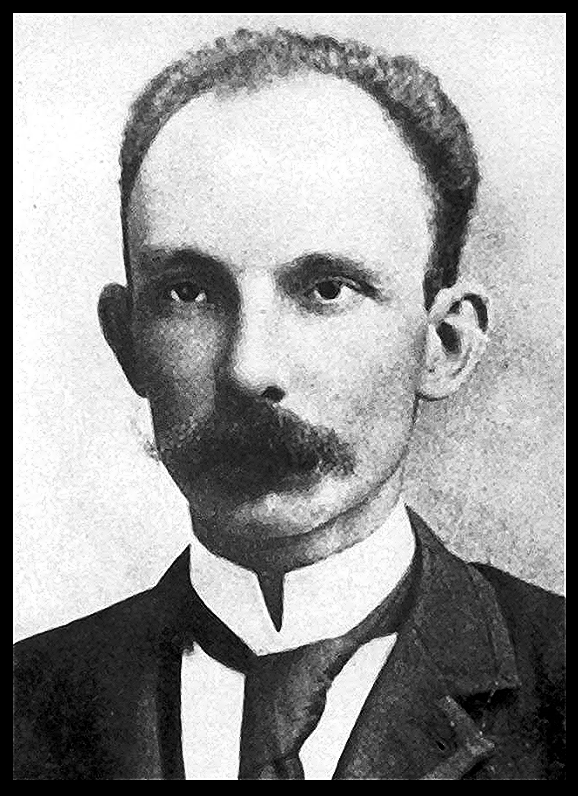
It was in New York City in 1891, where Lola Rodriguez De Tio and Cuban revolutionary leader Jose Marti met for the first time. What followed was a strong bond of mutual respect for one another and political collaboration.
Cuba’s iconic revolutionary leader, Jose Marti.
Many believe that credit for the original idea of inverting the colors of the Cuban flag to create the modern-day Puerto Rican flag was shared coincidentally by revolutionary poets Francisco Gonzalo Marín and Lola Rodríguez De Tió. Both of these prominent figures adamantly promoted the importance of building on Cuban and Puerto Rican solidarity, especially by revolutionaries living together in exile.
It was in that setting where the proposed design of the present-day Puerto Rican flag was discussed and approved on December 22, 1895, in a secret meeting held at Chimney Corner Hall. At the helm of this historic effort were the prominent Manuel Besosa, Antonio Velez Alvarado and Juan de Mata Terreforte. Among the 59 attendees included the archivist of Black history, Arturo Alfonso Schomburg.
De Tió worked hard with the Cuban and Puerto Rican exiles in efforts to raise funds for an upcoming revolutionary war in Cuba. When the military struggle against Spanish colonialism sparked in Cuba Jose Marti and many of his compatriots returned to fight. Unfortunately, on May 19, 1895, the beloved revolutionary leader, was killed in battle.
After the Spanish-American War, in 1899, Lola Rodríguez and her family returned to Cuba where she lived for the rest of her life, although continuing to visit Puerto Rico. She continued to work in her profession at the Cuban Academy of Arts and Letters. She also continued advocating for Puerto Rico’s independence and equal rights for women in Cuba through her articles published in various newspapers and journals throughout Latin America.
On November 10, 1924, the belove Puerto Rican poet died. Lola Rodríguez De Tió’s remains are buried at the Colon Cemetery in Havana, Cuba. Her legacy symbolizes the centuries-long traditions of the Two Wings of the Same Bird – Cuba & Puerto Rico. Lola Rodriguez De Tio impacted later generations of Puerto Rican women, specifically those of the Nationalist Party and beyond.
Lola Rodriguez De Tio’s tomb at the Colon Cemetery in Havana, Cuba.
Long live the legacy of Lola Rodríguez De Tió! ¡QUE VIVA PUERTO RICO LIBRE!




















 carlitoboricua