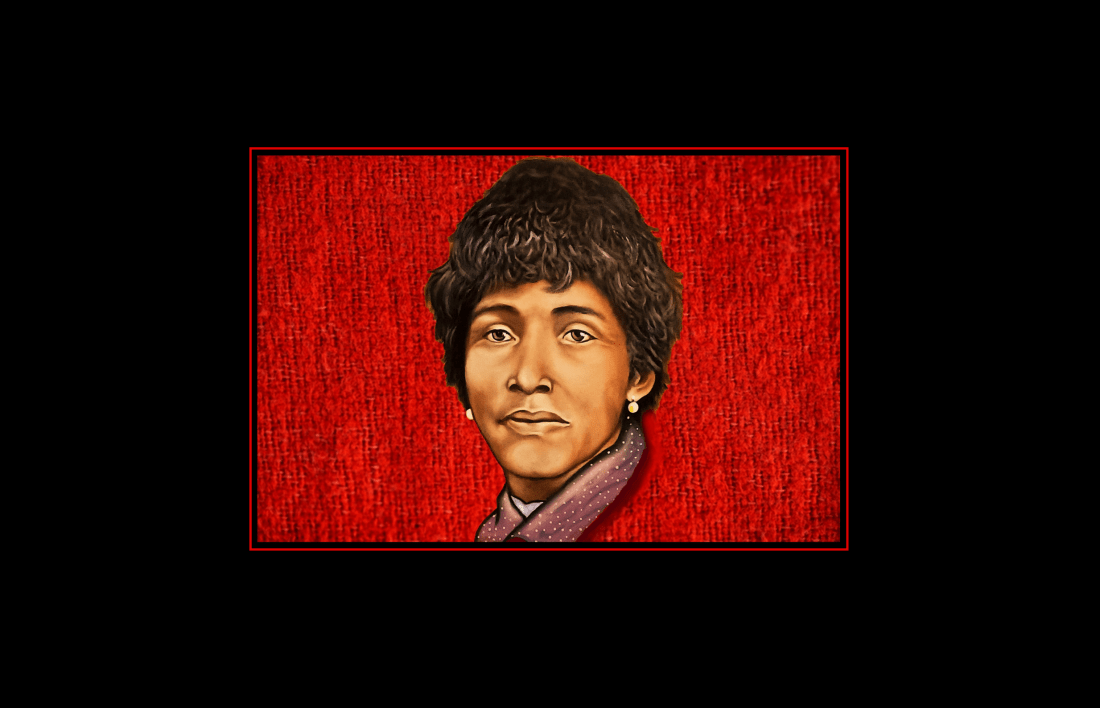
Tribute to Lucy Gonzalez Parsons 1851 – 1942

_________________________________________________________________________

“Now, what do we mean when we say revolutionary Socialist? We mean that the land shall belong to the landless, the tools to the toiler, and the products to the producers.” ― Lucy Parsons

_________________________________________________________________________

By Carlos “Carlito” Rovira

The struggles of the U.S. working-class have produced some of the most exemplary militant fighters which will continue inspiring millions of people for generation to come. Among these powerful historic figures is Lucy Gonzalez Parsons.

Although Parsons never made mention about it throughout her life researchers disclosed in recent decades that she was born enslaved at a plantation in Virginia. In 1863, her slaveowner brought 12-year-old Lucy to Texas along with her mother named Charlotte.

In the years following the end of the Civil War in the United States of 1860-1865, in which ended African chattel slavery was ended, Parsons became a journalist, labor organizer, revolutionary feminist, and an anarcho-communist.
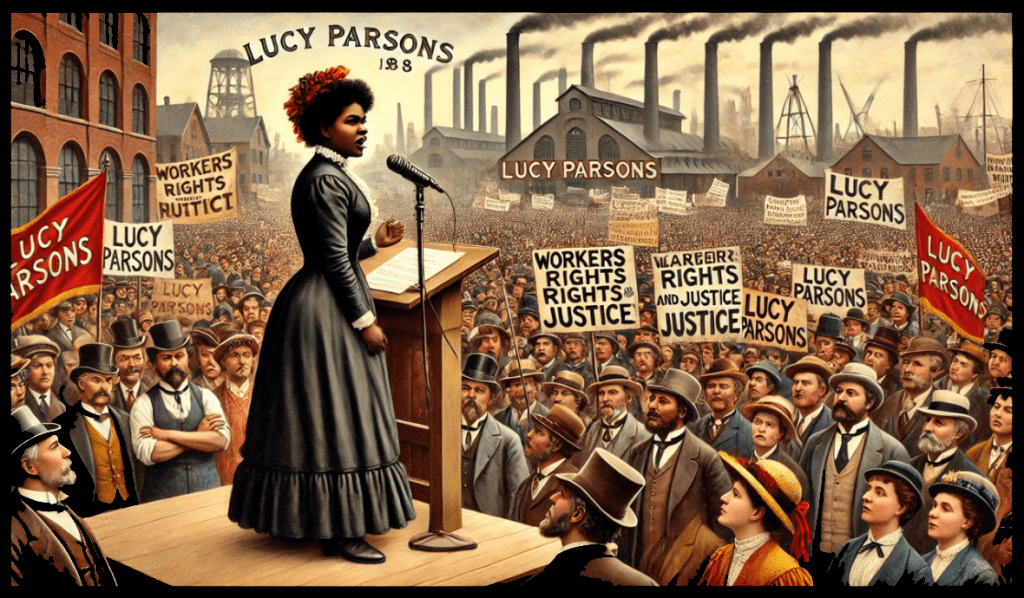
Artist depiction of Lucy Parsons speaking at a labor rally.

She fought vigorously to bring about the eight-hour day, women’s rights, against child-labor and socialism. Despite hardships caused by tragic events in her personal life Lucy Parsons became a true working class shero with a deep disdain for the capitalist system.

Lucy Parsons lived in Texas with her husband Albert Parsons and their two children. They were despised for being an interracial couple. Albert Parson was white and Lucy an obvious woman of color, with African American, Mexican, and Indigenous racial strains.

As Jim Crow laws intensified and due to her outspokenness, the Ku Klux Klan threaten their lives quite often. Eventually, the family was compelled to move to Chicago where they found relative safety from racist terror.
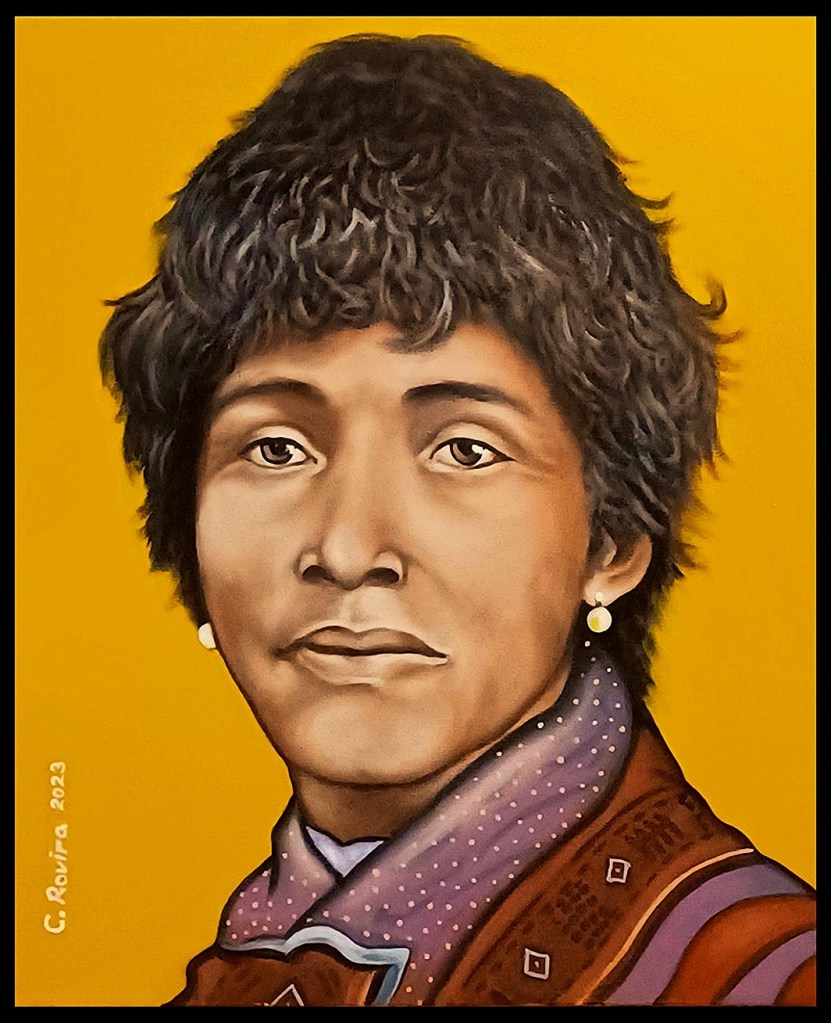
My portrait of Lucy Parsons. 20″ X 24″, acrylic paint on canvas.

At the first May Day rally in Chicago’s Haymarket Square, on May 4, 1886, during a labor demonstration for the eight-hour workday that was attended by thousands of people, a bomb was thrown. The explosion and subsequent gunfire killed seven police officers and four civilians.

This tragic event became a perfect excuse for the government to make a punishing example by launching a crackdown on the labor movement. What resulted was a controversial trial with questionable evidence. Following a guilty verdict, on November 11, 1887, four labor leaders were executed by hanging at Chicago’s Cook County jail. Lucy Parson’s husband, Albert Parsons, was among the four men accused and executed, alongside his comrades August Spies, Adolph Fischer, and George Engel.

For Lucy Parsons to Lose her beloved to a horrifying government persecution served to further radicalize her. She became more outspoken in condemning the capitalist system. Parsons led a national campaign involving speaking tours to raise funds for legal defense and to expose the injustice committed against the Haymarket martyrs, especially in the New York City tri-state area which became a hub for the labor movement. Parsons’ efforts succeeded in reaching the hearts and minds of millions throughout the country.

As Parsons rose to become a prominent voice, she bonded with another renown female working-class figure, Mary Harris, better known as Mother Jones. Parsons and Jones were the only women to speak at the July 8, 1905, founding convention of the International Workers of the World (IWW) also known as the “Wobblies.” Their quest was to build one big labor union of all trades.

The IWW was one of the most militant workers organizations in U.S. labor history, where Parsons and Jones played leading roles. In many cases, striking Wobbly members would conduct their pickets and other actions by boldly displaying their firearms for self-defense and to convince others of their allegiance to convictions.
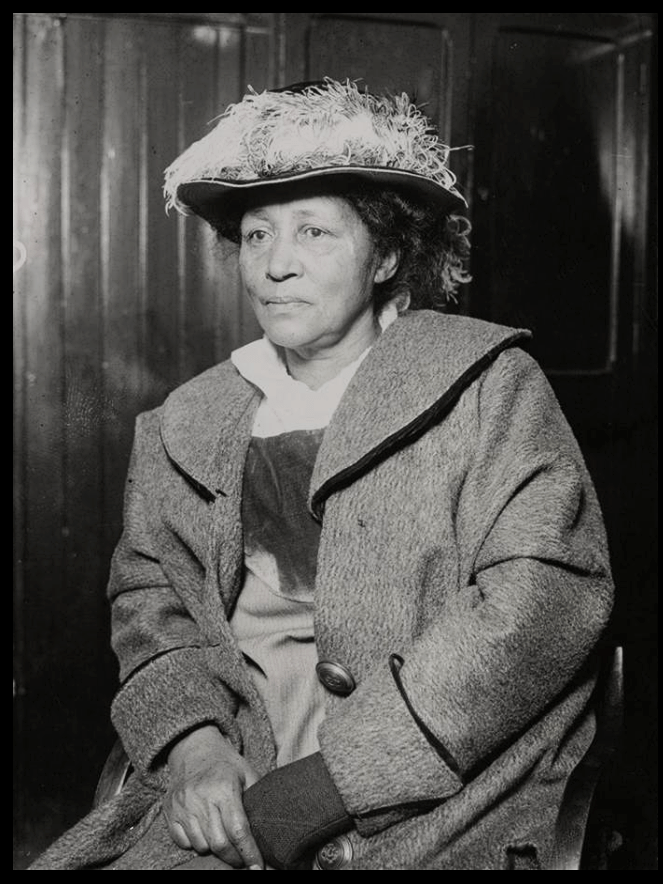
Lucy Parsons

As years passed, Lucy Parson’s perspective of the world and class struggle expanded. The 1917 Russian Socialist Revolution had a tremendous impact on her. She was a writer for the Anarchist newspaper The Alarm, where she expressed many controversial views, including support for Vladamir Lenin and the Bolshevik victory that established a revolutionary worker’s state.

Such was the bases for differences she held with Emma Goldman and others in the U.S. feminist movement. Parsons polemicized with those who tended to raise women’s rights isolated from other social issues, the plight of Black people and fighting for a socialist world. She believed that fighting women’s oppression was an integral part of engaging in the class struggle.

During the Great Depression of the 1930s, Lucy Parson became highly critical of the Communist Party USA for excessively supporting President Franklyn D. Roosevelt’s New Deal policy. Parsons believed that it was a government ploy designed to deceive the working-class and prevent its revolutionary politicization.

However, although Parsons identified primarily as an anarchist for much of her life, and despite her critiques, she officially joined the Communist Party USA in 1939. She came to the conclusion that what was more important than sectarian organizational affiliations is to fully commit to advance the cause for the emancipation of the working-class.
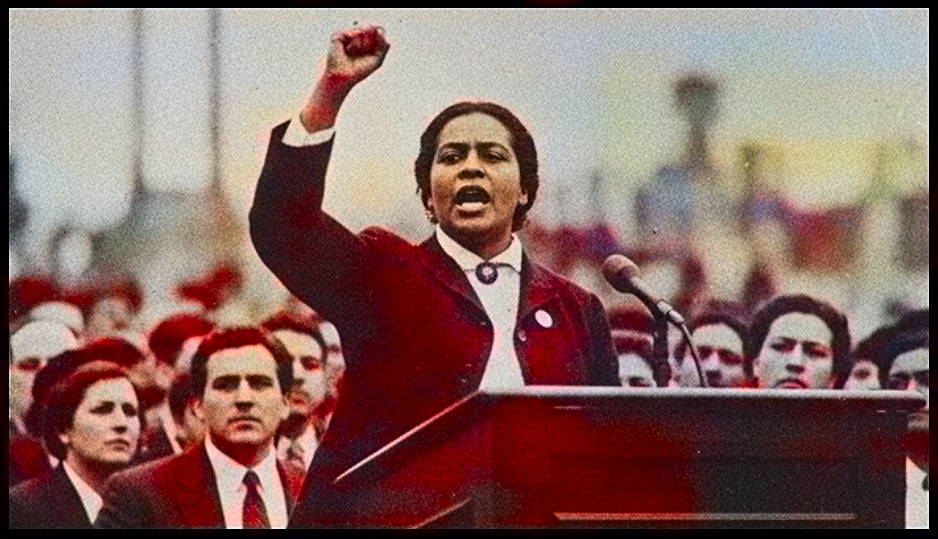
For the remainder of her life Lucy Parsons travelled across the country agitating for the freedom of the Scottsboro Boys, partaking in picket lines of numerous striking workers and speaking to audiences at union halls to promote the ideas of socialism.

Lucy Parsons became known for her defiance. She was not afraid of imprisonment nor death. This heroine would challenge law enforcement officials whenever they attempted to shutdown public meetings. The Chicago Police Department and the Justice Department’s J. Edgar Hoover, perceived Lucy Parsons as an active threat to the established social and economic order. Chicago Police Chief Frederick Ebersold famously characterized Lucy Parsons more dangerous than a thousand rioters, referring to her advocacy for socialist revolution.

Tragically, Lucy Gonzalez Parsons died on March 7, 1942, in an accidental house fire in Chicago. She is buried in the Forest Home Cemetery in Forest Park, Illinois. Parson’s life-long examples of resilience and conviction will be remembered. She has earned a special place of honor for all eternity in the historic archives of the class struggle.
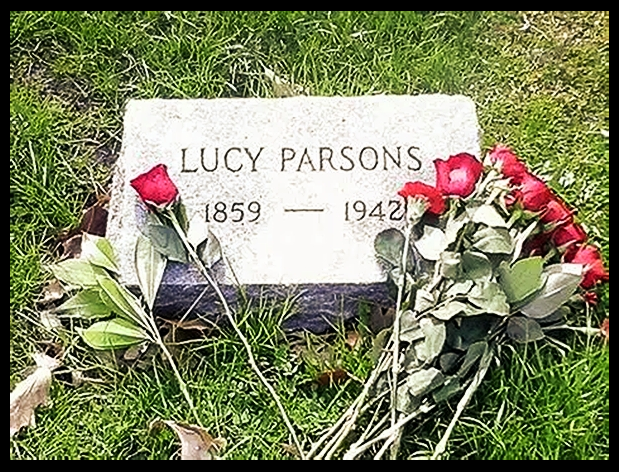
LONG LIVE THE LEGACY OF LUCY PARSONS!
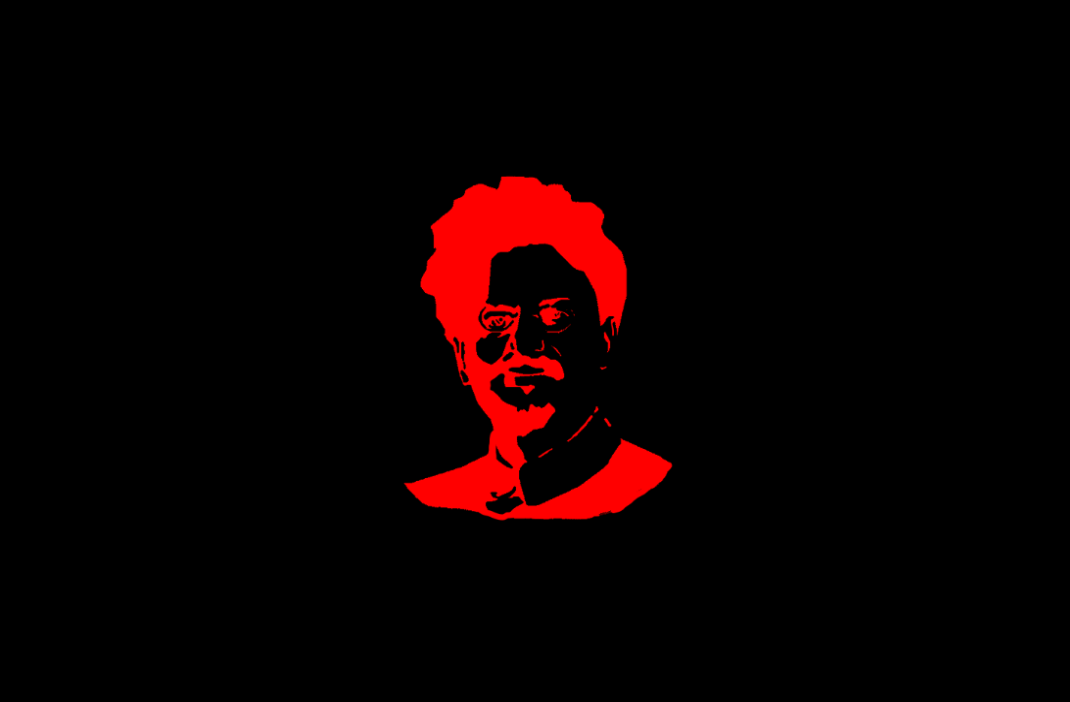
Tribute to LEON TROTSKY Centurion of the October 1917 Russian Socialist Revolution

Para la versión en español: https://carlitoboricua.blog/2024/10/23/homenaje-a-leon-trotsky-centurion-de-la-revolucion-socialista-rusa-de-1917/

____________________________________________

“The United States is not only the strongest, but also the most terrified country.” ― Leon Trotsky

____________________________________________

By Carlos “Carlito” Rovira

Leon Trotsky was born as Lev Davidovich Bronstein to a wealthy Ukrainian Jewish family on November 7, 1879, in Yanovka, Ukraine during the Russian Empire. However, after becoming drawn to Marxism as a teenager, he purposely repudiated his social class privilege and rejected the Jewish identity as an unapologetic atheist. Trotsky grew to become a prominent figure in one of the most momentous events of the Twentieth Century, the 1917 Russian Socialist Revolution.

In February 1917, Czar Nicholas II was forced to abdicate his throne due to extreme political unrest in Russia. Trotsky returned to Russia with thousands of his followers eager to join the Bolsheviks. The country was undergoing a promising revolutionary crisis.

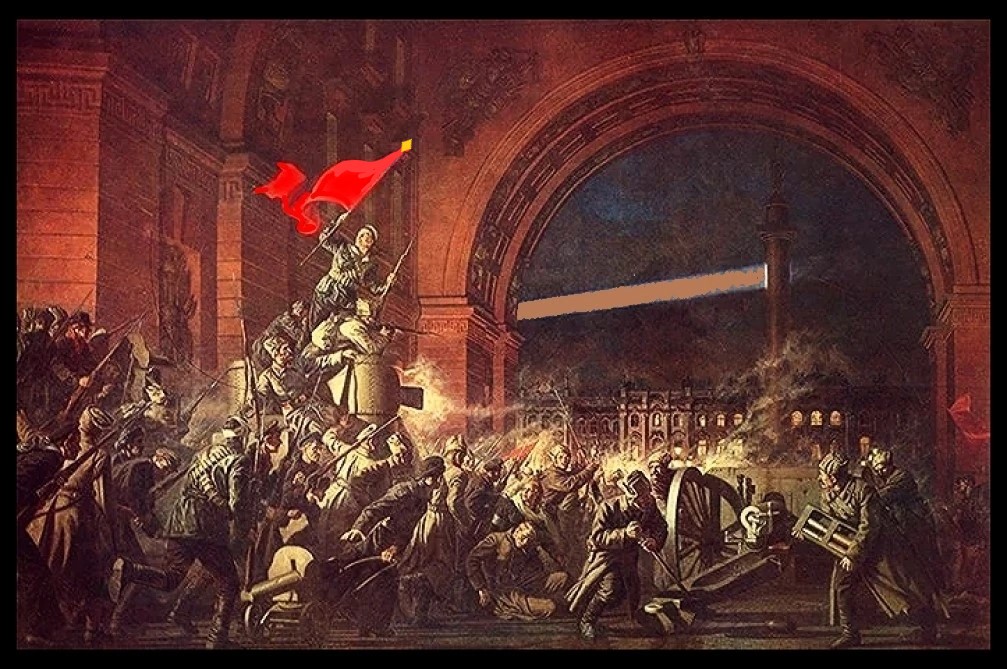
As chairman of the Petrograd Soviet, Trotsky played a key role in the storming of the Winter Palace in which the Kerensky Government was overthrown. Trotsky had then become one of Vladimir Lenin‘s most trusted comrades.

Artist depiction of Bolshevik insurgents storming the Winter Palace in Saint Petersburg, October 1917.

Between 1918 to 1925, Trotsky served as Commissar for Military and Naval Affairs, the equivalent title of a defense minister. He was also founder of the Soviet Red Army.

Under Trotsky’s leadership, the Red Army defeated attempts by counterrevolutionaries to restore the old semi-Feudal capitalist order. He also played a decisive role expelling from 5,600 miles of Russian territory, 14 invading imperialist armies. This included invading military forces from the United States.

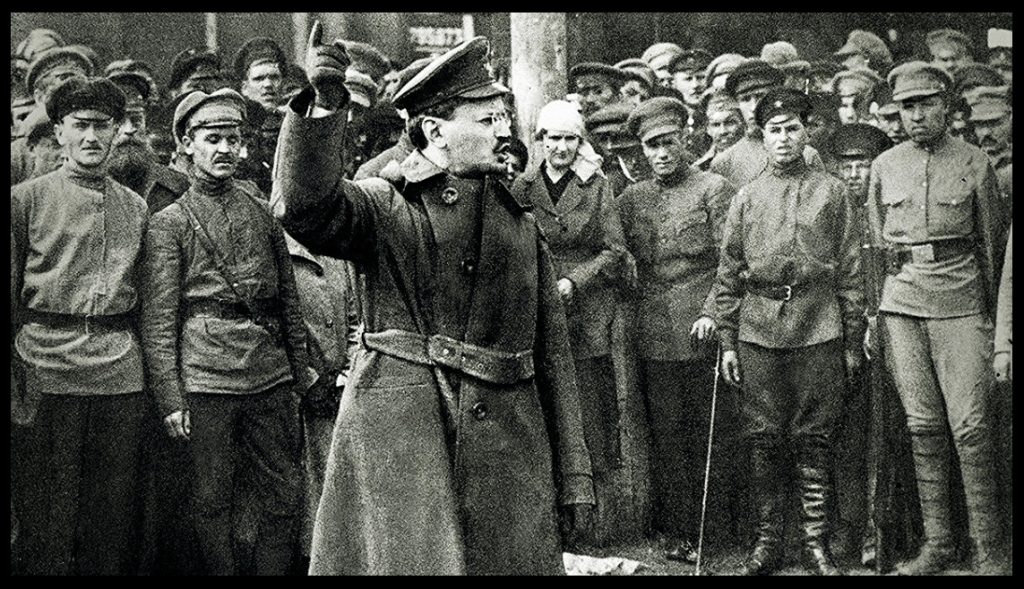
Trotsky speaking to Red Army troops before a battle.
The Red Army in pursuit of counterrevolutionary forces during the Civil War in Russia.

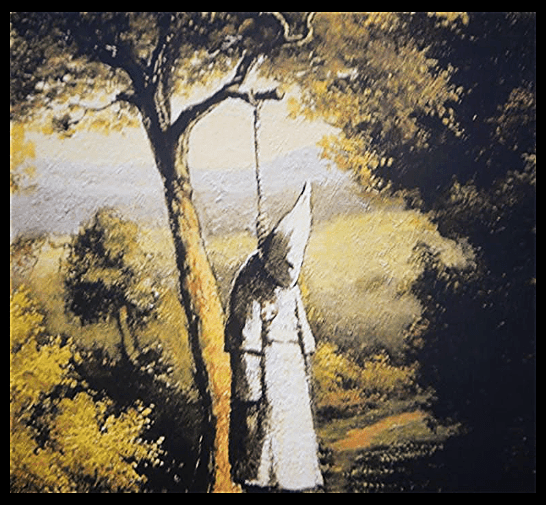
Being well-versed in the politics of the United States, Trotsky was quite outspoken against the racist policies of its government officials – especially on the subject of the Klu Klux Klan (KKK), the historic expression of white supremacy which originated from among defeated Confederate Army officers and soldiers after the U.S. Civil War.

Trotsky’s outspoken and unforgiving stance with white supremacy came at the height of lynching of Black people in the U.S. southern states. He adamantly encouraged U.S. Communists to inflict the same terror on the KKK. Trosky stated: “Let us raise the slogan so that these capitalists will hear it plainly: LYNCH THE LYNCHERS OF THE NEGROES AND THE POOR TOILERS!”

Banksy’s Hanging Klansman. A vision Leon Trotsky likely had when speaking about the KKK.

Trotsky had profound respect for the spiritual power of culture. His Collected Writings on Literature & Art, expressed the importance he gave to this subject for winning over the hearts and minds of millions of working-class people.

Unlike Joseph Stalin’s official restrictions on artistic license, Trosky was enthusiastically in favor of artistic freedom development in all forms. This view was also expressed at a public meeting on May 2, 1956, by China’s Mao Zedong: “Let a hundred flowers bloom; let a hundred schools of thought contend.

Leon Trotsky standing by the Kremlin.

Trotsky’s views on culture and art reflected his general disposition on the power of worker’s rights and power which aimed to encourage dialog and debate. Trotsky wanted to use culture as a tool for strengthening the intellectual potential of all citizens- especially the farmers and working class in a county where illiteracy was widespread.

Moreover, Trotsky envisioned creating a system of checks and balances where the average worker had a voice in the workplace and government. Elected “Commissars” as defined by the principles of Workers & Soldiers Soviets, would have subjected government and military officials to immediate recall if necessary.

Leon Trotsky with fellow combatants of the Red Army.

Trotsky’s logic was to compel officials to practice good leadership by earning the respect and loyalty of their subordinates. However, the role of Commissars fluctuated as the ferment of the revolution gradually waned. Ultimately, these elected posts were eliminated by decree, becoming a key area of contention between Stalin and Trotsky.

THE STALIN – TROTSKY SPLIT

As the Soviet Union moved forward to consolidate its political power, especially after the death of Vladamir Lenin on January 21, 1924, contradictions sharpened between two opposing currents within the Communist Party of the Soviet Union (CPSU).

The differences became crystalized and were spearheaded by Joseph Stalin on the one hand and Leon Trotsky on the other. Stalin represented a fierce movement to concentrate power in the government bureaucracy, whereas Trotsky advocated for empowering the Soviets (committees) of workers.

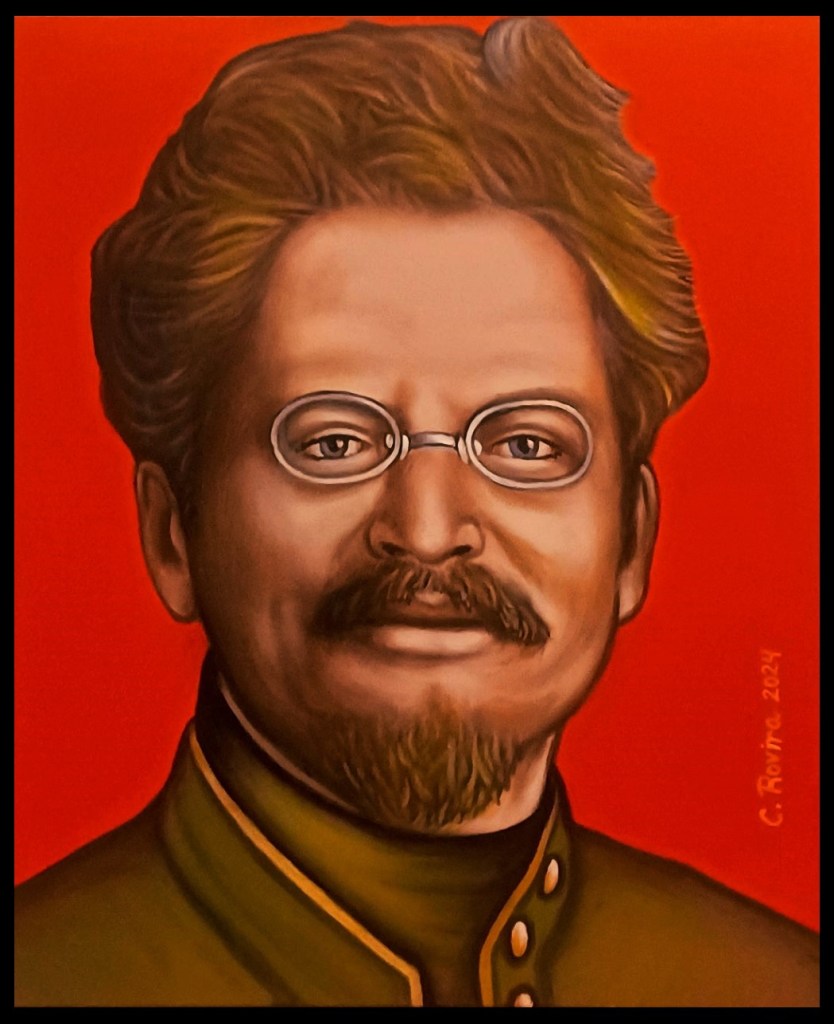
My portrait of Leon Trotsky. 20″ X 24″, acrylic paint on canvas.

As Lenin’s health began to rapidly decline due to a debilitating stroke, he dictated a letter to his trusted aide stating his last wishes that Joseph Stalin not become his successor as leader of the Soviet Union. This historical document became known as Lenin’s Last Testament. However, Stalin manipulated everyone opposed to him by appointing his close allies to key government positions to thwart objections. This event outraged many Bolsheviks who expected Trotsky to be next in line as head of state.

In the years after Lenin died, the majority of the CPSU’s rank and file was gradually steered to partake in a deliberate campaign against Trotsky. He was horribly vilified and removed from his duties as Commissar of the Military, the Politburo, as well as purged from the Communist Party altogether. Eventually, Trotsky was exiled out of the Soviet Union.

As always, dynamics exist everywhere in nature and politics. Tragically, the differences within CPSU were unable to be resolved, resulting in increased antagonism which led to the assassination of Trotsky in Mexico on August 21, 1940, by a NKVD secret agent Jaime Ramón del Rio. In addition, Trotsky’s loyal followers were suffering persecution inside the still developing USSR.

Until the last moments of his life, Trotsky maintained a revolutionary posture by urging his followers to continue defending the Soviet Union. Although Trotsky was scornfully opposed to Stalinism, he understood that it was a phenomenon that did not originate from the capitalist camp but from socialism.

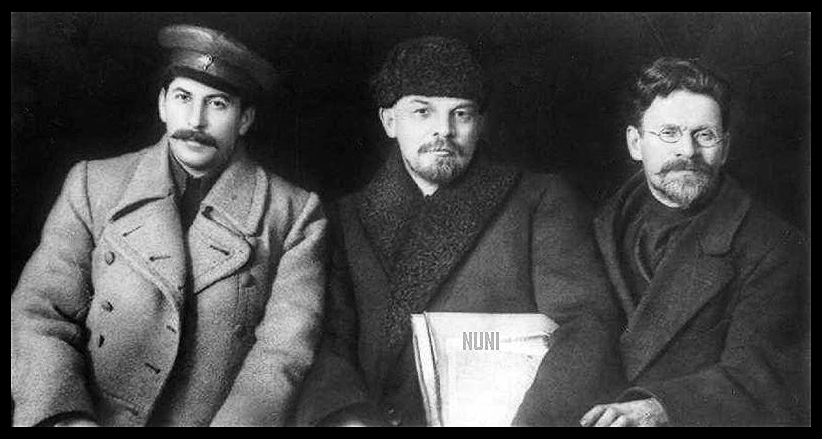
From left to right: Joseph Stalin, Vladamir Lenin, and Leon Trotsky before their political fallout.

Internal turmoil is often the initial spark that ignites the implosion of any revolutionary movement. One can easily point to a similar historical occurrence, when in June 1971 internal conflicts caused the disastrous demise of the Black Panther Party (BPP).

The scenario of domestic dispute and violence applies in both absurd situations. Brothers & sisters turned against brothers & sisters to the highest level of hostilities.

It is impossible to overlook how the BPP split was a set-back for the U.S. movement. And it doesn’t take much to conclude how the BPP split was largely orchestrated by the FBI’s COINTELPRO. Conversely, we cannot dismiss the possible role by foreign intelligence in the Stalin-Trotsky conflict.

However, Leon Trotsky repeatedly warned the international revolutionary movement about the detriments of Stalinism, most notably his predictions of the USSR’s shift to the right and its eventual collapse, which occurred in 1991. Trotsky’s detailed critiques of Stalinism were outlined in his classic polemic titled A Revolution Betrayed.

The collapse of the Soviet Union provided the international gang of capitalist tyrants and exploiters an opportunity to advance their anti-Communist smears. It also caused many difficulties for revolutionaries throughout the world, as well as republics resisting imperialism like Cuba.

There are many lessons to be drawn by future generations of the 1917 Russian Revolution. Specifically, Leon Trotsky’s contributions to the establishment of the very first socialist state, and his comradeship with Vladamir Lenin.

Vladamir Lenin and Leon Trotsky together after the Bolshevic seizer of power.

It will require serious inquiry about this history to counter the baseless anti-Communist slanders directed against the legacy of Leon Trotsky, which originated from Stalinism.

Hopefully, the next major Socialist revolution, wherever it may be, shall avoid a repeat of past mistakes and correctly grapple with socialism’s inherited contradictions. That will surely guarantee a decisive victory for the emancipation of oppressed and exploited people.

LONG LIVE THE REVOLUTIONARY LEGACY OF LEON TROTSKY!