Para la versión en español: https://carlitoboricua.blog/?p=6986&preview=true&_thumbnail_id=6990
By Carlos “Carlito” Rovira
On December 22, 1895, Puerto Ricans affiliated with the Cuban Revolutionary Party, approved a proposed design of the Puerto Rican Flag at a secret meeting held at the Chimney Corner Hall in New York City. At the helm of this effort were the prominent Manuel Besosa, Antonio Velez Alvarado and Juan de Mata Terreforte, an exiled veteran of the 1868 Grito De Lares uprising. Among the other 59 attendees was also the renown literary and archivist of Black history Arturo Alfonso Schomburg.

From the early 1800’s, New York City served as a safe haven for both Cuban and Puerto Rican revolutionaries seeking refuge from Spain’s repressive agencies. Cuba and Puerto Rico were Spain’s remaining colonies, after a series of successful revolutions in Latin America. Madrid wanted to preserve its colonizer status for as long as possible. Its no wonder why New York became the birthplace for both the Cuban and Puerto Rican flags.
The Puerto Rican patriots chose to invert the colors of the Cuban Flag, following the traditions of the “Two Wings of the Same Bird” – which originated from a poetic metaphor written by the legendary female literary Lola Rodriguez De Tio. This metaphorical expression was later used in musical rendition by Cuban revolutionary leader, Jose Marti. Freedom fighters from both countries collaborated for centuries in a mutual struggle against Spanish tyranny.
It is believed by many that the idea of inverting the colors of the Cuban flag originated from Lola Rodriguez De Tio. And understandably so, Lola collaborated closely with Cuban revolutionaries in exile when she lived in New York City.

To Puerto Ricans, like all oppressed people striving to build nationhood, the flag represents many things. It is the one representation that compels us to express our aspirations and deepest sentiments connected to history, culture and heritage.
Twenty-seven years prior of the Chimney Corner Hall meeting, the legendary Dr. Ramon Emeterio Betances and other revolutionary leaders of the 1868 El Grito De Lares uprising saw the necessity of creating such a symbol for the newly established nation in struggle. The leadership of that movement understood quite well the role spirituality plays in a fierce battle for liberation.
In collaboration with Betances, Mariana Bracetti Cuevas, who was also a professional stitcher, created the first Puerto Rican flag. She put together a banner comprising of two red and two turquoise blue boxes, divided by a white cross (similar to the Dominican flag) with a white star on the upper left. The design was partly a tribute to the Dominican people for allowing Boricua revolutionaries to have a base of operations in their country, and because Betances’ father was also Dominican.

In the years following the courageous attempt by Lares insurrectionists, the independence movement continued to exist clandestinely, due to unfavorable circumstances. The Lares martyrs and their supporters were systematically imprisoned, tortured and brutally killed by the Spanish authorities. Puerto Rico was under the most repressive situation, compelling the movement to retreat.
Many who survived the onslaught fled to New York while others went to Cuba joining their comrades fighting to liberate their homeland. Among these brave Puerto Rican patriots was Juan Ruiz Rivera, who would earn the rank of general in the Cuban Liberation Army.
Despite the difficult conditions, the anti-colonial movement in Puerto Rico gradually regained momentum. Moreover, it was these harsh circumstances that motivated the meeting at Chimney Corner Hall and the creation of the current Puerto Rican flag.
On March 24, 1897, the present-day flag of Puerto Rico was flown for the first time at the municipality of Yauco, in an uprising known as “Intentona de Yauco” (Attempt of Yauco). It was the last act of resistance against Spanish colonialism.

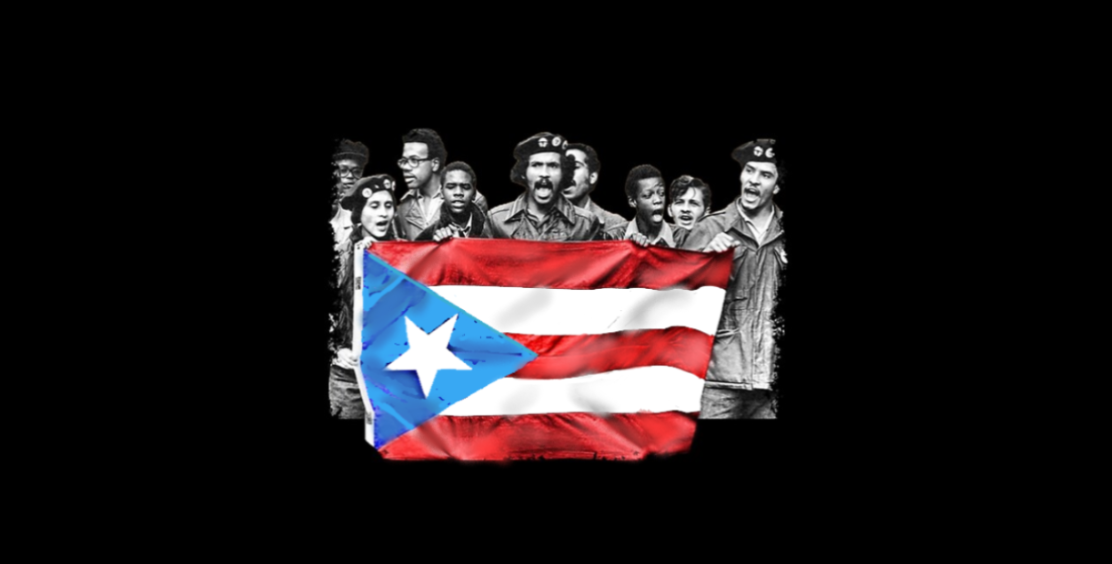
Since the Intentona de Yauco, the Puerto Rican Flag has served to inspire the anti-colonial movement in Puerto Rico as well as in the diaspora. It has been tradition for the flag to be an inspiration in the battle for freedom and justice, such as during the rise of the Young Lords.
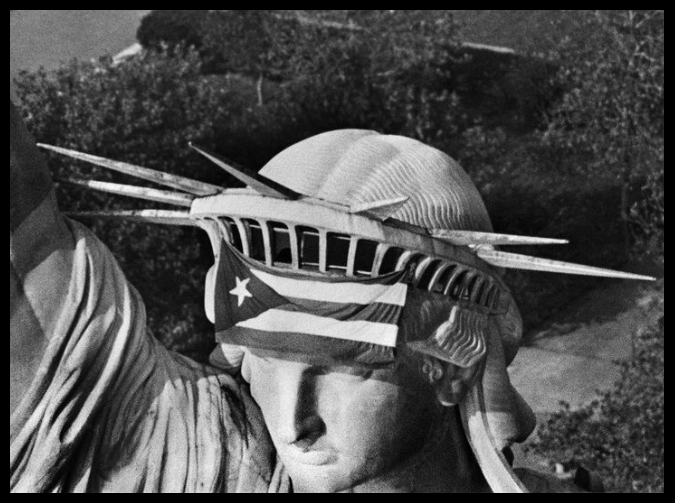
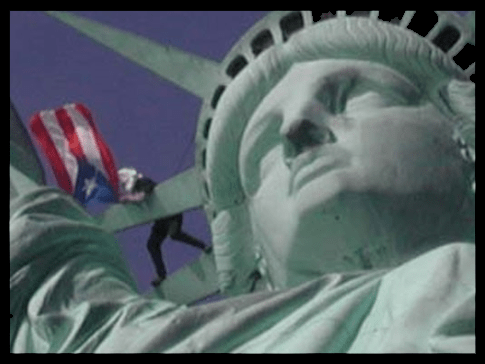
In two dramatic events, Puerto Ricans took center stage in world news with the national flag highlighted in occupations of the Statue of Liberty. In 1977 they occupied the monument to demand the release of political prisoners Lolita Lebron, Rafael Cancel Miranda, Irvin Flores, Andres Figueroa Cordero and Oscar Collazo. And again, in the year 2000 to demand an end to the U.S. Navy’s bombing practice on the Puerto Rican Island of Vieques.
The devastation caused by Hurricane Maria in 2017 coupled with the continued enforcement of U.S. colonial policy, made the flag a symbol of hope. Nationalism became a critical force that provided moral strength in the ongoing resistance.
In fact, Mother Nature’s destructive forces can never compare with the attitudes and corruption of U.S. government officials. With their policy of neglect U.S. officials contributed to the loss of 4,645 Puerto Rican lives — death tolls the Trump administration blatantly disputed and trivialized. The criminality of the Jones Act combined with the dangerously ineffective FEMA administrators, showed us (and the World) the genocidal policies of both past and present U.S. Presidents — regardless of political party affiliation.
Criminalization of the Puerto Rican Flag
Adding insult to injury, after the U.S. militarily invaded and colonized Puerto Rico in 1898, use of the flag was discouraged and stigmatized as something evil by U.S. officials. But it was during the imposition of Law 53 of 1948, better known as the Gag Law, (in Spanish: Ley de La Mordaza), anyone caught displaying or possessing the Puerto Rican flag was immediately arrested by the colonial authorities. The infraction was punishable by up to 10 years in prison. This vicious law aimed to quell mass support for independence but was also used to persecute Dr. Pedro Albizu Campos and the Nationalist Party.
Without warrants, homes, schools, businesses and houses of worship were randomly searched by colonial police looking for the “contraband flag”. Thanks to the nationalist fighting spirit of the Puerto Rican masses the U.S. rulers were compelled to eliminate this law.
In 1957, Law 53 of 1948, was repealed as well as the ban on the Puerto Rican flag. A development that came about as a result of militant people’s struggle. However, the original turquoise blue on the flag was replaced by the same dark blue as in the U.S. Flag. This was an attempt by the U.S. colonizers to psychologically cause a false sense of assimilation between Puerto Ricans and the foreign oppressors.
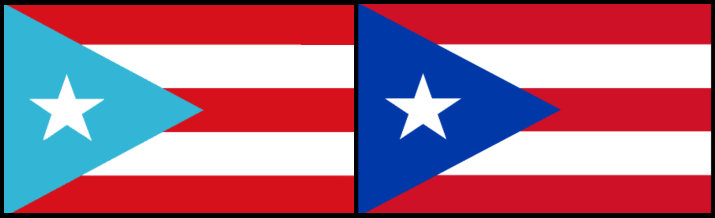
meeting in New York City. On the right the version imposed by U.S. colonialism.
When we wave the Puerto Rican Flag in annual events, let’s not do it in vain and end up taking this honor for granted. Those who continue to colonize us want to ensure our national symbols be no more than a passing fad. The Puerto Rican Flag came about with sacrifices made by those who fought and died for the freedom of our people.
That is why we celebrate the Puerto Rican Flag and salute the memory of our ancestors who fought gallantly for a noble cause. Despite everything the U.S. has done to us through racism and attempts to destroy our identity as a people, Boricuas continue to say with pride QUE BONITA BANDERA!


 carlitoboricua
Would love to learn more about the history around the change in light blue to dark blue. Was that bc of US colonialsm?
LikeLike
Yes Alyssa. Historically colonizers always attempt to make a colonize people feel that they have a stake in colonialism, so they’ll give you a false impression of you being assimilated.
LikeLike
Yes. It was a way to give Puerto Rican flag a semblance to the U.S. flag. It was part of the psychological warfare to suppress the self-identity of the Puerto Rican people; a way of instilling in the minds of the colonized people the false notion that we are one with the United States and dismissing the historical fact that Puerto Rico was conquered by military invasion.
LikeLike
email me whatever you have on Puerto Rican history. The true Puerto Rican History. Thank
LikeLike
Hi Ervin. Send me your e-mail address, at carlitoboricua@yahoo.com. Happy Holidays, -Carlito
LikeLike
Beautiful. …. Keep up the great work…. PALANTE.
LikeLike
Thank you Pablo.
LikeLike
I think this history should be taught not only to Puerto Ricans but to other cultures because sometimes we don’t understand why they are so prideful.
LikeLiked by 1 person