Reconstruction & African American political power

By: CarlosCarlito” Rovira

A revolution drowned in blood

The period of U.S. history known as Reconstruction, following the Civil War, lasted from 1865 to 1877. During this period, formerly enslaved people in the South made some of the most far-reaching gains that African Americans have seen in U.S. history. Those gains, ultimately drenched in blood, were not to be seen again until the civil rights struggle nearly 100 years later.

The Civil War, which began in 1861 and lasted until 1865, was a profound social revolution. It brought an end to chattel slavery, which until that time had been the foundation for the rise of U.S. capitalism.

Although the victory of the North resulted in the end of chattel slavery, that was not the stated aim of either President Abraham Lincoln or the industrial bourgeoisie that was the dominant social class in the North when the war commenced. The war began only as a result of the decision by most of the “slave states” to secede from the Union in 1861.

Lincoln refused to end slavery, assuring all slave owners who cooperated with the federal government that they would maintain “their property.” His eventual decision to issue the 1863 Emancipation Proclamation, which decreed the end of legal slavery, was fundamentally a military decision.

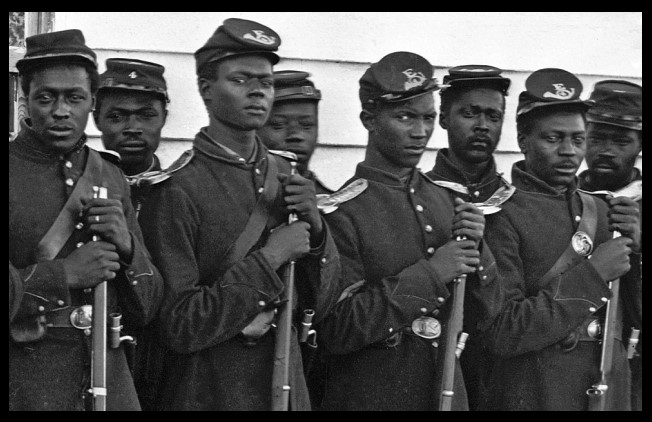
Without the enlistment of thousands of escaping enslaved people into the Northern army, the defeat of the Confederate army seemed remote. These newly enlisted Black soldiers, with their incredible resolve, determination and self-sacrifice, turned the tide of the war. It was a case of law following reality: Enslaved people were deserting or refusing to work on the plantations in growing numbers. They demanded the right to join the battle.

African Americans were decisive in the outcome of the Civil War.

The military exigencies of the day overcame the white supremacist policy of the Northern army and the federal government, which had refused to abolish slavery until that time.

The Emancipation Proclamation had the effect of drawing into the struggle the Black masses—and it proved decisive. African Americans comprised a social class rooted in the slave system itself and ultimately determined the outcome of the Civil War. After the proclamation, some 180,000 freed slaves enlisted in the Union Army and became fearless fighters against the army of their former masters.

When Confederate General Robert E. Lee surrendered in 1865, the question of how to reintegrate the Southern states into the Union was sharply posed. This was the basis for the period of Reconstruction. It represented a continuation of the conflicts of the Civil War, but under new circumstances determining the direction of the life-and-death struggle between the overthrown and the overthrowing classes.

Suppressing counterrevolution

Like every revolution, the military conflict of the Civil War was followed by a period in which the remnants of the previous order were suppressed, both by political means and by force. The French Revolution, the 1917 Russian Revolution, the 1949 Chinese Revolution, the 1959 Cuban Revolution and others all relied upon extraordinary measures to survive and fight off the attempts of the former rulers to regain political power.

How to suppress these forces had been the subject of debate in Northern political circles throughout the war. On the one hand, were moderates like Lincoln who wanted to incorporate as many elements as possible of the old slave-owning class into a new pro-Union government. On the other hand, Radical Republicans like Thaddeus Stevens and Charles Sumner favored harsh repression and exclusion of Confederate society from political power.

The Radical Republicans were the political driving force of Reconstruction. They were in an objective sense the revolutionary, unwavering and determined wing of the divided capitalist class. Their political base was in Congress, where they held a majority that grew in the years immediately following the end of the war.

They understood that the formerly enslaved were the most solid base of support for the Union. African Americans rejoiced at the military defeat of the Confederacy. Across the South, formerly enslaved people organized meetings and political organizations to take advantage of their new freedom.

The freed slaves were the most solid base of support for the Union.

Social gains of Reconstruction

In March 1865, just weeks before Lee’s surrender, the federal government created the Freedmen’s Bureau. Under the military protection of Union troops, Black and white, the Bureau organized a vast education project for former slaves—a project which laid the foundation for public education nationwide, from which poor whites also benefited. It was even authorized to carry out a land redistribution program, although such radical measures were never widely implemented.

The decrees following emancipation challenged racist notions and recognized Black people as human beings. The formerly enslaved and property-less Black masses looked forward to a new beginning free from racist violence and with compensation for everything they had endured.

But differences emerged almost immediately over how to reconcile the interests of the formerly enslaved with the needs of the victorious Northern capitalist class. The tenuous political alliance of the anti-slavery forces during the Civil War soon broke apart.

The Radical Republicans understood the strategically important role of African Americans in smashing the former slave-owning class. The moderates, however, sought to rely on a partnership with the old ruling class as opposed to the revolutionary momentum of the Black masses.

Johnson’s ‘Black Codes’

President Andrew Johnson, who had assumed the presidency after Lincoln’s assassination, had postured as a Radical during the war. But he quickly emerged as the leading force of political reaction within the national Republican Party.

After the defeat of the Confederacy, Johnson installed new governments in the Southern states made up wholly or primarily of pardoned ex-Confederates. In late 1865, several of these Johnson-installed state legislatures passed laws known as “Black Codes.” These laws set up the terms for the newly freed Black population to participate in Reconstruction. They were in many ways precursors to Jim Crow laws, creating a separate and unequal system for African Americans.

The Black Codes varied from state to state, but they had common features. They required labor contracts for Black laborers—often with terms not much different than slavery. They prohibited Blacks from migrating from one state to another unless they possessed papers specifying that he or she was bonded by contract to labor for an employer. They limited African Americans’ participation in politics with educational or property restrictions. Former slaves were generally described by the laws as “servants, “while the description used for employers was “master.”

Economically, the main thrust of the Black Codes was to reinstitute the plantation system. For example, Blacks were restricted from choosing where they worked and the type of work they did. In many parts of the South, they were forbidden to work in towns and cities. In some areas, skilled Black workers were required to receive a license or certificate in order to get employment in occupations other than in agriculture or domestic work.

In the eyes of many, both former slaves and Northerners, the power of the former slavocracy was being restored. Johnson’s “Presidential Reconstruction” was seen as selling out the gains of the Civil War. Further inflaming Radical sentiment, in 1866 Johnson vetoed an extension of the Freedmen’s Bureau and a Civil Rights bill that would extend citizenship to African Americans.

Radical Reconstruction and Black political power

New elections to the House of Representatives took place in 1866. With the southern states not yet readmitted to the union, Radical Republicans made big gains, winning enough seats to override Johnson’s vetoes.

The 10-year period beginning in 1867 is what is known as “Radical Reconstruction” and was a period of the most far-reaching social change seen in United States history. A Civil Rights Act was passed over Johnson’s veto in March 1866. The Congress passed the Reconstruction Act, which put the whole former Confederacy under military control and forced the creation of new state governments in accord with voting rights for African Americans.

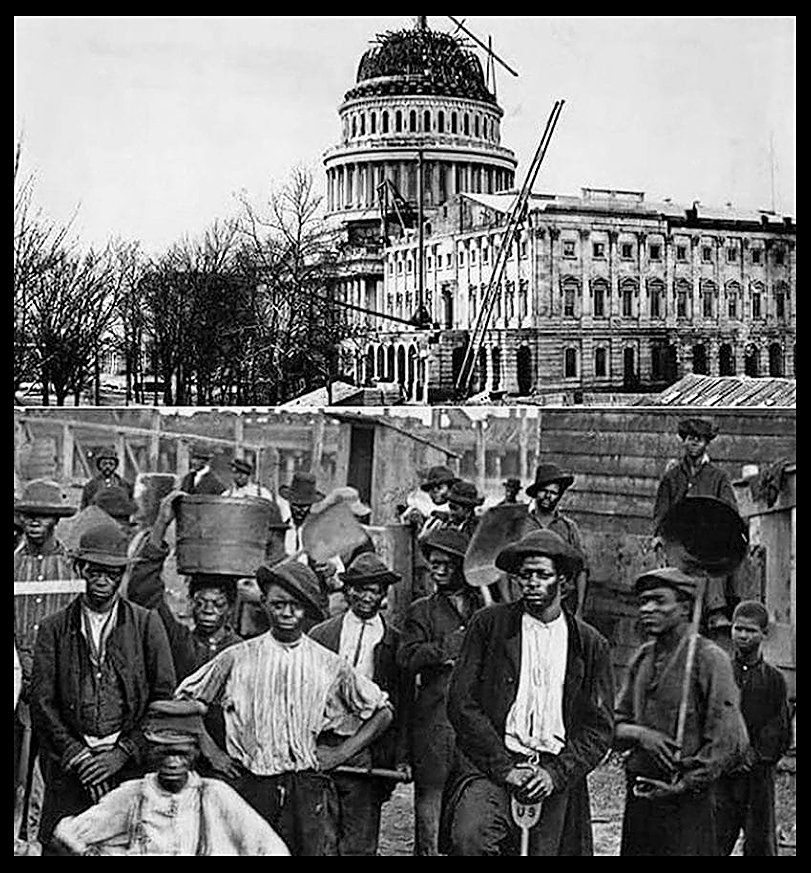
It was enslaved Black people who constructed the Capitol building and most of Washington, DC.

African Americans organized into Union Leagues to exert their new political power. Over 600—a majority former slaves—were elected to state office during this period. A wide variety of social programs were introduced: widening public education, funding for health care for the poor in South Carolina, free legal aid for the poor in Alabama.

Racist violence

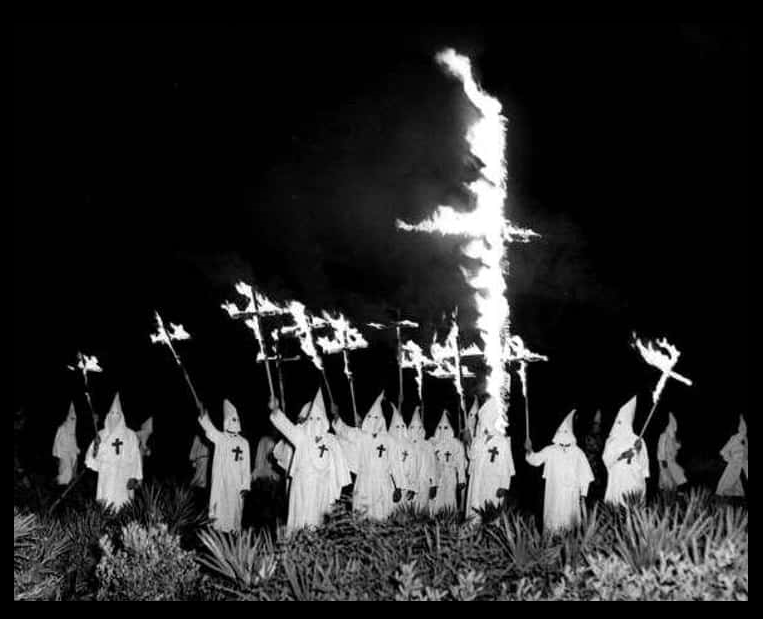
But each step forward for the newly emancipated African Americans was met by violent resistance from the former rulers. White Southern politicians colluded to undermine Reconstruction. As early as May 1866, Gen. Nathan Bedford Forrest rallied a group of ex-Confederate soldiers in Pulaski, Tennessee., to form the infamous Ku Klux Klan, which spread quickly throughout the Southern states.

The sickening cross-burning gatherings of the Ku Klux Klan, designed to intimidate.

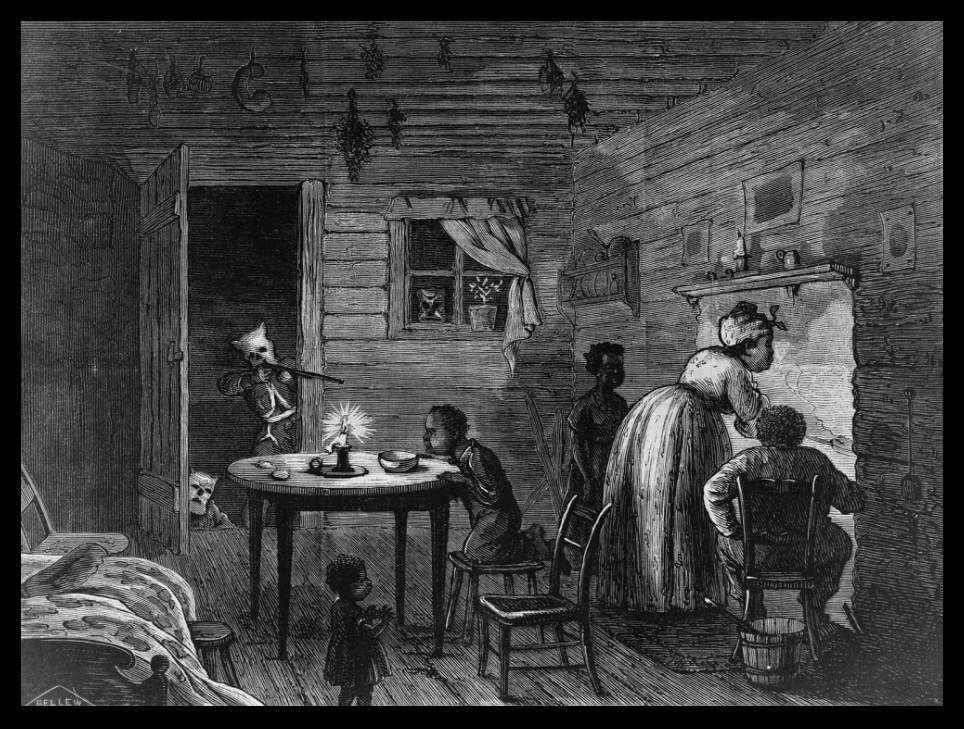
The KKK invaded the homes of outspoken African Americans.

The KKK’s primary objective was to crush the new mobilization of African Americans. Knowing that the African American people had the will and numerical advantage to create the South in their own interests, the KKK targeted the families of outspoken Black leaders in twilight-hour raids of their homes. The terrorist organization also attacked progressive Northern whites who were serving the purposes of Reconstruction.

Throughout Reconstruction, political debates in Congress or in state legislatures were accompanied by violent massacres committed by organized white racist groups. Such massacres took place in New Orleans in 1866, Memphis, Tenn. in 1866, Pulaski, Tenn. in 1868, Opelousas, La. in 1868, Camilla, Ga. in 1868, Meridian, Miss. in 1870, Eutaw, Ala. in 1870, Laurens, S.C. in 1870, New York City in 1870 and again in 1871 and in Colfax and Coushatta, La. in 1873. The list of these atrocities continues for the duration of Reconstruction, setting the precedent for the lynchings and apartheid terror for African Americans into the 20th century.

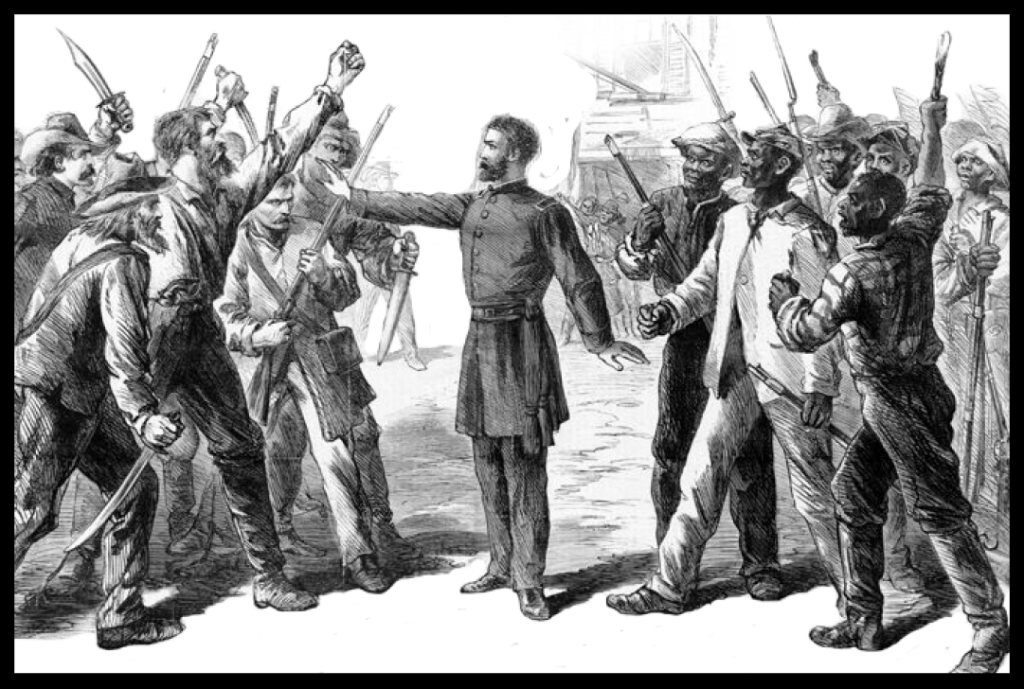
African Americans defended themselves and the gains of emancipation through mass campaigns and with arms in hand. Regiments of Black soldiers patrolled streets throughout the South. But the weight of the racist whites’ organizations proved to be too powerful for the African American community to overcome—especially as support for Reconstruction waned in the North.

African Americans defended Reconstruction with guns at hand.

Racists sought to disarm the Black masses. Throughout the Southern states and neighboring regions, gun control laws were introduced—but selectively applied only to African Americans, who relied on their guns to defend themselves. At the same time, economic depression in the 1870s along with corporate corruption scandals led to the emergence of a growing anti-Reconstruction coalition in the federal government. Federal troops were removed in one state after another, each time resulting in the reversal of political and economic gains for African Americans.

In 1877, Republican president-elect Rutherford B. Hayes—having lost the popular vote in the 1876 elections and with the election outcome uncertain in the electoral college — agreed to what became known as the Compromise of 1876, or in the Black community as the “Great Betrayal of 1876.” Hayes and the Republicans agreed to remove all remaining federal troops from the South in exchange for the Republicans retaining the White House.

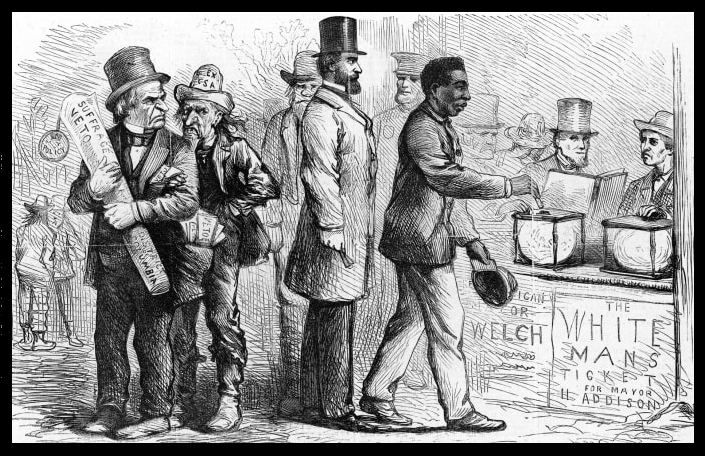
Laws were created to deny Black people their right to vote.

A reign of KKK terror and lynching enveloped the South as the Northern troops were removed. The dictatorship of the Reconstruction period—with the old slave owners repressed and formerly enslaved people living in a semi-democracy—was replaced by the reintroduction of the old dictatorship of the slavocracy.

The former slave owners could no longer possess human beings as their property, but they reemerged as junior partners of the Northern industrial bourgeoisie. In the southern part of the United States, this dictatorship of the Southern and Northern capitalists continued the legacy of unmatched cruelty and oppression of an entire people. The period known as Reconstruction was officially over.

The first real experience of Black political power—coming after centuries of attempted slave insurrections and resistance—was ultimately defeated.

Capitalist consolidation vs. Black liberation

The Civil War that was led by the Northern industrial bourgeoisie, uprooting the slave-owning class in the South, opened the door for the exploited Black masses to organize and make real social gains. During the period of Radical Reconstruction, the interests of this oppressed class dovetailed with the Northern capitalists’ short-term interests in crushing their former rivals. This was despite the fact that the African American masses’ class interests were hostile to both Northern capital and Southern chattel slavery.

The most important task for the U.S. capitalist class was increased centralization and consolidation. It was in the midst of the genocidal campaign against the Native peoples in the west. Life-and-death battles with the newly emerging industrial working class were taking place in railroads, mines and factories across the country. The capitalists were within 20 years of joining the worldwide race for colonial plunder.

The industrial capitalists made peace with the defeated slavocracy at the cost of many concessions—the easiest for them being the aspirations of the exploited African American working classes. Although subjected to renewed and constant terrorism from the forces of white supremacy, who had all the institutional threads to political power in the form of control over local and state police forces, the freedom movement of the African American community could not be extinguished. Generation after generation found new methods of struggle.

Between the mid-1950s and the 1970s, this freedom struggle culminated in the emergence of the broadest and most militant social movement in the history of the United States. It was this movement that would eventually force the U.S. government to formally outlaw the apartheid system that replaced the Reconstruction era following its overthrow in 1877. The passage of the 1964 Civil Rights Act and the 1965 Voting Rights Act restored the legal rights that had been violently suppressed 90 years earlier.

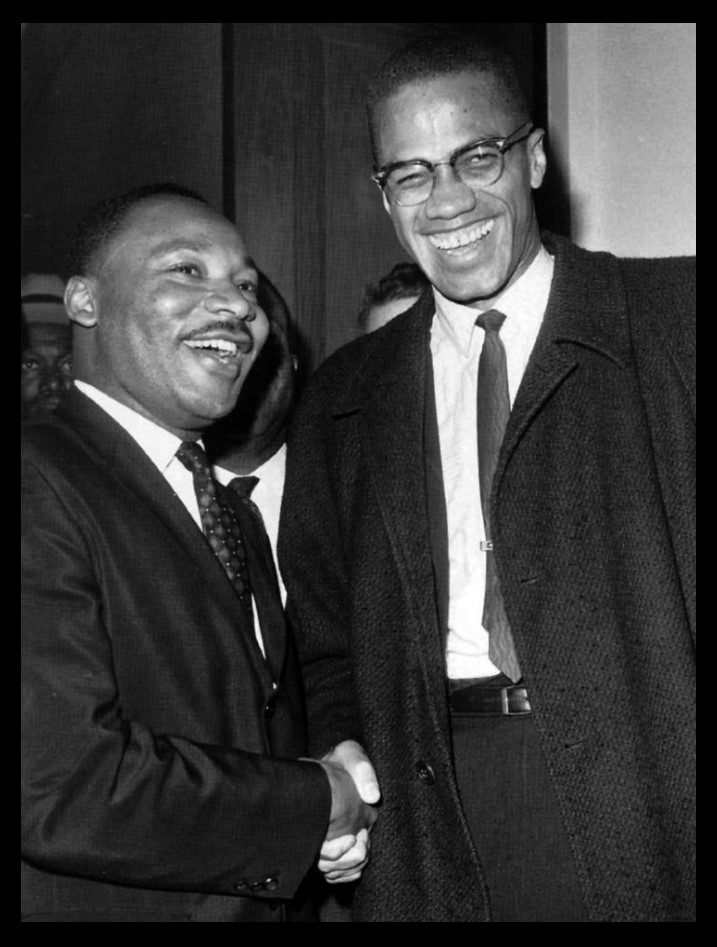
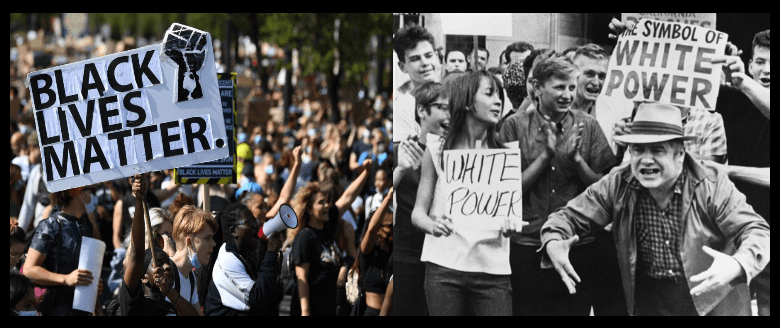
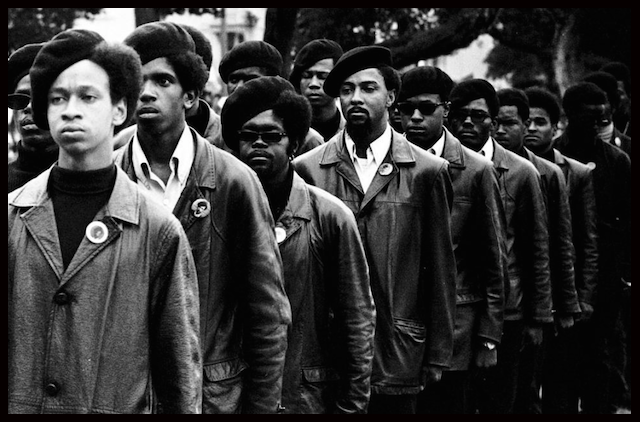
The Civil Rights and Black Power movements were the continuum of the Black liberation struggle.

The democratic aspirations of African Americans were betrayed precisely because it is impossible to reconcile the interests of the capitalist class with the social interests of Black people. The lucrative system of African chattel slavery was born as an appendage of capitalism.

The relatively young U.S. white working class of the 1860s and 1870s was too infected with racism to serve as an ally to the aspirations of the African American masses, even though their objective social interests overlapped.

The completion of the tasks of Reconstruction and the later civil rights and Black liberation movements remains on the agenda today, nearly two centuries later. Building a united class struggle against the imperialist ruling class remains the best hope for fulfilling that agenda.

Long Live the African American struggle for emancipation!

Don’t Be Fooled By The Smear Campaign Against Carlos “Carlito” Rovira – By Rebekah McAlister

https://www.lindabastaya.com/file-c-users-19176-onedrive-desktop-20211012115234884-20-6-pdf

By Rebekah McAlister

Relevant Terms:

  • Restorative Justice A system which sees crime as an act against the victim and shifts the focus to repairing the harm that has been committed against the victim and community. Restorative Justice holds that the offender also needs assistance and seeks to identify what needs to change to prevent future violations.

  • Due Process Fair treatment, a citizen’s right.

  • Abuse to treat with cruelty or violence, especially regularly or repeatedly. Smear Campaign – a plan to discredit a public figure by making false or dubious accusations.

  • Defamation – the action of damaging the good reputation of someone. Slander – the act of harming a person’s reputation by telling one or more people something that is untrue and damaging about the person.

  • Libel – a published false statement that is damaging to a person’s reputation, a written defamation.

———————————————-

On Monday, September 13, 2021, the Campaign to Bring Mumia Home (CBMH) NYC, released a public statement to their listserv which leveled a targeted smear at Carlito Rovira to defame his character and banish him from the NYC Left. This statement depicted Carlito as a sexual predator and even insinuated that he had engaged in sexual contact with a minor by repeating “our youngest, most vulnerable member” repeatedly. Shortly thereafter, an entire website devoted to this defamatory campaign was posted entitled “https://carlitoroviraexposed.com/.” In her statement on this site, the unnamed accuser says that she was in her twenties during her affair with Carlito! The age of consent in New York State is seventeen years old, so this propagandistic insinuation of Carlito’s having contact with a minor is false, deliberately misleading, and manipulative.


On Monday, September 13, 2021, the Campaign to Bring Mumia Home (CBMH) founded and led by Dr. Johanna Fernandez, PhD and associate professor at Baruch College -CUNY, released a public statement to their listserv which leveled a targeted smear at Carlito Rovira to defame his character and banish him from the NYC Left. This statement depicted Carlito as a sexual predator and even insinuated that he had engaged in sexual contact with a minor by repeating “our youngest, most vulnerable member” repeatedly. Shortly thereafter, an entire website devoted to this defamatory campaign was posted entitled “https://carlitoroviraexposed.com/.” In her statement on this site, the unnamed accuser says that she was in her twenties during her affair with Carlito. The age of consent in New York State is seventeen years old, so this propagandistic insinuation of Carlito’s having contact with a minor is false, deliberately misleading, and manipulative.


The Truth is that Carlito and the Unnamed Adult Woman Had a Consensual Affair & She is Now Falsely Accusing Carlito in Order to Take Him Down


I will call the unnamed person making these claims against Carlito, Participant A. Sometime toward the end of the summer of 2016, Participant A whom I considered a friend and fellow comrade, told me that she was attracted to Carlito and was thinking about becoming intimate with him. Participant A expressed that Carlito had “offered to give her some sexual experience,” that this was tempting to her and that she was having sexual fantasies about Carlito. She said to me that wanted to have sex with him. Participant A expressed hesitation around the fact that she and Carlito were not actually dating, but in fact friends who were talking about having sex. I advised her in no uncertain terms not to do it. Also, I advised her that sex is very intimate for women, especially if she was exploring her sexuality. I told her that ‘just getting some experience’ was not a realistic plan and that she would develop deeper feelings for Carlito that would end in heartbreak and disaster. Surely, personal disaster that would hurt her and destroy her relationship with Carlito but damage the entire Campaign. The age difference was the least of my worries, but it did play into my advice. Don’t do it, I said. It is tempting, I know, but the consequences will be very hurtful.


Several weeks later, we spoke again, and she said that while she was very much enjoying the attention from Carlito, she had decided not to engage with him sexually. She stated that she wanted them to stop interacting in a way that was flirtatious and sexually suggestive. I asked if she had asked him to stop and she said she had not. At no point did she say that she felt threatened or coerced. I said that Carlito is a respectful person and adheres to boundaries and suggested that she should tell him that she wanted to end the sexual talk. I believe that they were going to the movies, or dinner or something around 96th street in Manhattan. According to Participant A, she followed my advice, told him she wanted to talk, and told him she no longer wanted to engage in sexual conversations. She told me afterwards that I had been correct in my prediction of how such a request would go: he agreed that they would end the sexual talk and that they would continue to be friends. This issue was done – as far as I knew.


About a year later, in the summer of 2017, Participant A mentioned casually to me that once again she and Carlito were having sexually suggestive conversations that she was enjoying, but she was not sure it was a good idea or if she should engage intimately with him. She mentioned it as if all our previous conversations about their relationship had never happened. At this time, Carlito was engaged to be married to Ana Betancourt, whom I knew and cared for. I was incredulous that Participant A was being so casual about continuing her relationship with Carlito. She was clearly still enjoying the attention. I found the resurfacing of this past conversation to be exasperating – as if I were trapped in the film Groundhog Day. One thing I discovered about Participant A over years of our friendship, was that she will listen to your advice for hours and shine you on, and then completely ignore any counsel you have given and even act surprised that you have any opinion on the matter. It appears she refuses to grow or challenge herself at all. (This was corroborated by at least one current and one former member of CBMH with whom I was close).


As a result, this time when the conversation about Carlito reemerged, I advised against it again, especially considering his current relationship, but I also said that I did not have energy to talk to her about it anymore. After that, Participant A stopped confiding in me regarding this affair, perhaps because she knew I did not approve, and she had not taken my advice. She had obviously decided that she wanted to continue to engage him, as evidenced by the text-message screenshots that are posted on the website. That’s the last I heard about it until now. The accusation leveled on the CBMH’s defamatory website that I ‘enabled the abuse’ and then told Participant A to ‘stay silent’ and that ‘no one would believe her’ is not only a slanderous lie it is an inversion of the truth.


Furthermore, according to the afore-mentioned text-message screenshot ‘evidence’ on their own website, Carlito was very explicit with Participant A about their mutual sexual attraction. Is it crude, offensive? -perhaps. However, this was a private exchange with a 27–28-year-old adult woman. If he had been ‘grooming’ her, he would not have been so direct about wanting sex. In my experience, abusers pretend they are up to something else, they are not direct and explicit with sexual requests, as Carlito was in the published text-exchange. At no point does she say, “don’t talk to me like that” or “no, I do not want to have sex.” Participant A may have been hurt because she wanted an actual relationship, (which the texts suggest and was my concern when advising her not to do it). While I certainly have compassion for her pain, this is not a sexual violation nor abuse.


Participant A Is Being Duplicitous and Manipulative


Participant A has refused to come forward, even amidst a flurry of support. She has posted online claiming to ‘defend the victim,’ even though she herself IS the victim – she is playing two roles. This is hard to wrap your mind around. This is not only a truly disturbing level of dissociation, but it also suggests that the goal here is not to give the accuser her chance to speak publicly against the accused. The CBMH members who know who she is and are going along with her playing victim and savior are also duplicitous. Maybe they are not seeing that it’s duplicitous to play both roles. It is not ethical nor honest to be both the victim and the savior writing statements on behalf of the anonymous victim. She was not interested in the self-help resources dealing with abuse that I gave to her to support her around conversations we had about her abusive relationship with her father. This deliberately misleading behavior is manipulative. This is in fact abuse. I am aware that sometimes individuals reporting sexual assault or sexual harassment need to remain anonymous for safety reasons. However, given that no sexual violation occurred here, and this individual is being deceitful, she cannot legitimately claim the need for the cloak of secrecy. I therefore reveal that Sophia Williams is making these false claims also known as “Participant A”


Johanna Fernandez’s Secret Affair with Her Younger Former Student at Baruch College & How She Manipulated Us in a Smear Campaign Against Him

I will call him Participant B. Both Sophia Williams and Participant B were students of Johanna’s at Baruch and were recruited by her into the CBMH. Johanna disclosed to me that she felt sexual tension with Participant B when he was her student. After recruiting him into the CBMH, Johanna put him in the position of Co-Chair of the group (talk about grooming) and at some point, they began to have a relationship that Johanna insisted be kept secret from the group. At a certain point, frequent and visible hostility between the two of them forced the relationship into the open. He turned to me for help, and confided in me about the relationship, asking for my help to mediate between them. Johanna was outraged that he had disclosed their affair to me, despite she and I having a very close friendship at the time. She and I had discussed the tension between her and Participant B on numerous occasions, at great length. She had never breathed a word that they were secretly dating.


After I was brought in on this secret sexual relationship, Johanna related to me a tale of him covertly abusing her. The accusation was vague, but I believed it because I trusted her unconditionally. Johanna pressured me to send him a long letter detailing all her complaints about him, with which I thought I agreed at the time, but did not feel right sending to him and refused. She only relented on pressuring me to send it when I told her that my mother, a psychiatrist, had advised me that my sending such a letter would be inappropriate, unhelpful, and not mediation – which I am not qualified to do anyway. Johanna subsequently told a few other CBMH members who were close to her (including Carlito) that it had been an abusive relationship and she needed our help to confront Participant B. Again, she gave no specifics, and none were asked for. We loved her, we felt protective of her, and we wanted to defend her. So, we went along with it and tied him to the (metaphorical) whipping post – twice.


During the first confrontation, involving Carlito, Johanna, Sophia Williams, myself, and Participant B, we berated him for hours in Carlito’s (and Ana’s) house. All the way home in the car, Johanna was upset with me and Sophia for not being willing to continue to castigate Participant B on the way out the door. She ranted about how awful he was and how we were not defending her sufficiently. Several months after this, we ambushed him in a full CBMH meeting to discuss his alleged ‘abuse.’ During this meeting, Johanna accused us of not “protecting” her from this abuse, which in the public meeting some members pushed back on (including one of the signers of the letter against Carlito) – how could we protect you when the relationship was kept secret from us? We did not get a clear answer, just insinuations that we had let her down. That we had ‘enabled abuse.’ I pushed it into the back of my mind at the time, but the accusation had been leveled: we had not had her back, our loyalty could not be trusted. She manipulated the situation to appear as if she was a victim who had been abandoned by her allies, and implied that we were responsible for her being allegedly abused. This, despite our not knowing about the relationship.


Johanna continued to assert that she had been abused, despite her not going into specifics. Since Participant B did not actively refute the accusations, none of us openly questioned the narrative. Participant B left the organization, of his own volition not long after that. However, I cannot say I blame him for feeling exiled and acting on that feeling. I would have done the same (in fact I did leave when I felt that such manipulative attacks on me were imminent). He left, but no one asked Johanna for a shred of accountability, although the leader and founder of our organization had engaged in a secret, toxic relationship with a former student, causing our organization to become sidetracked in our purpose. Indeed, this chapter risked the very existence of our collective. We were all deceived by Johanna; yet we were blamed by her as well.


Moreover, since the CBMH’s statement repeatedly highlights the age difference between Carlito and Sophia. Johanna’s former student /co-Chair / secret boyfriend (Participant B) is nearly twenty years younger than she – and I do not remember anyone ever bringing this up. Which situation has more of an unequal power dynamic: an older unofficial mentor or your older college professor? In any case, the hysteria over the age difference is blatant hypocrisy. One last point of import here is that Johanna turned to Carlito for help when she decided to confront Participant B publicly. She relied on Carlito’s tough demeanor and history as a fighter in the YLP to intimidate Participant B. It is ironic, contradictory, and hypocritical that it is those very same qualities of Carlito’s that she is targeting now through another smear campaign.


Johanna Has a Vendetta Against Carlito


During the winter of 2018 – 2019, Johanna was working on finishing her book on the Young Lords Party, for which she had interviewed Carlito countless times since 2008. Carlito’s fiancé had just died tragically the previous spring. Seemingly out of nowhere, he and Johanna started butting heads over the history of the YLP. This seemed strange, as they had been close friends for years, together they were the political backbone of our organization, they had worked closely on Johanna’s research together for over a decade. Additionally, she and I, and a several other CBMH people had been giving Carlito a lot of support as he grieved the loss of Ana. Since I was close with both Johanna and Carlito at the time, they both called me frequently to vent about the constant arguments. As I recall, they were clashing on the history of the Young Lords, an organization Johanna was researching and authoring a book on, of which Carlito was a vital member. He relayed one anecdote to me that from this period that I feel is very revealing: During a meeting that the two of them were having, Carlito disagreed with her about how something or other had happened, and she told him, “Carlito, I wrote the book,” – as a way to communicate that she knew better than he, even though she hadn’t been born at that time and he was there.


Johanna’s perspective in our many conversations about conflict with Carlito was never clear to me. She kept saying he was “crazy” and asking, “what’s wrong with him?!” When I suggested at one point that he might be wrestling with grief at the loss of his fiancé, she dismissed this possibility. During my conversations with Carlito about arguments with Johanna, he was calm, albeit frustrated, when telling me what happened. In contrast, Johanna was highly agitated when relating her disagreements with him. One day while speaking on the phone with Johanna about Carlito, I remember becoming frustrated because she was saying the same thing over and over again and working herself into a frenzy. I remember saying something like “I need you to stop and focus on something else and we can come back to this,” to which she responded, “okay fine but…” and launched right back into the anti-Carlito diatribe. This conversation went on and on and I finally just excused myself.


Shortly before I left the organization, we were in her car on our way to an event and I spoke with Johanna about how she and Carlito seemed locked in a conflict out of which there was no clear exit. I remember comparing what I was seeing with a metaphor of two sharks locked in conflict: Both of their teeth face backward, so constantly tugging just leads to further enmeshment. In order to resolve or reset, one of them must let go. I said that it was difficult for me and other CBMH people to have them constantly arguing and that this was disruptive to our collective. She immediately zeroed in on my distress and proceeded to tell me that this was hard for me because of my own childhood trauma. I was aghast at this blatant deflection and pop psychology judgement on something that was irrelevant and untrue.


During meetings when Carlito was not present, Johanna began turning CBMH calls into complain-about-Carlito sessions and was consistently leveling the accusation that he was acting in a way that was chauvinistic and macho, an assessment for which I saw no grounds and said so at the time. Johanna did not level this critique to Carlito in public or to me when we spoke one-on-one. At one point when Carlito was on the call, he volunteered to make a flyer for an upcoming event, and Johanna accepted. When he subsequently emailed us a draft of the flyer, she began texting me on a thread with Sophia and Gwen. Her texts were coming in quick and angry succession: She appeared to be having a total meltdown about how much she hated the flyer and how awful and misogynistic Carlito was for producing it. It was a picture of Mumia and a slogan in solidarity with Venezuela, and I did not see her point at all, but I was the only one who pushed back. When she texted us that he was “swinging his dick around,” I had had enough – I took myself off this text chain. Shortly thereafter, Carlito and I both chose to leave the CBMH. The truth, regardless of whether Johanna or anyone else wants to face it, is that she pushed us out, just as she pushed out the former co-chair with whom she had had the secret toxic relationship.


Johanna Knew About this Consensual Affair Between Two Adults WHILE it was happening in 2017 & She is Currently Running a Smear Campaign Against Carlito


The unfortunate cascade of emails many on the Left have been receiving recently represent the final phase of a pattern that Johanna has repeated and again: she recruits people, she becomes very close with them, she builds them up and encourages them to take responsibility within projects she’s working on, only to subsequently devalue them. As soon as her control over them starts to slip she begins to discard them. She did it to Participant B, she did it to me, and she is now attempting to discard Carlito from the entire Left and even from the entire world. In Johanna’s mass email of 10/4/21 she claimed to not be the author of the CBMH’s smear of Carlito, as the twelve signers of a previous email also attested. I was there for many times of drafting of a document with these very people, and I distinctly recognize Johanna’s hand of influence when I see it. I also recognize in the flurry of emails coming out over the last few weeks in favor of this defamation plot, the recruiting of allies by a manipulator to attempt to gain control over a target.


Johanna is using an “old ruling class trick” (her words) known as lying. She has taken things she knows to be true and has distorted them, all to take down a target. For example, Johanna knew at least as far back as 2017 about the exchanges between Carlito and Sophia, as she and I discussed their consensual relationship and agreed that while it was ill advised it was their personal business. Johanna knew as far back as 2014 about the information from forty years ago written salaciously within the CBMH’s libelous website. Thus, the claim made repeatedly in the CBMH’s statements, that they began ‘investigating’ these incidents ‘as soon as they found out, one year ago’ is false. Johanna has known the truth about these parts of Carlito’s past for years, as she worked closely with him throughout, on research for her book.


Johanna’s aim is clearly to take down Carlito, and from the wanted poster, even for his death because of this extreme character assassination. The Campaign to Bring Mumia Home is running an event on 10/16/21 under the guise of survivors of abuse testifying, but there are no actual survivors scheduled to give testimony. Additionally, two prominent, longtime MOVE supporters who have left MOVE expressed concerns under a flyer for the event that Sophia posted on her Facebook page. The former MOVE supporters said while they were certainly in solidarity with survivors of abuse, that two of the panelists at the CBMH’s 10/16 event are implicated in the abuse of MOVE survivors. In response to their questioning the event’s lineup, no one from CBMH addressed their concerns, one member saying only that the event was not all about MOVE survivors. Johanna commented publicly, going after both former MOVE supporters with vicious, vague, and hyperbolic attacks on their character.


At the bottom of the flyer for the 10/16 “speak-out” it says ‘for more information’ click here, on their “exposing Carlito” website. What?! This does not add up. So, we are speaking about survivors of abuse but not hearing from them, but for more information, please ingest our smear of one person. Wait, are we hearing from survivors or taking down Carlito with no hint of due process and very vague manipulative accusations of serious crimes? I think the purpose is clear. This has nothing to do with survivors. There is no attending to their healing, their needs, or any semblance of restorative justice. Johanna is lying and manipulating the truth to take down someone whom she perceives to have challenged her power. To accomplish this, she is utilizing a covert smear campaign, to which she has recruited a handful of allies who admire her so much that they trust her word unconditionally. I know, I used to be one of them. This, in fact, is narcissistic abuse.


Restorative Justice and Due Process


The call for actual restorative justice “shifts the focus to repairing the harm that has been committed against the victim and community” as well as seeking to support the perpetrator in repairing the damage, in a way that feels safe for survivors, as well as to come together as a community to prevent further harm, and to plan for a healthier, safer environment for all in the future (Zehr, 1990). That is not what we were doing with Participant B, and that is not what the CBMH and supporters are seeking to do with Carlito. This character assassination campaign against Carlito claims to be advancing the cause of “justice,” yet nowhere was there any hint of due process or restorative action of any kind. What is the purpose of these letters and the entire ‘Exposing Carlito’ website? What is the end goal? A public crucifixion? Carlito beat up or even killed? The poster with Carlito’s photo looks like a wanted poster and the “Carlito Rovira Exposed” website looks like you have uncovered a mass murderer, not dug up painful anecdotes to fit a vendetta.


What is the goal of a targeted smear like this without any attempt at anything resembling due process or restorative justice? If we are to exist within a democratic framework, even those whom we despise are entitled to a fair hearing to determine innocence or guilt. If you genuinely believe in due process, then you defend it even for your enemies – you do not pick and choose based on what you think about the accused. You either believe in due process or you do not. I am reminded of Martin Niemöller’s famous post-war piece “First They Came,” which cautions us that if you stand by passively while someone else’s rights are being curtailed, it is only a matter of time until your own liberty is at risk. I would hope that we are all in agreement with wanting to rebuild society in a just and humane manner. Allies of Carlito have been asking politely and diplomatically for a meeting to openly discuss these allegations. These requests have been flatly refused and demonized as chauvinistic, when what they represent is transparency, due process, and the potential for restorative justice.


Survivors Must Have Agency


We must inject responsibility and agency into this conversation about survivors. I reject this infantilizing of women, where they have no agency. At some point you have to say, “these are my standards – I don’t date unavailable men or I want my first sexual experience to be with you or I don’t.” CBMH did not have any clear standards. No rules. No boundaries. No structures and routines for negotiating conflict, recognizing harm, or facilitating reconciliation and healing. The CBMH was an anything-goes, chaotic cult of personality where whether what you were doing was up ‘to snuff’ was up to our leader and could change on a whim. As a result of this disorder, messy relationships of all kinds will happen. As we know, they happen even when guidelines and structures are in place! This is not to say we should not hold people accountable. On the contrary, there should be structures in place to prevent exploitation of power to prevent abuse in the first place, especially for leadership. We should have processes for protecting survivors and we need to hold abusive men (and women) responsible for their behavior. We must expect men to be responsible for themselves, but we also must expect women to have agency and control over their own choices. If someone manipulates and coerces you, physically or emotionally, that is an abuse of power. If you are unable to leave a cult and forced into child-marriages, as is alleged by the MOVE survivors, that is abuse. However, being in a relationship with someone who has a different standard than yours may cause you pain or an unpleasant experience, but you have the agency to say that is not my standard and I will not engage with you like that. That is not abuse.


My Time in the Campaign

I joined the Campaign to Bring Mumia Home in January 2013 after attending a screening of a film about Mumia’s case and meeting and connecting with Johanna. I met Carlito not long after joining the Campaign, sometime in the Spring of 2013. I worked closely with both Johanna and Carlito, as well as many other CBMH people on many projects about which I felt and feel great pride. We hosted screenings, concerts, and book talks, made our own mini movies, put on a play for which we wrote lines and music, we interviewed long-time activists and created a film series around their invaluable work for our collective freedom. I maintain that we did good work together: we helped to raise awareness around the importance and details of Mumia’s case, and we worked to advance both the cause of freedom for political prisoners and the wider struggle for revolutionary justice. Were we bringing Mumia closer to freedom? We were trying with all our hearts. Though victories were few and far between, there have been a handful, and I pray that one of these victories will unlock the door forever and bring Mumia home to his family, to live out his days in health, peace and safety, as the brilliant teacher that he is, advancing the causes of radical education, justice, and prison abolition into the future.


I cut my political teeth in this organization. I learned so much from Johanna and from Carlito. My favorite time, ironically, used to be when they disagreed politically because it was extremely illuminating to listen to their argument and reflect on each of their points. They were my political mentors, and the Campaign was my political home, its members were my family. There was a long time where I felt more comfortable and accepted within the Campaign than anywhere else, I had ever been. I came of age politically in this organization and owe a great debt of gratitude to both afore-mentioned mentors, among others, who, over countless hours, endless conference calls, car trips, conferences, protests and demonstrations, book talks, late-night (hilarious) meetings and work sessions, helped me shape and hone my political identity.


My Own Escape from Abuse, Recovery, Healing and Growth


During my time in CBMH, I escaped from an abusive relationship (with someone outside of the group). A vital part of my recovery journey has been to sharpen my boundaries around what type of behavior I will and will not tolerate, instead of giving everyone many chances to be better than the last time they treated me in a way that was manipulative or otherwise unacceptable to me – my standard. Over years in CBMH, I began to see increasingly clearly that the group had problems with boundaries, that our leader was chaotic and enforced chaos while blocking other people’s attempts at implementing structure or boundaries. There was a huge amount of time spent on interpersonal drama, with nothing to show for it on a personal level or for the wider movement. A prime example is the time we spent being dragged into the drama of Johanna’s relationship with her former student, with nothing positive accomplished in the end.


An essential tool of my healing from abuse was going into psychotherapy (which ironically, Johanna strongly supported). I went into private counseling and mentoring around surviving abuse, as well as healing and thriving afterwards. As the years went on and I was learning how to draw healthier boundaries, I started to recognize what was unhealthy about both the Campaign and Johanna’s dysfunctional behavior. Out of the growth of recovery, it slowly dawned on me that I was enmeshed in a cult-like atmosphere in the CBMH at the very least that I was being manipulated. When Johanna heightened the frequency and vitriol of her attacks on Carlito and began to insinuate that I was also to blame for the flaws she perceived in Carlito, I finally realized it was time to go. It is with no joy that I dig all of this up. To those of you who are still in solidarity with Johanna and who mean well, I am sorry if you are hurt by this. As a former member of this collective and close friend of many of the signers, the accuser as well as the accused, I am in a unique position now to shed light on the veracity of the claims against Carlito and the motivation for this character assassination campaign.


What Does This Have to Do with Freeing Mumia and Building a Better World?


Mumia needs this like the plague. The enemies of Mumia- there are many – would love nothing more than to catch wind that his name has been pegged to this imagined scandal that bears no relation to him. Furthermore, what is the history of Mumia’s case? He’s a man who was falsely accused. He is a man who was not allowed to speak for himself, who was denied due process. Mumia’s name was slandered publicly, and he was denied a fair hearing. He was convicted in the court of public opinion without the public getting to hear his side of the story. For obvious reasons, an entirely baseless smear campaign has no place in the CBMH.


Most enraging about this situation is that the silencing of women of color, the silencing of Black women, the silencing of Indigenous women, the silencing of all women, does happen. Sexual and emotional abuse and exploitation happens. These and other awful things happen. When false allegations are made publicly and salaciously like this with no legitimate goal and no due process, to satisfy someone is twisted egotistical political and personal envy, it makes it more difficult for victims to come forward and be heard and taken seriously. Shame on you Johanna, and shame on everyone uncritically going along with this public crucifixion. Of course, we support survivors, but we cannot uncritically demand someone’s head. No good will come of this.


There should be enough revolutionary love and celebration for all of us and it is heartbreaking to see people unwilling to make the room that so many of us so desperately wanted to accommodate for both of the CBMH’s political leaders to be amazing, and yes – flawed human beings. Fellow revolutionaries, there is so much work to be done. Conflict happens. Let us proceed with caution, compassion, and honesty. May we all live to see a world without prisons, police, and the horrors of capitalist exploitation. A world where Mumia and all our beloved political prisoners, and indeed every one of us, will be free.


Rebekah McAlister
October 2021
Former member of the Campaign to Bring Mumia Home, NYC
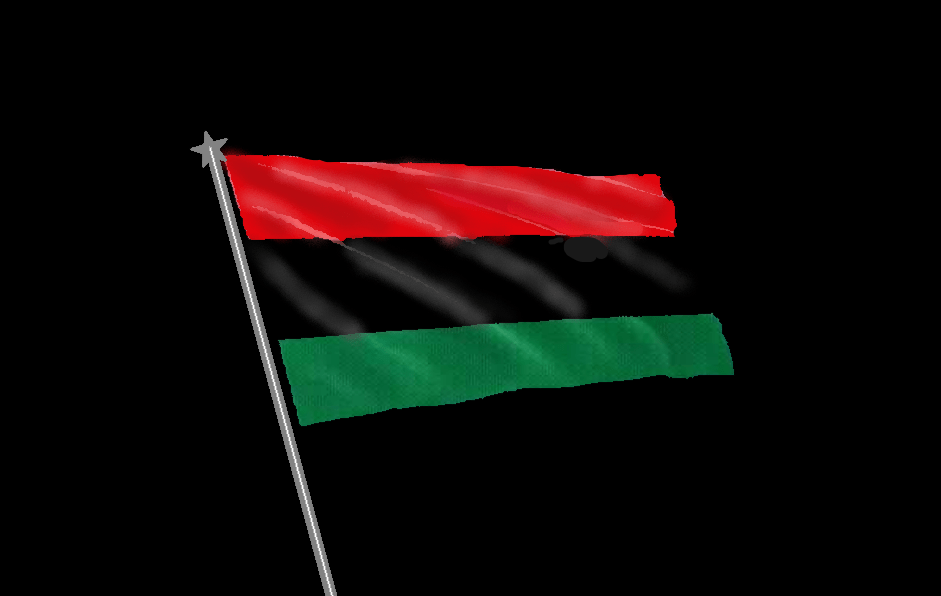

Lolita Lebrón and the Puerto Rican Nationalist Attack on the U.S. House of Representatives

________________________________________________________________________

“My life I give for the freedom of my country. This is a cry for victory in our struggle for independence.” –Lolita Lebron

________________________________________________________________________

By Carlos “Carlito” Rovira

Throughout Puerto Rican history, women have played an exemplary and leading role in the struggle against colonialism. Political and military leaders like Mariana Bracetti, Lola Rodríguez De Tío, Juana Colón, Blanca Canales, Isabel Rosado and many others, have been models of courage and devotion to the struggle for independence and self-determination.

One of the most widely known and respected women of the Puerto Rican liberation struggle in the 20th Century is Lolita Lebrón. Because of her outspokenness and firm disposition, her name became synonymous with the daring March 1, 1954 Nationalist attack on the U.S. House of Representatives.

Lolita was born on November 19, 1919, to a poor working-class family who lived in the legendary municipality of Lares, known for the famous September 23, 1868 “El Grito de Lares” uprising. It was a revolt aiming to end Spanish colonialism and African chattel slavery.

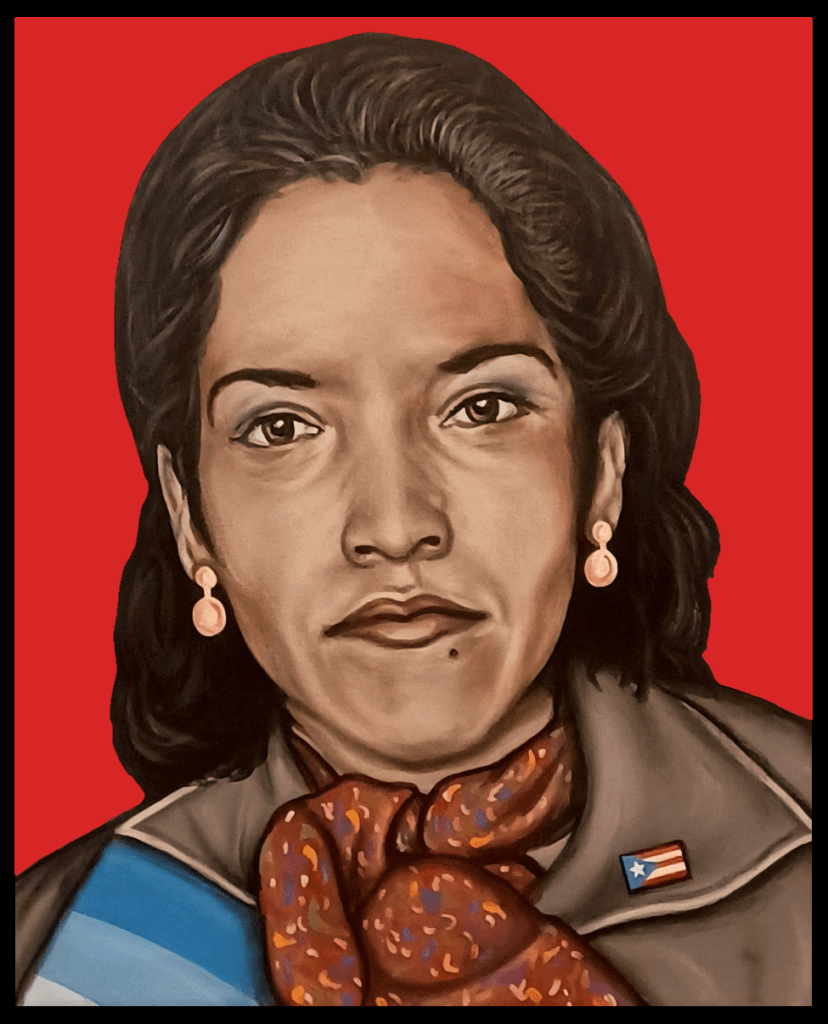
One of my portraits of Lolita Lebron. 20″ X 24″, acrylic paint on canvas.

The hardships Lolita’s family experienced during her youth, brought upon by tightening U.S. colonial economic policy, contributed to her strong character. As a young woman, like so many Puerto Ricans, she decided to leave Puerto Rico in 1940 in search of a better life.

After World War II and into the 1960s, an annual average of 63,000 people were displaced. They were compelled to migrate to the United States. By the end of this exodus, half of the Puerto Rican nation uprooted. They were pushed off their land in order to make way for lucrative agricultural and mining industries. This was an aspect of Washington’s colonial plan implemented in the interests of capitalist corporations at the expense of the native population.

Lolita Lebrón settled in New York City’s El Barrio community (East Harlem), then the largest concentration of Puerto Ricans outside the homeland. Like so many who left Puerto Rico, Lolita was employed as a stitcher in NYC’s Garment District. She immediately came face to face with the racism and exploitation that defines life for immigrant workers in the United States.

The Nationalist Party

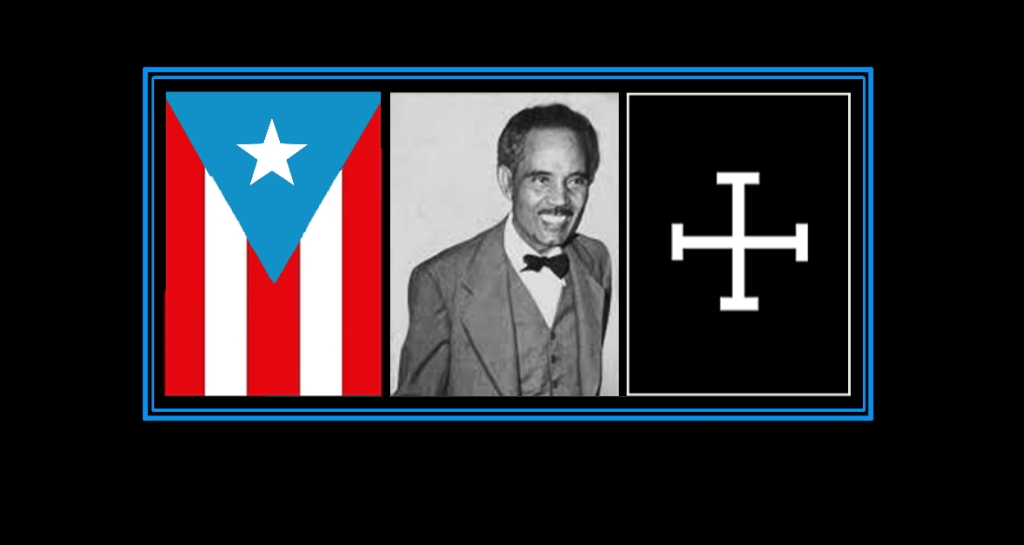
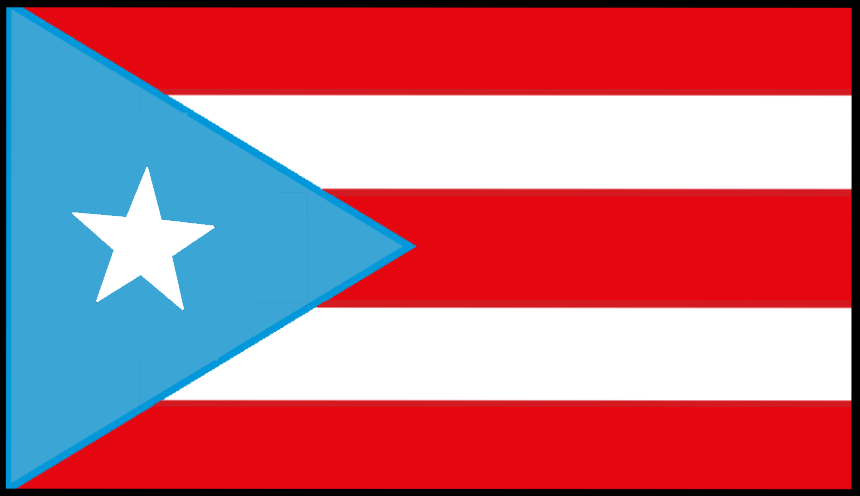
Symbol of the Nationalist Party of Puerto Rico.

Having a proud sense of identity and a strong belief in the cause for Puerto Rico’s independence, Lolita increasingly developed resentment for the presence of foreign oppressors in her adored homeland. And because she witnessed first-hand the suffering of her people forced to endure racist violence and discrimination in a distant land, persuaded her to join the secret New York committee of the Nationalist Party, led by Julio Pinto Gandia, a confidant of the legendary Dr. Pedro Albizu Campos.

The Nationalist Party was banned in 1938. It continued its activities under intense repression, especially following the 1950 Jayuya Uprising and the attempted assassination of President Harry S. Truman that same year by Nationalists Oscar Collazo and Griselio Torresola. During the anti-communist, anti-labor and racist witch-hunts of the McCarthy era, the Nationalist Party secretly operated under the name “Movimiento Libertador” (Liberation Movement).

The New York committee served as a rear guard within the colonizing country to gather political and financial support for the movement in Puerto Rico. They held meetings with the hope of organizing the Puerto Rican community and to draw allies around the issue of independence.

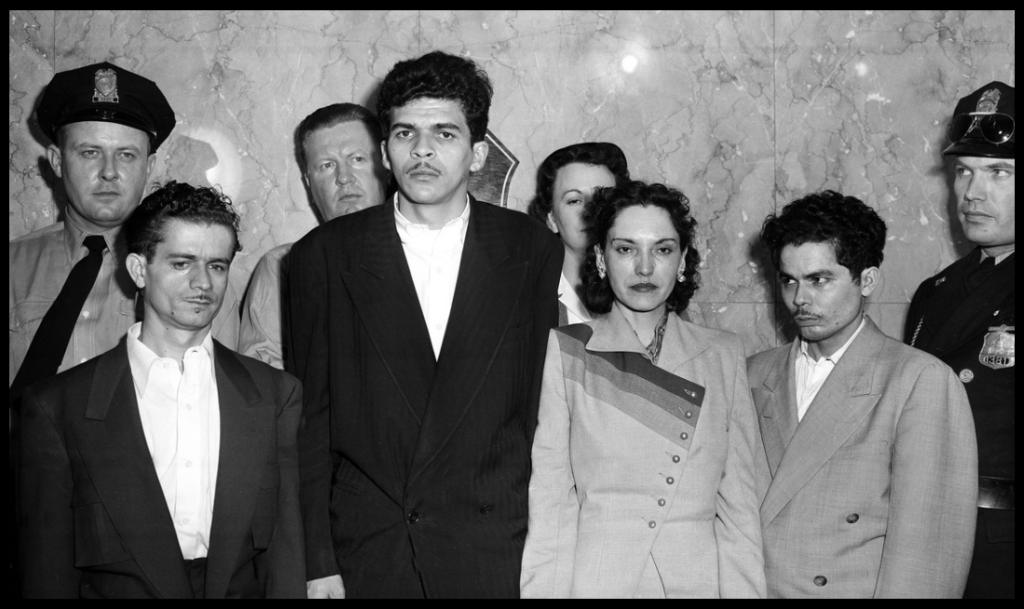
From left to right: Irvin Flores, Rafael Cancel Miranda, Lolita Lebron and Andres Figueroa Cordero.

Colonizers shift tactics

Taking advantage of the imprisonment of Nationalist leaders, the U.S. government shifted methods of disguising its role as colonizers. The governorship of Puerto Rico was no longer to be a military official appointed by the U.S. president. Instead, supposed “free elections” were held with Puerto Rican candidates exclusively approved by U.S. rulers. In addition, in 1952 the U.S.-dominated United Nations was persuaded to approve a resolution that designated the case of Puerto Rico as an “internal matter” of the United States.

Faced with this new reality, anti-colonial activists had to find new tactics to expose the colonial reality that Puerto Rico still experienced. Dr. Pedro Albizu Campos put out a call to carry out any form of action that would bring attention to the criminal nature of U.S. domination in Puerto Rico.

A group of members from the New York committee—Rafael Cancel Miranda, Andrés Figueroa Cordero, Irvin Flores and Lolita Lebrón—secretly prepared to respond to Dr. Pedro Albizu Campos’s call. For many weeks and months, the four patriots met to discuss and select the target, with no regard for their own personal safety or survival.

With no mention of their plan to families or friends, the four left for Washington, expecting never to return. Their only concern was to achieve the political objective in the action they undertook.

A bold and daring attack

Lolita Lebron among other Puerto Rican Nationalists after
the attack on the House of Representatives.

On the morning of March 1, 1954, members of the House of Representatives were meeting to discuss immigration policy and the government of democratically elected President Jacobo Árbenz of Guatemala—a government the CIA overthrew in November of that year. The four patriots calmly entered the Capitol building, passing through the lobby and up the stairs to a balcony designated for visitors.

As the proceedings went on, Lolita Lebrón pulled out of her shoulder bag the Puerto Rican flag and a gun. She then shouted, “QUE VIVA PUERTO RICO LIBRE!” Within seconds of brandishing their weapons, the four revolutionaries opened fire on the U.S. Congress.

When the gunfire began with bullets whistling through the air, panic erupted in the chamber. Many congressional figures and their staff began screaming as they frantically pushed one another to get to the exit doors. Others avoided being shot by running to hide underneath tables and behind chairs.

Position of Nationalist gunfire at the House chamber.
Puerto Rican flag and weapons confiscated from the four PR Nationalists
once they were apprehended by Capitol Police.

Before it ended, 30 rounds were fired, and five congressmen were wounded. All government buildings were shut down, and security throughout the District of Columbia was increased.

The brave patriots were immediately apprehended. The mass media then launched a vicious campaign to vilify the Puerto Rican independence movement. The four Nationalists were ultimately convicted and sentenced to life imprisonment.

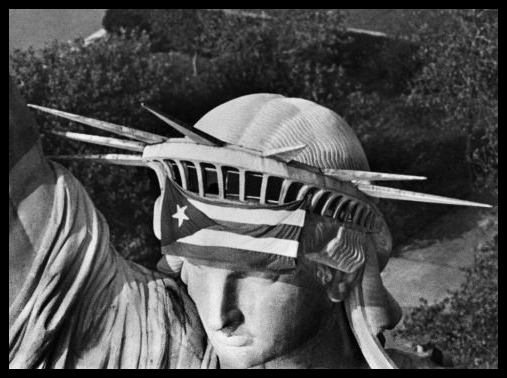
On October 26. 1977, protesters took over the Statue of Liberty to demand freedom for
Lolita Lebron and all Puerto Rican Nationalist political prisoners.

As Puerto Ricans mounted their struggle against racism and the right to self-determination during the upsurge of the 1960s and 1970s, more and more people raised the demand for the immediate release of Puerto Rican political prisoners. Such was the case on October 25, 1977, when a group of 30 Boricuas and allies unexpectedly exposed the issue on a worldwide scale. They courageously seized physical control of the Statue of Liberty, in New York Harbor. This event politically embarrassed U.S. rulers.

Thanks to the diplomatic skillfulness and uncompromising solidarity work of the Cuban revolutionary government, an international campaign galvanized widespread support for their release.

The political pressure paid off in 1979, when President Jimmy Carter granted amnesty to Lolita Lebrón, Rafael Cancel Miranda, Andrés Figueroa Cordero, Irvin Flores Rodriguez, as well as Oscar Collazo, who on November 1, 1950, attempted the assassination of President Harry Truman at the Blair House.

The release of these brave freedom fighters was joyfully celebrated in Puerto Rico and throughout the diaspora. A sense of pride and accomplishment was widely felt.

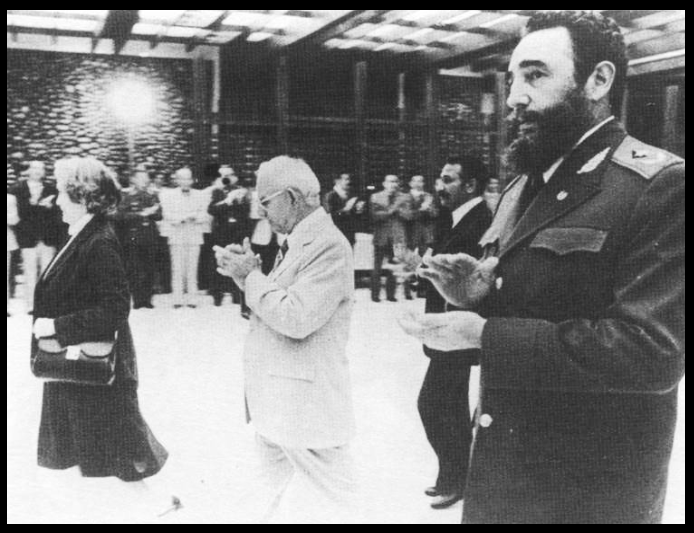
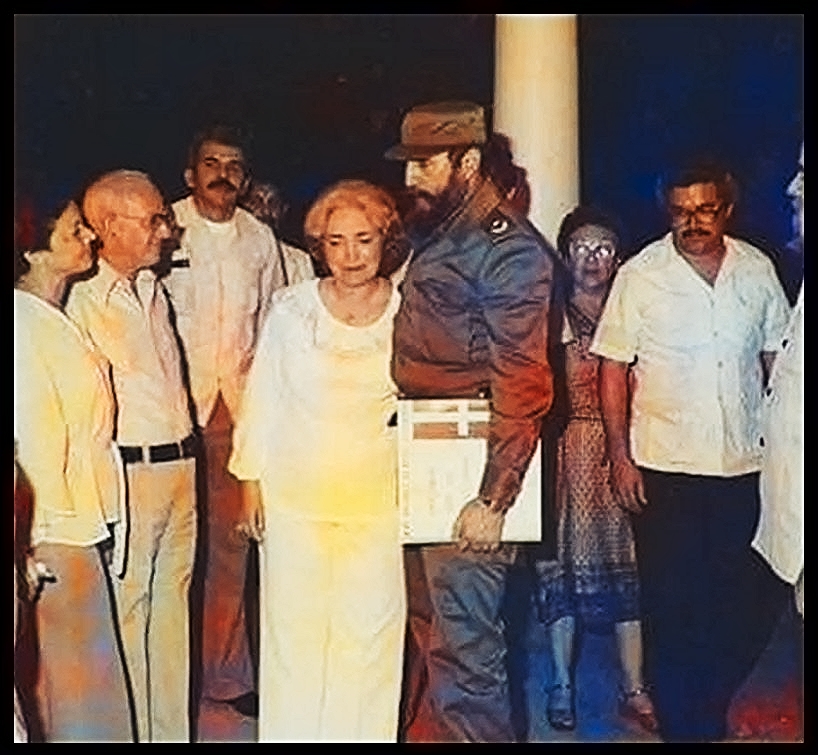
In 1980, Cuban President Fidel Castro Ruz invited to the formerly
incarcerated Puerto Rican Nationalists to visit Cuba.
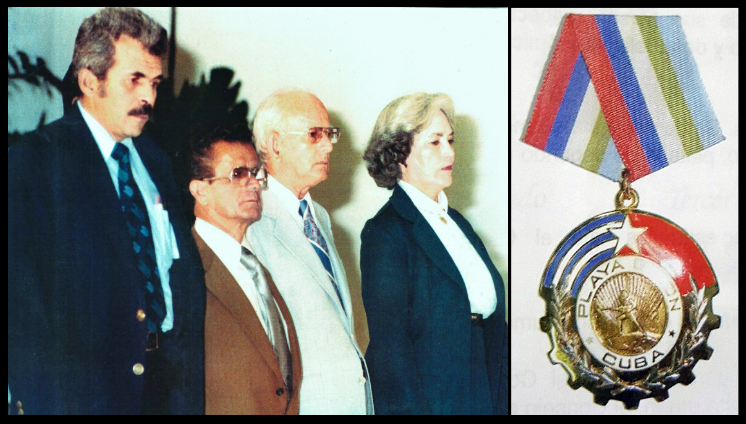
Cuba’s revolutionary government honored each of the Puerto Rican Nationalist
heroes with the Medal of the Order of the Bay of Pigs.

Lolita Lebron and Fidel Castro Ruz at center, with Oscar Collazo and Rafael Cancel Miranda to the left.

The actions of these formerly incarcerated patriots are events that shocked the imperial-minded men and women of privilege — a shock they never overcame nor forgotten. The colonizers of Puerto Rico never expected such a bold act in the capital of their empire.

What Lolita, Rafael, Andrés and Irvin did on that day symbolizes not only the fury of the colonized Puerto Rican nation but of every oppressed people that strives for a world without foreign domination.

¡QUE VIVA PUERTO RICO LIBRE!

Trump supporters were not lured on January 6, 2021 – they are part of a fascist movement

By Carlos “Carlito” Rovira

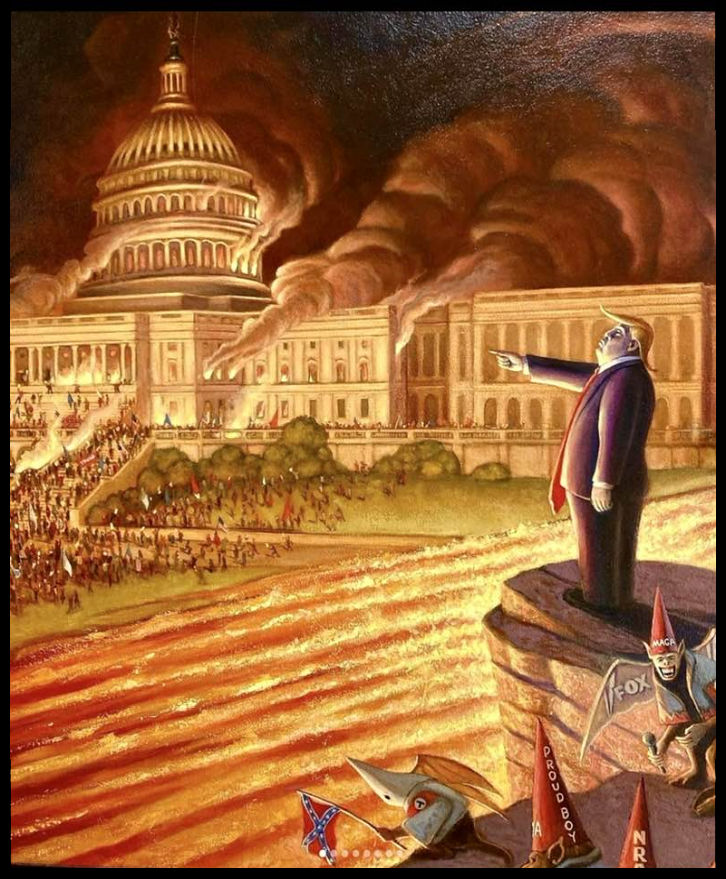
Since the white supremacist rebellion on January 6, 2021, at the Capitol building there has been an exerted effort by the mass media, and other apologists, to describe the people who attended as “misled” by Trump’s rhetoric. This narrative is not only hilarious and false but also patently dangerous.

We can see how even the news media tended to lend sympathy for the fanatical Trumpster Ashli Babbitt, who was shot to death by police when she attempted to breach an off-limits area in the Capitol where members of Congress were placed for their safety.

The MAGA loyalists descended upon Washington from every part of the United States days before January 6 in an apparent attempt to overthrow the government on behalf of Donald Trump, who called for a “wild” rally. Each of the participants were committed to a pathetic last stand aimed at illegally extending Trump’s presidency and suppress the voting rights of African Americans and all people of color.

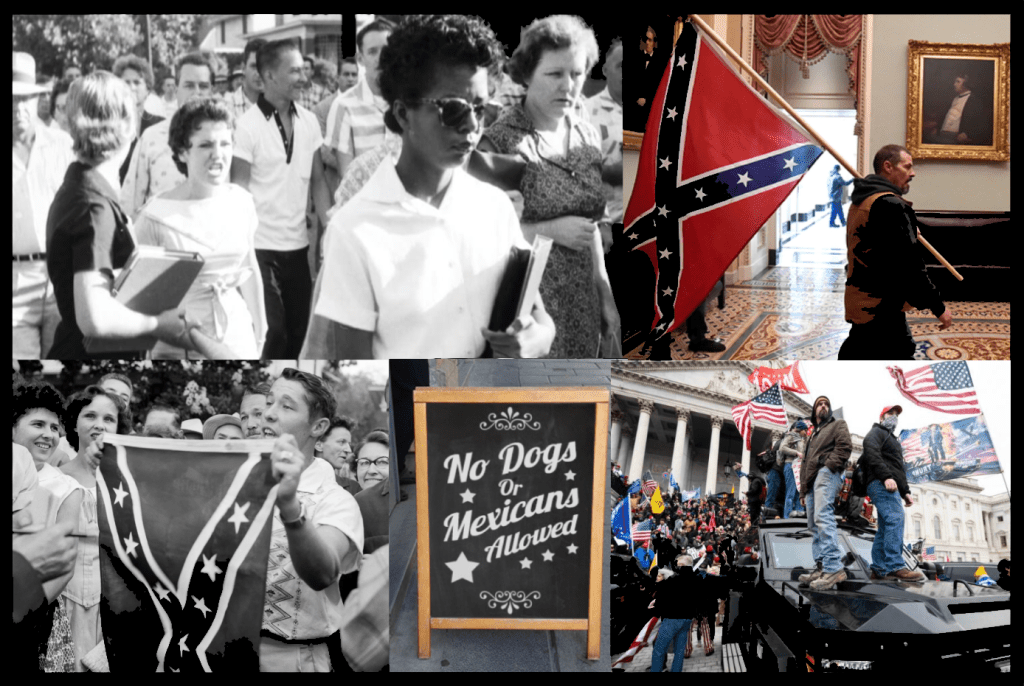
Denying African Americans the right to vote has historically been a symbolic feature of white supremacy in the United States, based on Black oppression.

White supremacy has existed like the official religion of the United States.

Since the start of Trump’s 2016 presidential campaign, when making his infamous announcement at Trump Tower in New York City, his supporters were well aware of his white supremacist stance. They were quite comfortable with his derogatory attacks on Mexican people, calling them rapists and welfare cheats.

Needless to mention the hurtful and racist overtures made when Hurricane Maria claimed the lives of 4,645 Puerto Ricans. Trump was overheard saying that “Puerto Ricans are dirty and poor”. Let us also not forget that he referred to Haiti and African nations as “shithole” countries.

Trump’s offensive gesture on Sept 12, 2018, in Puerto Rico.

Trump supporters were not offended by the openly racist language spoken with impunity. Implicitly and explicitly, he called for violence against people of color. His followers knew quite well that the rhetoric used were not-so-hidden commands to inflict deadly harm on Black, Latinx, Asian, Indigenous and Arab people.

Trump supporters were not lured, they have been grounded by racist traditions and history dating back to the days of slavery in this country. Their stubborn loyalty to him is cemented in ideology, that is, white supremacy.

One only needs to examine the absence of empathy among Trump supporters for murdered victims like Breonna Taylor, George Floyd and other Black and Brown people similarly killed by police. It was not a coincidence that many who were arrested for breaching the Capitol were either active or retired law enforcement officers and military personnel.

The rage displayed by the January 6 insurrectionists was rooted in a frantic belief of needing to defend their white privileges from encroaching Black and Brown people. These white self-proclaimed “patriots” were driven by deeply embedded customs, habits and traditions fermented in racist hatred.

In every objective sense they are more than just Trump supporters, they are part of a social prop for a menacing fascist movement in this country. Calls for “national healing” by “liberal” and moderate politicians, media commentators and so on, only serve to obscure an inherited cancer within capitalist culture this movement represents.

Traditional bourgeois representatives, in academia, journalism, the clergy and so on, will describe the desires to eliminate Critical Race Theory, the right to vote, a woman’s right to abortion, same sex marriage, etc., as attempts to “harm our democracy”, when in actuality these are symptoms of a much bigger problem.

Mainstream scholars are incapable of fully assessing this political movement because they are systemically forbidden to make critical analysis of capitalism. Fascism has always been an inherited trait of this system.

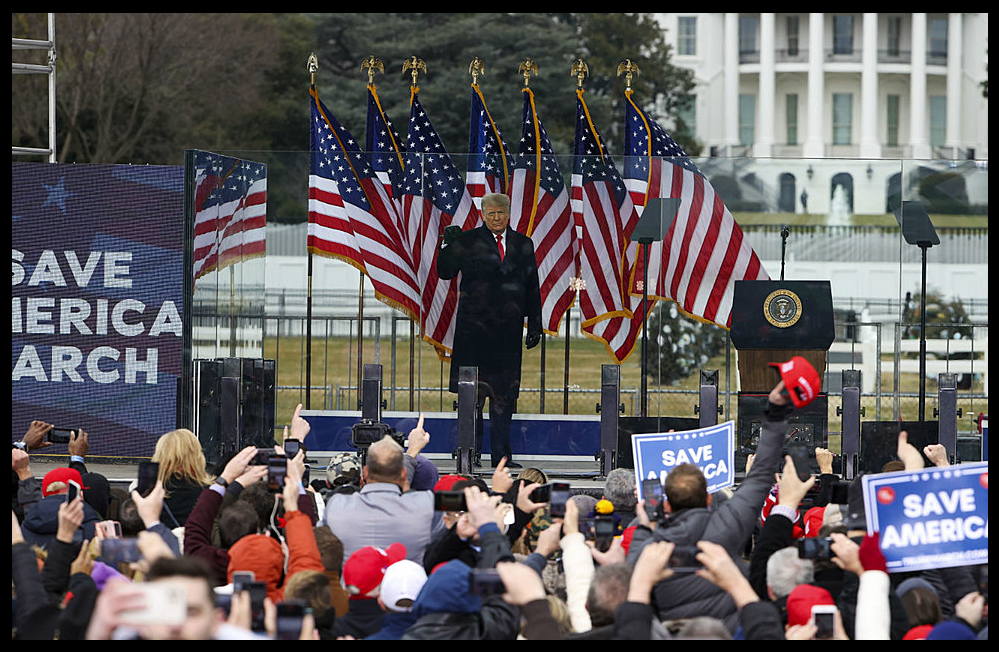
Trump addressing his followers moments before storming the Capitol building.

Historically, the shrewdest elements of the ruling class are never shy to expound their fascist visions and act to chip away the mere semblances of democracy. This is why the January 6 Congressional Hearings were meaningless.

The “investigative” character of these procedures was limited to formalities and legal jargon. Instead of being a vehicle for justice they have become nothing more than an entertaining show depicting a battle among two opposing groups of thieves.

For just a few exceptions, the short sentences given to most January 6 defendants proves the unequal justice that prevails in the legal system in the United States, one for whites and the affluent, and another for the rest of us who experience various forms of persecution.

Imagine if the January 6 insurrectionists were Black and Brown militants, the likelihood would have been bloodshed with many dead bodies on the steps of the Capitol building.

Trump supporters storming the Capitol.

It would have been a qualitatively different scenario if Donald Trump and all the January 6 defendants were investigated, tried and sentenced by a people’s revolutionary tribunal.

The fascist attempted coup on January 6, 2021, was carried out by forces who also work to defend the capitalist system just as much as those opposing Trump.

The billionaire class is nervous about mass uprisings erupting due to the uncertainties of the capitalist economy. Fascist forms are always kept in reserve and ready to be unleashed for unforeseen threats to this system. It’s not a coincidence that Trump and other far-right figures became more vocal as a tremor of political crisis developed with the Covid pandemic and Black Lives Matter demonstrations taking place across the country.

And now, that Trump won the 2024 presidential race against Kamala Harris, we can expect the country to shift further to the right. We can also expect representatives of both political parties to compete vigorously against each other not in the service of working-class people but to win the top-ranking title of caretaker for the billionaire class.

No one should be surprised when both Democrats and Republicans seek ways to sell working people upgraded versions of the same-old-lies. Their trickery with words are designed to make us accept policies that sink us further into poverty while having our civil liberties stripped away.

The solution to this rising fascist momentum begins with not falling into the trap of relying on another group of villains, better known as the “lesser of two evils”. History has shown us repeatedly that in the end all factions of the ruling class will unite to preserve the life of this system, they only differ in how to go about it.

Unity among those with a vital interest for fundamental change in our world is the key. That is, those who are exploited daily with low wages and are victims of racism, police terror, victimized due to immigrant status, standing up for a woman’s right to choose, LGBTQ+ rights, etc. How else can we strike fear in the minds of cowards if not by focusing on their main area of vulnerability?

THE PEOPLE UNITED CAN NEVER BE DEFEATED!!

Salute to the life of El Maestro: DR. PEDRO ALBIZU CAMPOS

By Carlos “Carlito” Rovira

On September 12, 1891, in the municipality of Ponce, Puerto Rico, Dr. Pedro Albizu Campos was born. This iconic figure is highly regarded in Latin American history and revered as Puerto Rico’s leading symbol of the independence cause in the Twentieth Century.

Campos was raised by his aunt in a poor but humble family setting. His mother died due to illness when he was a very young child. And when he was only seven years old, on July 25, 1898, the United States militarily invaded Puerto Rico, an outcome of the Spanish-American War.

In the days leading up to the onslaught naval warships blockaded all commercial ports of the island nation. The young Pedro Albizu Campos experienced the panic caused by the U.S. Navy when they threaten to bomb the city of Ponce if the residents did not surrender. Witnessing firsthand the arrogance of foreign soldiers is likely why he held an everlasting contempt for U.S. colonialism.

During his formative years Campos was exceptionally gifted. Due to his academic skills he was put in an accelerated track in school. By 1912 he received a scholarship to study engineering at the University of Vermont. A year later, Campos applied and was accepted to Harvard University.

But with the outbreak of World War 1 in 1917 he joined the U.S. Army where he served as First-Lieutenant in the U.S. Army’s segregated All-Black units.

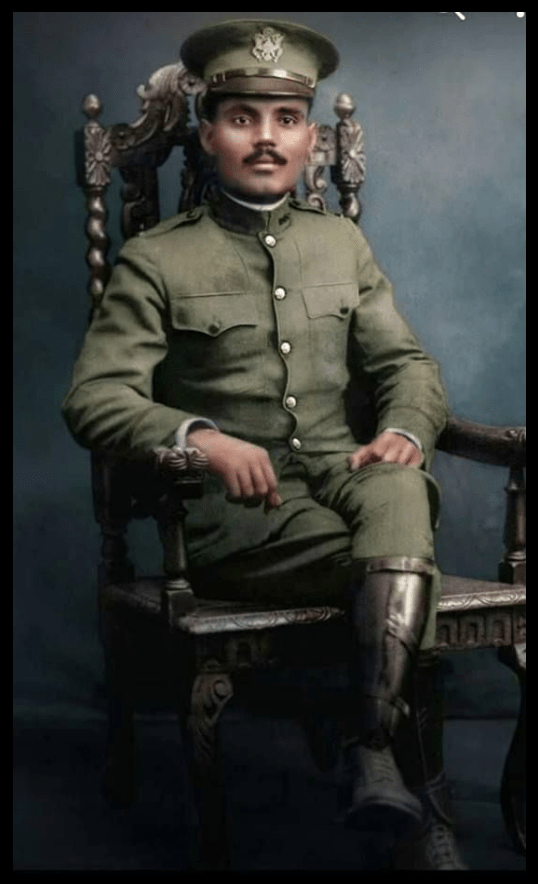
First Lieutenant Pedro Albizu Campos during World War I.

In 1919 Campos continued his studies. He achieved his law degree, as well as in Literature, Philosophy, Chemical Engineering, Military Science, and Language. Campos fluently spoke English, Spanish, German, French, Portuguese, Italian, Greek and classic Latin.

Campos was a genius, not by bourgeois and Euro-centric standards but because of his high level of humanity. His humility, and ability to reaffirm Puerto Rican anti-colonial traditions earned him the nickname “El Maestro” (The Teacher). The common folks greeted him by the name handle “Don” (Don Pedro) – a salutation of endearment and respect in Latino culture.

Dr. Pedro Albizu Campos during his studies at Harvard University.

Campos was the first Puerto Rican to attend Harvard University and graduate with the highest honors. Soon after finishing his education high paying employment offers were made to him, as Hispanic Representative in the Protestant Church, Legal Aide to the U.S. Supreme Court, the U.S. State Department and so on. But Campos declined. Instead, he chose to be a lawyer for the poor, many times defending clients unable to pay him.

Don Pedro adamantly condemned U.S. imperialism which earned him recognition by other contemporary revolutionary figures, most notably Ernesto Che Guevara, James Connolly, Marcus Garvey, to name a few.

Because he was influenced by the examples of Dr. Ramon Emeterio Betances, Pedro Albizu Campos became a revolutionary nationalist with an internationalist criterion.

In fact, Campos’s outspoken oratory against the “racist practices in the house of the empire” caught the attention of Pan-Africanist leader Marcus Garvey, who traveled to Puerto Rico to meet the renowned leader. Despite their differences in goals and tactics, this meeting was highly symbolic. The two leaders proceeded in their separate line of march but with the highest respect for each other.

Puerto Rican & Irish Solidarity

During his years at Harvard University Campos became involved in support work for the Irish Republican movement. Ireland was at a threshold in its historic liberation struggle against British colonialism. Campos’ admiration for the Irish cause served as his introduction to the ideals of revolutionary politics, which he eventually brought back to Puerto Rico.

Through his direct contact with representatives of Sein Fein in Boston and New York City, Don Pedro became good friends with James Connolly, The renown Irish socialist revolutionary and co-founder of the Irish Republican Army (IRA). Connolly was also instrumental in the emergence of the Industrial Workers of the World, (IWW) also known as The Wobblies”.

Irish revolutionary leaders Éamon de Valera and Connolly asked Campos to contribute a written draft for what would become the Constitution of a free Irish Republic. The collaboration between revolutionaries from two oppressed nations — Boricua and Irish — is of paramount significance in history.

Pedro Albizu Campos assumes leadership

In the earliest days of U.S. colonialism, a movement capable of addressing the new circumstances did not exist. The Unionist Party was conveniently repudiating independence from its program in an opportunistic effort to appease the mainstream. After many internal conflicts, on September 17, 1922, the radical members broke away to form the Nationalist Party.

Campos came to prominence in 1925 at a Nationalist rally held in San Juan. Colonial decree required all public events to display the American flag. To stay within the bounds of legality organizers decorated the railing around the stage with small U.S. flags.

One of my depictions of Dr. Pedro Albizu Campos, painted in July 2025. 20″ X 24″, acrylic paint on canvas.

As Don Pedro walked to the podium he calmly began to remove the U.S. flags, one by one, and tucked them in his pocket. He began his speech by saying “American flag, I will not salute you, if you symbolize a free and sovereignty nation, in Puerto Rico you represent piracy and pillage.”

Dr. Pedro Albizu Campos’ bold act shocked many in Puerto Rico and put into question the lack of militant energy in the Party’s leadership. The courage and charisma Campos demonstrated at this event is likely what propelled his ascendancy to the leadership. In 1927 he was elected Vice President and in 1930 he became President of the Nationalist Party.

Don Pedro was a man of his people.

In 1927 Campos traveled throughout Latin America and Caribbean on behalf of the Nationalist Party. His mission was to seek support for Puerto Rico’s independence. Revolutionary nationalist movements were rising up everywhere during that decade.

When Campos was elected President of the Nationalist Party in 1930 it sharpened existing internal contradictions. His more radical political views came into conflict with rivals who tended to be conciliatory towards U.S. colonial policy.

In addition, due to the history of African chattel slavery in Puerto Rico, white members of the Party became contemptuous to the idea of following the leadership of a Black figure. Racism and reaction to a revolutionary direction compelled conservative forces to leave the Party.

Despite these internal contradictions Don Pedro’s oratory skills, tenacity, defiance, and fearlessness earned him the highest level of moral authority in the independence movement and from all social stratums in Puerto Rican society.

Don Pedro speaking to the news media.

Once Dr. Pedro Albizu Campos assumed leadership the Nationalist Party was transformed. In 1932 the Cadets of the Republic were organized — a para-military youth component of 10,000 members with Nationalist Raimundo Diaz Pacheco as its commander. The uniform of the Cadets was black shirts and white pants. They strove to become a liberation army, following the model of the Irish Citizen Army (ICA) created by James Connolly.

Cadets of the Republic was the para-military component of the Nationalist Party.

Moreover, under Don Pedro’s leadership, an all-women component to the Party was also created. Among the heroines to rise up to prominence were Rosa Rosado, Blanca Canales, Lolita Lebron, Leonides Diaz, Carmen Maria Perez, Ruth Reynolds, Olga Isabel Viscal Garriga, among others. The Nationalist women traditionally played exceptional roles as leaders and combatants in Puerto Rico’s anti-colonial struggle.

Anti-colonialism intertwined with class struggle

U.S. colonial agencies began scrutinizing Campos and the Nationalist Party, especially after they gained influence among the striking sugarcane workers in 1934.

Labor strikes frequently occurred during this period. The influence Dr. Pedro Albizu Campos had on the victorious sugarcane workers heightened the prestige of the Nationalist Party among wider sectors of the Puerto Rican working class.

Worker’s unrest in the United States during the Great Depression caused enough havoc for U.S. rulers. And because Campos won the respect of the labor movement in Puerto Rico it compelled Washington officials to repress the Nationalist Party. A media campaign was launched to demonize Don Pedro and the independence cause. The mere sentiments of Puerto Rican nationalism posed a threat to U.S. capitalist interest.

Campos addressing the striking sugarcane workers, 1936.

Repression against Puerto Rican nationalism

FBI agents and the colonial police arrested, brutalized, and murdered Nationalists. On October 24, 1935 students at the University of Puerto Rico (UPR) were killed by police for merely raising the Puerto Rican flag. In 1936 Don Pedro was imprisoned to ten years supposedly for Conspiring to overthrow the Government. In 1938 the Nationalist Party was banned by decree.

Dr. Pedro Albizu Campos was praised by many, one of whom was the socialist U.S. Congressman Vito Marcantonio. Marcantonio was a staunch supporter of the Puerto Rican independence struggle and served as Campos’ attorney.

Don Pedro being arrested in 1936.

The following year on March 21, 1937, on a Sunday morning, in the city of Ponce, hundreds of people – women, children and men — gathered at the town plaza, in a peaceful demonstration to demand the release of Don Pedro. Once the gathering began to march the police carried out the unthinkable — they opened fire with rifles and Thompson submachine guns. The casualties were 21 people killed and 235 wounded. It became known in history as the Ponce Massacre.

U.S. rulers feared the moral authority Dr. Pedro Albizu Campos governed as well as his tenacity and valor. The colonizers were well aware of the legitimacy the Nationalist Party had in the hearts and minds of the people.

The “Gag Law” & defending Boricua dignity

After Don Pedro returned to Puerto Rico from a 10 year prison sentence his resolve proved to be untouched. From a San Juan based radio show Campos conveyed his anti-imperialist views to a listening audience. He also used this media to condemn the secret genocidal activities of Cornelius P. Rhoads, who was later discovered to be the mastermind behind the secret sterilizations of Puerto Rican women.

Washington officials sought ways to impose harsh decrees to minimize the threat posed by growing sentiments favoring independence. On June 10, 1948, Law 53 of 1948, better known as the Gag Law (Spanish: Ley de La Mordaza), was enacted by the U.S. installed San Juan colonial government in a blatant attempt to silence the pro-independence movement.

The Gag Law was filled with many outrageous draconian measures, such as forbidding the mere mention of independence in literature, billboards, music, and public speech. The decree also made it illegal to possess and display the Puerto Rican flag. This law created favorable conditions for repression.

While the notorious Senator Joseph McCarthy carried out his anti-communist witch hunt in the United States, the ugliest forms of repression were seen in Puerto Rico. Advocates of independence were blacklisted, denied employment, jailed, or were systematically shot in open daylight.

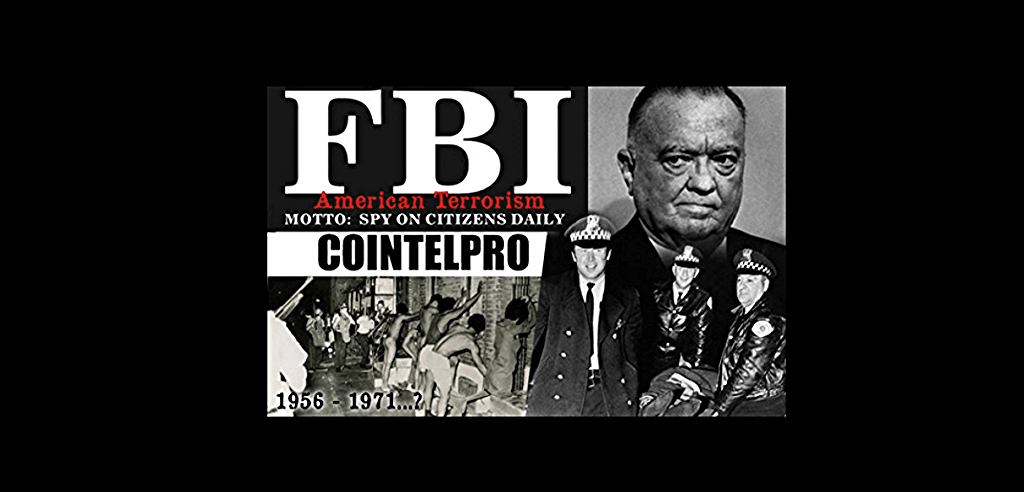
From this point on advocating independence was considered a risk to one’s life. The persecution against the Nationalists was identical to what was inflicted on the Black Panther Party with the FBI’s Operation: COINTELPRO.

In 1950 Nationalist Party intelligence operatives discovered a secret plan to destroy the movement. Don Pedro was then compelled to make a general call to arms in order to strike the first blow. In response to his directive, Nationalists attacked colonial authorities in cities throughout Puerto Rico.

In San Juan, the headquarters of the Nationalist Party was attacked by police. Campos, Isabel Rosado and others undertook an armed battle until they were overwhelmed by tear gas.

On the morning of October 30, 1950, a young woman named Blanca Canales led one of the boldest actions in Puerto Rican revolutionary history. An armed contingency entered the township of Jayuya in the central region. The Nationalists forced the police to surrender, after a gun battle which lasted an hour. Blanca Canales then gave the command to burn the police headquarters to the ground. This event is remembered as the Jayuya Uprising.

Blanca Canales was leader of the Nationalist Jayuya uprising..

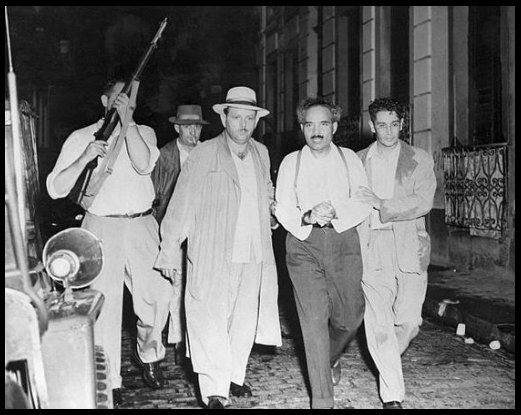
On November 1, 1950 Nationalists Oscar Collazo and Griselio Torresola attempted the assignation of President Harry Truman. Torresola was killed and Collazo was critically wounded in a shootout with the Secret Service and Capital Police.

Oscar Collazo after his conviction.

Adding insult to injury when the question of Puerto Rico was first proposed for discussion before the United Nations Organization in 1952 the U.S. immediately blocked the effort. Washington officials claimed that Puerto Rico was an “internal matter of the United States”. Justifiably, the imperial arrogance of the U.S. only stiffened the resolve of Nationalists living in New York City.

On March 1, 1954, Nationalists Lolita Lebron, Rafael Cancel Miranda, Irving Flores and Andres Figueroa Cordero entered the House of Representatives while proceedings were taking place. Lolita Lebrón shouted, “Que viva Puerto Rico libre!” The freedom fighters then aimed their weapons and opened fire on the U.S. Congress.

Puerto Rican Nationalists attacked the House of Representatives on March 1, 1954.

What followed was brutal suppression of the entire independence movement. Many Nationalists were randomly imprisoned throughout the 1950’s. Anyone with pro-independence inclination was deemed terrorist; civil liberties for Puerto Ricans were virtually non-existent. The prevailing state of fear and intimidation overshadowed colonialism’s tightening economic grip. The Draconian measures of the 1948 Gag Law continues to have a psychological imprint in Puerto Rico to this day.

At his 19th year of imprisonment, Dr. Pedro Albizu Campos was pardoned, on November 15, 1964, by the notorious Luis Munoz Marin — the U.S. approved Governor and greatest traitor in Twentieth Century Puerto Rican history. Don Pedro’s release was a political maneuver by the U.S. colonizers to disguise the heinous acts committed against the Nationalist Party.

Despite U.S. government denials evidence showed that Dr. Pedro Albizu Campos was tortured with radiation experiments during his incarceration. What was obvious to the naked eye corroborated with findings made by independent medical experts. When Campos was released from prison the physical condition of his body served as indisputable testimony of this heinous crime.

On April 21, 1965, the beloved Don Pedro died at 73 years old. In the final analysis, Dr. Pedro Albizu Campos was murdered by the U.S. colonizers through a gradual not-so-hidden process.

Medical evidence proved that Dr. Pedro Albizu Campos was tortured with radiation during his imprisonment.

The Legacy

Although Dr. Pedro Albizu Campos came short of realizing his quest for an independent Puerto Rican republic, he succeeded in revitalizing Boricua revolutionary traditions. He also reaffirmed the self-identity of the Puerto Rican people, which the U.S. colonizers attempted to destroy. In short, Don Pedro left us with a new disposition for our people to utilize in future struggles. That in itself will continue to pose a threat to the U.S. rulers.

His repeated motto “The homeland is valor and sacrifice” describes what he knew the Puerto Rican people are destined to carry out.

El Maestro firmly believed that freedom cannot come about by blindly following posturing political figures or partaking in meaningless elections. Campos was critical of political deceptions designed to corrupt and derail the national liberation struggle.

Dr. Pedro Albizu Campos knew quite well that his mission in life was to set a revolutionary example — the rest was up to future generations; it is the youth who are destined to smash U.S. colonialism in Puerto Rico and make the Boricua contribution to the global defeat of U.S. Imperialism.

Que Viva Puerto Rico Libre!

Operation: COINTELPRO — The Original Social Media

By Carlos “Carlito” Rovira

When Whistleblower Edward Snowden chose to defect from his professional allegiance to the Central Intelligence Agency (CIA) in 2013 U.S. rulers went into crisis mode. Snowden fled to Russia but not before causing panic by leaking classified information about National Security Agency (NSA) surveillance programs.

We now know how advancements in computer technology, especially the Internet and its many social media outlets, are being used to gather intelligence on U.S. citizens and serve as a tool to stifle the creation of a new people’s movement against oppression.

For those familiar with the consequences of Operation: CONTELPRO, during the 1950’s, 60’s & 70’s, should never become so naive to believe that these government projects ever ended. On the contrary, government surveillance continues to this day with greater ferocity and sophistication, especially now with political extremists in government itching to bring about an openly fascist dictatorship.

Edward Snowden

We have learned a lot about covert operations after the 1970s and how it was used to diminish the strengths of the Black liberation, Puerto Rican independence, Chicano, Indigenous, labor, Socialist, and anti-war movements, especially at the height of mass opposition to the war in Vietnam. What we tend to overlook is that the government has also gained many lessons from those experiences which it intends to use for upgrading their techniques against a potential rise of a new people’s movement.

Operation COINTELPRO employed the most shocking tactics imaginable. It used subtle and emotionally convincing methods to carry out its deceit. Cunning techniques were accompanied by open violent repressive force aimed to have a devastating psychological impact on the movement opposed to the status quo.

COINTELPRO was created in the early 1950’s to spy and disrupt the Socialist and Civil Rights movements, at a time when the notorious Senator Joseph McCarthy launched his anti-Communist, racist and anti-labor campaign. COINTELPRO utilized information obtained from wiretaps, intercepting postal mail and informants. Today much of that has become obsolete thanks to the invention of non-other than the Internet, specifically social media.

The upgraded methods of surveilling and manipulating conflict by the police state involves specialized units that monitor social media for intelligence gathering and developing plans of actions aimed to cause disruptions and havoc within targeted politically progressive circles.

The notorious J. Edgar Hoover

The notorious J. Edgar Hoover would have been delighted if Facebook, Twitter, Instagram or Tik Tok existed during his time as FBI Director. It is certain that Hoover’s use of today’s social media technology would have been for speeding up the persecution of the Black Panther Party – targeting its most outspoken members, like those who were murdered by police or imprisoned for life.

The New York Police Department (NYPD), the Chicago Police Department (CPD) in coordination with the FBI, used the same divide & conquer tactics against the Black Panther Party’s fraternal ally, the Young Lords.

Dr. Martin Luther King, Jr. and Malcolm X were both targets of COINTELPRO.

One of the many things that the racist J. Edgar Hoover became known for was openly expressing his disdain for African American leaders like Dr. Martin Luther King, Jr. and Malcolm X, el-Hajj Malik el-Shabazz, as well as the Puerto Rican independence movement, specifically Dr. Pedro Albizu Campos and the Nationalist Party.

Puerto Rican Nationalist leader Dr. Pedro Albizu Campos.

What did COINTELPRO rely on?

Gossipers, individuals who engage in petty discourse are the greatest resource the government relies on for building cases to repress social movements and prevent one from rising up.

Professional covert operatives from the FBI, CIA, and police are trained to analyze and utilize gossip and personal conflicts as one of their primary techniques, especially to manipulate the sentiments of the emotionally weak, narrow-minded, and self-serving individuals. What this methodology depends on is the absence of critical thinking in a society that automatically accepts cancel culture.

Moreover, to achieve this part of spying and suppression government agencies maintain files containing psychological profiles of individuals in order to assess who they can best manipulate and steer for precise moments when they are used to incite or aggravate disputes.

These are usually targeted individuals known to be gossipers and unstable elements in the habit of engaging in whisper campaigns. In addition, they are also known for their indifference if the progressive movement achieves its political goals, or not. Such is a profound trait of hypocrisy while professing to be “progressives, leftists”, or “revolutionaries.”

Panther
The FBI and police placed primary focus on destroying the Black Panther Party.

The state uses these individuals to accomplish its desired outcome of destroying reputations to paralyze progressive entities by instigating divisions. The government’s ultimate strategy is to cause demoralization, diminish people’s energies and discredit the politics of a movement.

That is why we must always be vigilant and know the identities of rumor mongers, gossipers, and promoters of petti discourse within our midst. In the end, they serve as the greatest assets to the police state, as if they are paid operatives themselves.

A close examination of what Edward Snowden revealed should easily tell us that although COINTELPRO succeeded destroying a movement in the past the government’s program against progressives continues to exist. Whatever name covert operations have today the goal is still the same – to prevent a new revolutionary movement rising up.

We should never allow ourselves to be played and lured again into that trap. We would be guilty of complicity in hindering the struggle for human emancipation.

The Young Lords were also targeted by Operation: COINTELPRO’s divide & conquer tactics.

History tells us that we should never underestimate the police state. They will utilize all situations and any issue to steer our focus away from challenges before us. A severe economic crisis is looming, accompanied by an intensity of racism, repression and the possibility of war. The state will do anything to stifle our efforts to counter such possible scenarios.

For those who hold a contrary view should ask themselves: Why is white supremacy blatantly showing its ugly face at an increased pace with civil liberties eroding? Events today serve as warning signs to alert us of an approaching crisis in this country, which we must all confront.

Regardless our platforms, socialist, anarchist, nationalist, feminist, LGBTQ, and so on, we must not have complicity in what the rulers are attempting. The police state does not need our help to divide us further.

There is always a politically mature way of reaching resolution to any problem. We must always have the victory of the liberation struggle in mind.

Social media should be used as a tool for educating and organizing ourselves against the common enemy. If our oppressors use the Internet to keep us disoriented and preserve their power, we must strive to become better users of that technology to combat the system perpetuating oppression.

The police state is not invincible. Their strength relies on poisonous petti discourse. The state’s covert activities against progressives can be stifled and stopped. However, we must adapt a standard of using critical analysis of solidarity and respect, when issues or crisis arise among us. It is imperative to our growth that we not employ the reactionary use of cancel culture.

Let’s make a fundamental part of countering the fascist menace guarding against its hidden and not-so-hidden operations of divide and conquer within our midst!

The African Blood Brotherhood and the Proletarianization of Blacks in Amerika

As a tribute to the African Blood Brotherhood I am re-posting this article on my blog. The history of the ABB and the role of African Americans in the socialist movement should be of the utmost importance for all to research.                                                                                                                                                                              -Carlito Rovira


The African Blood Brotherhood and the Proletarianization of Blacks in Amerika


By Comrade Tom Big Warrior (2010)
Reprinted from Right On! #1


The African Blood Brotherhood for African Liberation and Redemption (ABB) was the first Marxist, Revolutionary Black Nationalist organization in Amerika. Founded in 1917, it grew rapidly during the wave of white racist riots known as the “Red Summer of 1919,“ the ABB was a secret, armed, community self-defense-oriented society headquartered in Harlem.


Many of the “Blood Brothers” were combat vets who had fought in France in World War I. Many were workers, conscious of their proletarian class exploitation and oppression in capitalist society, as well as their caste oppression as “Negroes,” and national oppression as members of a nation of a new type defined by color and refined by slavery, terror and segregation.


The Nation of New Afrikans in Amerika, which was then a peasant nation concentrated in the cotton-producing “Black-Belt South,” was also evolving into a proletarian nation in the industrial centers and defined urban ghettos. The white riots were pogroms directed at these ghettos, which were expanding with the “Great Migration” from the South to the North and the West that had been encouraged by the need for industrial workers during the World War. Many of the white rioters were also returned war vets. There was also a big resurgence of the KKK at this time that peaked in the mid-1920s.


The urban Black proletarian had to be tough to survive. They were consigned to the dirtiest, most menial and demeaning jobs, and there was brutal competition for these jobs. The ghettos were overcrowded and transient, and Black on Black violence was rampant. Rubes from the country were sheep to slaughter for the lumpen criminals who preyed on them, and they kept coming as mechanization was displacing share-cropping in the South. Black workers quickly learned that whites who were not racist against them were probably class-conscious and Socialist. Militant unions like the IWW brought together workers of all ethnic backgrounds. But the core of leadership of the ABB was part of another migration from the Caribbean to the U.S., and particularly to Harlem.


The African Blood Brotherhood was the brain-child of Cyril Briggs, a light-skinned native of the Caribbean island of Nevis, where he was born in 1887. He migrated to New York on July 4th, 1905 and joined a growing community of West Indian Blacks in the city. That was the year of the first attempted revolution in Russia in which the Leninist Bolsheviks played a conspicuous role. The successful October Revolution of 1917 sent a shock wave around the world that was felt by oppressed people everywhere.


EE
CYRIL BRIGGS – Founder and leader of the African Blood Brotherhood.


Lenin particularly had a lot to say to the colored peoples of the colonial and semi-colonial countries and directly to the Black people in Amerika. Eventually, the ABB was absorbed into the underground communist Workers Party of America (WPA) which evolved into the CPUSA. The communist party founded by the Russian Federation declared its stance on the Negro Question in 1920: “The Communist Party will carry on agitation among Negro workers to unite them with all class conscious workers.”


Leninism distinguished itself from earlier Marxism by its conscious commitment to the national liberation struggles of the colonial and subject peoples which Lenin recognized to be closely linked to the World Proletarian Socialist Revolution. The class conscious ABB veterans and West Indians shared an understanding of a wider world of exploitation and oppression than the “Jim Crow” South and the ghetto street corner, the world of global capitalist-imperialist empire and world proletarian socialist revolution – a world illuminated by Leninism.


The ABB was committed to the liberation of Afrika and the whole of the Afrikan Diaspora from white world supremacy and capitalist-imperialism and saw the necessity of overthrowing this system to end the racist oppression of Black people and other people of color. As the immediacy of defending the oppressed Black communities from the violence of vigilante white mobs subsided, the ABB comrades began to see more and more the need to win white comrades to fight against white racism in the overall workers movement and all strata of society and prepare the U.S. for proletarian socialist revolution.


Former ABB members formed the core of the CPUSA’s Black cadre, and they were rigorous in opposing white racism in the Party and the unions and mass organizations influenced by the Communist Party. In the 1920s & 30s, the Communist Party initiated work in the South, including forming sharecropper unions uniting both Black and poor whites and unions among southern textile workers.


This was the CP’s most revolutionary period – though it tended towards “left economism” and “dual unionism” — and a period when many Blacks were first exposed to Communist ideology and organization. The “Harlem Renaissance” saw a flowering of Black consciousness and culture, and most of the artists and intellectuals involved were strongly influenced by Marxism-Leninism and leftist ideas.


The World War had shaken things up and raised Black expectations. Most expected progressive changes after the war and were disappointed and frustrated by the resurgence of KKK activity and overall reactionary backlash that swept white Amerika. Large numbers turned to the new Communist Party looking for direction.


LONG LIVE THE MEMORY OF THE

AFRICAN BLOOD BROTHERHOOD!


Image may contain: one or more people and people standing
Statue in honor of the African Blood Brotherhood, at the John Hope Franklin Reconciliation Park in Tulsa, Oklahoma 

The Young Lords, Palante: Lessons in Struggle

The author is an original member of the New York Young Lords.

Para ver la versión en español : Los “Young Lords”, Pa’lante: Lecciones de Lucha – carlitoboricua

By Carlos “Carlito” Rovira

In the late 1960’s and early 1970’s, news headlines focused on a group of Puerto Rican youth in New York City who used daring tactics and unusual forms of protest against racist oppression. These defiant and militant youths called themselves the Young Lords.

Their examples, and the mass movement from which they arose, continue to inspire young people, especially today as we see greater proof that the only solution to oppression is organization and struggle.

The Young Lords developed in Chicago in the late 1950s. Its founder and leader was the late Jose “Cha-Cha” Jimenez, April 8, 1948-January 10, 2025.

The Young Lords were unemployed students and working-class youth, who were among many street-youth organizations targeted by police and demonized as “gangs” by the capitalist-owned mass media.

These youths came from families compelled to leave Puerto Rico between the 1940s and 1960s as a result of economic hardships caused by U.S. colonialism. They continued to experience oppression but under new social circumstances, as victims of extreme exploitation in factories, greedy slumlords, police brutality and by the viciousness of racist white gangs.

My portrait of Young Lords founder Jose Cha-Cha Jimenez. 24′ x 30″, acrylic paint on canvas.

The Puerto Rican migration occurred during the same years the Civil Rights movement arose. The newly arrived Puerto Rican immigrants were impacted by African Americans who also experienced the vile nature of racism in this country since chattel slavery. In many instances, Puerto Ricans identified with the demands of the Black Power movement.

In 1966, the Black Panther Party was formed. Panther leader Fred Hampton of Chicago sought to politicize the street organizations, particularly the Puerto Rican youths. The BPP’s efforts were successful when, in 1968, under the leadership of Jose Cha-Cha Jimenez, the Young Lords became a revolutionary political entity; they then became part of a fraternal alliance known as the Rainbow Coalition (unrelated to Jessie Jackson’s later Rainbow/PUSH Coalition). The Rainbow Coalition also included the Brown Berets, I Wor Kuen, Young Patriots and the Black Panthers.

From L to R: Fred Hampton, Pablo Yoruba Guzman, Jose Cha Cha Jimenez, and name unknown.

Young Lords in New York

On July 26, 1969, the Young Lords made their debut in New York City at the 10th anniversary celebration of the Cuban Revolution held at Tompkins Square Park in Loisaida (Lower East Side). The Young Lords admired and supported the Cuban Revolution, led by Fidel Castro Ruz, Camilo Cienfuego, Celia Sanchez, Vilma Espin, Ernesto Che Guevara, and Raul Castro.

For many years, Black and Latino people complained about the New York Sanitation Department’s double standards in trash pick-up. White affluent areas were serviced properly, while Black and Puerto Rican neighborhoods were left in unhealthy conditions.

In the summer of 1969, the Young Lords in New York began sweeping the streets and amassing large piles of garbage that were a nuisance to the community of East Harlem. Many people wondered about what the young, seemingly “good Samaritans” were up to. But the mystery did not last long.

Banner reads: “Young Lords Party serves & protects its people.”

In August 1969, the Young Lords used the garbage they had collected as the means to execute a political offensive with military tactics. Tons of trash were dumped and set ablaze across the main arteries of Manhattan to disrupt traffic, including on the affluent 5th Avenue. The Lords demanded an end to New York City’s racist municipal policies on sanitation.

In neighborhoods where the “garbage offensive” was launched, the Lords galvanized community support; many joined the organization. Two months later the Lords opened an office on Madison Avenue and 111th Street, in the East Harlem, “El Barrio” community.

The mass media’s attacks on the Lords only worked in their favor. Within months, YLP chapters appeared in Philadelphia, Bridgeport, Jersey City, Boston and Milwaukee—cities with concentrations of Puerto Ricans. While mainly composed of Puerto Ricans, the organization also allowed members of other oppressed nationalities to join the Young Lords, specifically African Americans.

The Young Lords Party had a military-type structure with a process for recruitment and rules of discipline that were strictly enforced. The YLP believed that in order to defeat a politically and militarily sophisticated foe oppressed people had to prepare for their liberation by developing greater sophistication.

The YLP functioned with military-type discipline.

In the years following the Garbage Offensive, the Young Lords engaged in numerous campaigns that involved bold actions that drew widespread attention. One example was the physical takeover of the First Spanish Methodist Church on 111th Street and Lexington Avenue, which the Lords named The People’s Church.

The Lords repeatedly pleaded with parishioners for space in order to feed hungry children, but to no avail. This church was closed throughout the week and only opened for a few hours for worshiping by a congregation that mostly lived out of town.

Backed by community sentiment, the Young Lords entered the church during a Sunday mass and expelled the congregation. Using the church as a base, the Young Lords operated a free childcare service, breakfast program and legal clinic. Medical services were also provided.

Disease and poor healthcare have long been an issue in the Puerto Rican community. Other actions taken by the YLP included the seizure of an unused tuberculosis testing truck, equipped with X-ray technology. After the truck was seized, the city was compelled to provide technicians to run the machine. The truck was then taken to East Harlem, where many people were tested for the lung ailment prevalent in Black and Brown communities.

The Lords demanded that Lincoln Hospital, which served the people of the South Bronx, expand its services. Because this facility originated in the mid-1800s, when it also treated enslaved Black people who escaped the Southern states, its facilities were outdated and did not meet current needs. An infestation of rats and roaches in the hospital further exacerbated the deplorable conditions.

In the early morning hours of July 14, 1970, about 120 members of the Young Lords boldly seized control of Lincoln Hospital. For 12 hours, the Young Lords and progressive medical professionals in the Health Revolutionary Unity Movement provided free medical services to the community. Today’s modern Lincoln Hospital—with its newer facilities—is the result of a community struggle of which the Young Lords were in the leadership.

Young Lords held many demonstrations leading up to the takeover of Lincoln Hospital.

The Puerto Rican Revolutionary Workers Organization

In the summer of 1972, the Young Lords Party held its First Party Congress (and its last) in New York City. The event highlighted a new energy and direction for the organization. At this time,  the membership voted to change the name from Young Lords Party to Puerto Rican Revolutionary Workers Organization (PRRWO). Moreover, the changes solidified Marxism-Leninism as the entity’s ideological and political premise.

However one may view this stage in the organization’s development, many things proved to be certain years later — the Young Lords/PRRWO was undergoing a process of deterioration unseen by its members. The attempts made to rejuvenate its existence with a new line of march at the 1972 Congress came a bit too late. Making an erroneous decision to establish chapters in Puerto Rico, losing its base of mass support in the community, aggravated by internal hostilities instigated by COINTELPRO activities, eventually sealed the death of the once powerful organization.

El Frente Unido – The United Front

One of the least talked about areas of work of the Young Lords/PRRWO was the collaborative relationship it had with other organizations in the Puerto Rican diaspora; These organizations were the Puerto Rican Socialist Party (PSP), El Comite-MINP, Resistencia Puertorriqueña, and the Puerto Rican Students Union.

A great amount of the collaborative work these groups did jointly was centered around burning issues in Puerto Rico, such as the struggle to end the U.S. military’s practice bombings on the island of Culebra. Other issues compelling the joint work was the demand for the release of Puerto Rican political prisoners, such as Carlos Feliciano, Edwardo “Pancho” Cruz and the 5 Puerto Rican Nationalists.

Other actions El Frente Unido committed work towards were protest demonstrations against injustices inflicted against Puerto Ricans and opposing the U.S. War in Vietnam. Grave mistakes were indeed made of a sectarian nature that eventually made the coalition vulnerable to the divide & conquer tactics by Operation COINTELPRO. But nevertheless, the attempts made by El Frente Unido provided the Puerto Rican struggle with a wealth of experience to benefit the long-range fight for national liberation.

The Second People’s Church Takeover

In late 1970, YLP member Julio Roldan, who had been arrested at a demonstration in the Bronx and was pending arraignment, was found hung to death in his cell at the “Tombs” prison facility in lower Manhattan. During this period, many prisoners were found mysteriously dead in their cells, but prison officials always labeled them “suicides.”

The Young Lords responded to Roldan’s death with militancy, accusing the state of murder. Following a procession with Roldan’s coffin through El Barrio, the YLP returned to the People’s Church, which they had seized a year earlier—but this time, they came armed with shotguns and automatic weapons. They demanded an investigation into Roldan’s death.

Deeply entrenched community support for the Young Lords prevented a gun battle, as government officials knew there would be an enormous political fallout if they initiated a police onslaught. The Young Lords held the church for three months.

Young Lords responded to the death of Julio Roldan with arms.

There are many examples of heroism among these young revolutionaries—not only in New York or Chicago, but also in chapters formed in other cities where the Puerto Rican people rose up in struggle.

From YLO to YLP

Consequently, internal differences that festered for a while between the New York and Chicago leaderships, ended in an unfortunate organizational split by the middle of 1970. The lack of political experience and maturity necessary to cope with those dynamics, added to factors that resulted in a separation.

It was my personal observation as a member of the Young Lords during this critical time that leads me to conclude today that the differences between the Chicago and New York did not merit a breakaway. The decision to split was initiated exclusively by the New York Central Committee and had absolutely no input from rank & file members. What the lack of process reveals are questionable motives held by certain YLP leaders.

The differences between the Young Lords in Chicago and New York were not critical enough to call for a split. With a little effort the dispute could have been resolved without hurrying up to dissolve adherence to the organizational structure under Jose “Cha-Cha” Jimenez’s leadership. What comes to mind when recalling these events are habitual patterns that led to the complete dismissal of democracy in the organization, as well as the divide and conquer tactics of COINTELPRO.

Similarly, the total absence of a democratic process also occurred when a decision was made unilaterally by the leadership to establish chapters in Puerto Rico. Once that decision was made, offices were established in Aguadilla and El Caño. As a result, YLP resources were then used to maintain the two Puerto Rico chapters. Thus put a strain on the organization which aggravated other problems that caused its deterioration.

Ideology of the Young Lords Party

The New York Young Lords moved on and drew up what became known as the YLP 13-Point Program. This document outlined the organization’s political objectives. It included independence for Puerto Rico, as well as liberation for all Latinos and other oppressed people, like African Americans and Palestinians. The Young Lords upheld the struggle against women’s oppression and eventually voiced support for the rights of LGBTQ people.

These young revolutionaries believed that the power of the people would eventually overwhelm the power of the oppressors. In that spirit, the YLP believed in the right to armed self-defense. This became evident in actions they took while patrolling the streets in areas they organized. Whenever the Young Lords witnessed the police arresting community residents, they would intervene to confront the racist cops and often liberated the prisoners.

The Young Lords Aspired to Socialist Ideas

Shamefully, because that movement no longer exist, diluted, non-revolutionary and opportunistic interpretations of that history persist today, by former members who gradually drifted to the treacherous politics of the Democratic Party. In addition, some have also expressed their affinities for the police state.

Let’s set the record straight, the YLP openly denounced the capitalist system and called for a socialist society. They increasingly gravitated towards the ideals of Marxism, by conducting mandatory study of revolutionary-Marxist literature, such as Mao Zedong’s “Red Book,” The Communist Manifesto by Marx & Engels, Imperialism, the Highest Stage of Capitalism by Vladimir Lenin, Wretched of the Earth by Frantz Fanon, and so on.

Historical revisionism currently depicts the Young Lords and other frontline groups of the 1960’s-70’s as harmless to the capitalist system and irrelevant to the struggle for socialism today. In other words, despite historical versions from authors that seek approval by publishing houses and other parts of the mainstream the Young Lords were fundamentally revolutionaries that sought to smash the present social, economic and political order.

Contents to this pamphlet available online. Link below.

Regardless of what may be argued, the Young Lords openly called for the demise of the capitalist system and establishment of socialism in the United States. This is made indisputably clear in the YLP’s 13-Point Program and Platform, as well as in the pamphlet titled “The Ideology of the Young Lords“.

Women of the Young Lords

As with all movements of importance, it was the women of the Young Lords who served as the political backbone and spirit of the organization. At the height of the YLP’s development women comprised at least 40 percent of the membership. Their nobility and courageous leadership among the ranks was beyond exemplary.

However, respect and acceptance of their roles as leaders was met with resistance and obstacles often rooted in the oppressive traditions of male dominance. But the sisters were steadfast and formed the Women’s Collective, an internal organizational vehicle to enable launching the necessary fight against sexism in the Young Lords.

Yet, despite many internal battles, these sisters used the persuasiveness of politics and education to move forward the entire entity. We owe a debt of deep gratitude to all of these women.

As a result of their determination and work, many groups of women from international movements recognized them for their contributions against capitalism and its many forms of oppression.

Young Lords women were the backbone and soul of the organization.

The Young Lords, like the Black Panther Party, attempted to build a highly disciplined organization. They understood that without the organizational sophistication of a vanguard political party, revolution is impossible. It is precisely this lesson that revolutionaries today should embrace and emulate in order to realize the future victory of socialism.

LONG LIVE THE REVOLUTIONARY EXAMPLES OF THE

YOUNG LORDS!


PR Flag.png

Ode to Ana Luz Lopez Betancourt May 23, 1951 – May 11, 2018

By Carlito Rovira


Today, May 11, 2019 marks one year since the death of Ana Luz Lopez Betancourt, the woman whom I grew to love, respect, cherish and from whom I learned tremendously. After having a stroke months before many had hoped that Ana would heal. What resulted instead was an unexpected heart attack which eventually claimed her life. Being a witness to her suffering in those final moments became the greatest trauma that I have ever experienced.


Ana was a beautiful human being who had earned the respect and affection of many people, especially fellow poets and her students, many of whom were immigrants from various countries. She was a teacher of creative writing and assisted these students in the use of the English language for job applications. But her humanity was not strictly in her profession, Ana’s premise was selflessness on every level. If Ana were to see someone in need she would immediately step in to help.


Ana was a Buddhist who consciously practiced her spiritual beliefs by always making an extra effort to help others in need. Her humanism was undeniably expressed through her poetry. Ana wrote about love, sorrow, pain, joy, as well as poetic renditions of political themes in both English and Spanish.


ana12y.png


MG_3623.jpg
Ana Luz Lopez Betancourt reciting her poetry.


Ana was very proud of her Puerto Rican heritage as well as for being an Afro-Boricua. She would always challenge the influences of white supremacy with individuals who demonstrated to be impacted when they would express anti-Black notions by tending to deny or downplay the African blood among Latino people.


And having been born in Puerto Rico, suffering the consequences of colonialism, Ana’s steadfast became inseparable from her contempt for the U.S. colonization of her homeland, especially in the last days of her life when it became apparent how U.S. colonial policy welcomed the destructive forces of Hurricane Maria, in order to intensify their rule. Ana lived with the hopes of living long enough to see Puerto Rico as a free and independent republic.


Surviving the trauma of Ana’s death was very difficult, especially with the death of my very best friend Andy McInerney who died six months later. But I was very fortunate to have many friends who came to my support at a moment when I needed it the most. The people whom I shall forever be grateful to were members of the Campaign to Bring Mumia Home, most especially Johanna Fernandez, Sophia Williams, Gwen Debrow, Robyn Spensor, Rebekah McAlister, as well as Xen Medina, Mariana McDonald and my beloved dear friend Andy McInerney.


Ana shall always be remembered by many who grew to love her. And being that her convictions and morality also impacted me, which helped to strengthen my resolve in political struggle as well as making me a better man, Ana shall always have a very special place in my heart.


Ana Luz Lopez Betancourt – PRESENTE!


What the hell did you expect from the Robert Mueller Report?

By Carlito Rovira

                                                                                                                                                              You say you’re disappointed – what on earth were you thinking about when Mueller was first appointed special counsel?


Sure the rulers are not homogeneous and are contentious among themselves, but keep in mind that it was an inquiry created by and approved by them. Mueller, who is also a Republican, is a staunch cadre of the ruling class, and is highly regarded by them. His military career and as Director of the FBI under both Republican and Democratic presidents confirms his complete loyalty to this system.


If there is a strict rule these villains in power live by is to protect the political integrity of the capitalist system. Mueller’s investigative mandate was not aimed to protect “democracy”, but rather, to protect a system of exploitation, social privilege and inequality.


Whose interest did you think the special counsel really represented? Certainly not our’s, the tens of millions of working class people who are being impacted by the policies of the Trump administration, and every administration that came before — which have acted consistently with the interest of the ruling class — a class interest that Democrats also represent. This fiasco was more like thieves investigating thieves.


Of course Trump should be indicted, most people in this country will agree. In fact, people are now speaking about the Mueller Report everywhere with the highest level of disappointment. But what Trump should have been investigated, indicted and imprisoned for goes beyond collusion — which many in the ruling class are also motivated to engage in for their business interest.


What Trump is indisputably guilty of is stepping up the full agenda of billionaires in this country, who conspire daily to execute an onslaught against poor working class, people of color.


What Trump is guilty of is working feverishly on eliminating the gains African Americans made during the Civil Rights movement and openly legitimizing traditional racist groups like the Ku Klux Klan and the Nazies. He is also guilty of degrading Mexican Americans, Puerto Ricans, Muslims, and other people of color. Special Council Mueller’s mandate did not include addressing questions of social oppression which are the unavoidable consequence of capitalist society. 


Trump should also face criminal charges for plotting war against Venezuela; his disgusting and offensive disposition towards the Palestinian people when he established a U.S. embassy in Jerusalem; and his hurtful, chastising imperial behavior towards Puerto Rico, as thousands died horribly as a result of Hurricane Maria.


YES, Trump should be investigated, indicted and imprisoned, but by a people’s tribunal that can guarantee justice in the fullest sense, independent of financial interests and the intricate connections within the ruling class. Such would require a people’s revolutionary movement. Not only would Trump be held accountable for his criminal activities but so too would the capitalist system and the white supremacist movement which he represents.