By Carlos “Carlito” Rovira
For the many people who have engaged in the struggle for Puerto Rico’s independence, July 25th has a special significance. On that date in 1898, U.S. troops invaded Puerto Rico, beginning a period of U.S. colonial domination on the island that continues to this day.
The United States invaded Puerto Rico, as well as the Philippines, Guam and Cuba, in the setting of the Spanish-American War. That military conflict was the opening of what would be the menacing role and predatory nature of U.S. imperialism in the Caribbean, Latin America and the entire world.
The seizure of Puerto Rico, Cuba, Guam and the Philippines signaled the quest of the U.S. capitalist class to become a world power. European powers had pursued a policy of colonial acquisitions since the end of the 15th century.
But only in the late 19th century had the mature and developed capitalist powers virtually colonized the entire planet. The projection of U.S. rulers outside of the North American mainland signified a rush not to be left behind in this global division of markets.
Imperialism was transforming from a policy into a global system. No capitalist power could stand on the sidelines. Eventually this scramble and competition for colonies led to the First World War in human history, from 1914 to 1918, involving all the major capitalist powers.
Vladimir Ilyich Lenin, the renowned leader of the 1917 Russian socialist revolution, noted this trend in the very first sentence of his classic 1916 work Imperialism the Highest Stage of Capitalism. Lenin wrote: “During the last 15 to 20 years, especially since the Spanish-American War (1898) and the Anglo-Boer War (1899-1902), the economic and also the political literature of the two hemispheres has more and more adopted the term ‘imperialism’ to describe the present era.”

Until the Spanish-American War, capitalism in the U.S. was focused on the Westward expansion within North America which came from the push to seize Indigenous/First Nation people’s lands and conquest of nearly half of Mexico’s territory in the 1846-1848 U.S.-Mexican War.
Following the overthrow of the system of African chattel slavery with the end of the Civil War in 1865, industrial capitalism was able to grow rapidly. Facilitating trade and the transfer of raw materials by laying railroad tracks throughout the entire stretch of the U.S. territory. Mining of raw materials increased. Factories, ports, bridges and dams were constructed at a greater pace.
Beneath this supposed “progress” in U.S. society, there was a tremendous cost in human suffering. The consolidation and expansion of capitalism in the country could be measured by the many horrific acts of genocide on Indigenous/First Nation people.
What began at Plymouth Rock proceeded to become a tradition and custom of white supremacy. Outright murder, theft and rape became a requirement for U.S. capitalism’s further development. By the late 1890’s, Indigenous people were virtually annihilated within continental United States, as the so-called “Indian Wars” came to a close.
However, the westward expansionist drive by the white supremacist policies of Washington officials encountered the resistance of many Indigenous tribal nations. Their fighting spirit shall forever be exemplary to the freedom struggles of oppressed people everywhere. Tribal figures like Chief Joseph, Crazy Horse, Captain Jack, Red Cloud, Cochise, Sitting Bull and Geronimo, all stood up with dignity and led their people in many fierce battles against the encroaching white racist conquerors.

Eventually the dynamism of capitalism meant that the home market was insufficient. New markets, raw materials and cheaper labor were increasingly required for continuation of a vast increase in productive forces. Capitalist development began to be propelled in the direction of a new kind of expansionism, aimed at subordinating the economies of other lands.
COMPETITION BETWEEN THE UNITED STATES & SPAIN
The more benefits that U.S.-based companies derived from economic investments made in the Spanish colonies of Cuba and Puerto Rico before the war—amounting to $50 million in 1897—the more that U.S. manufacturers and bankers desired direct control of these markets.
Throughout the 1890’s, there was a growing war fever among U.S. capitalists. Prominent bourgeois figures, politicians, journalists and the clergy openly encouraged the military seizure of Spain’s remaining colonies. “Democracy” and “freedom” became the banner for all sorts of demagogic warmongers.
Militarism and racist arrogance, in the centuries of campaigns to expel Indigenous people from their lands and enforce a genocidal system, were now utilized to justify imperialist expansion. The use of brutal force against people in the invaded lands was justified as “divine will” or “manifest destiny.”
With mounting tensions between Washington and Madrid, the U.S. Navy targeted and harassed any vessel flying the Spanish flag in the open sea. U.S. Navy warships were instructed to stop Spanish freighters, carry out searches, and in many cases seize the cargo. This was despite the fact that a state of war did not yet exist.
Spain was a crumbling feudal power facing severe internal political strife. It no longer had the empire status that it enjoyed centuries ago. The Spanish government was not in a position to engage in hostilities with any country — especially the United States, which was demonstrating its industrial might and was eager to test its military ability.
A PRETEXT FOR WAR
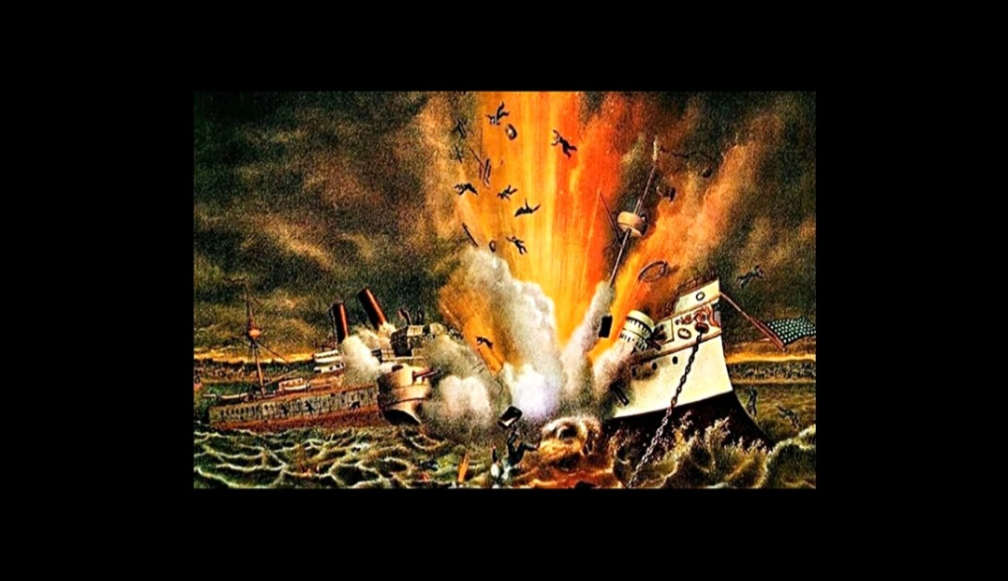
On the evening of February 15, 1898, the battleship USS Maine exploded while docked in the Port of Havana, Cuba. 266 sailors were killed as they slept in their quarters. The ship’s captain and his close officers ironically were not on board.
Washington officials were quick to blame the Spanish government, claiming that the explosion was caused by a floating mine. The fact that many eyewitnesses saw the force of the explosion coming from within the bow of the ship did not matter to U.S. investigators. Whatever the cause, the Spanish government was in no way responsible.

Despite Spain’s repeated diplomatic efforts and willingness to compensate for the loss of life and the destroyed ship, the U.S. government exploited the situation as a perfect excuse for war.
On April 25, 1898, the notorious U.S. President William McKinley, with the consent of the U.S. Congress, made his infamous declaration of war against Spain. The United States would now be recognized as a world imperialist power.
The military campaigns that followed impacted the lives of millions of people in the Philippines, Guam, Cuba and Puerto Rico. They were now to become subjects of a new colonial oppressor.
THE U.S. MILITARY INVASION & COLONIZATION OF PUERTO RICO
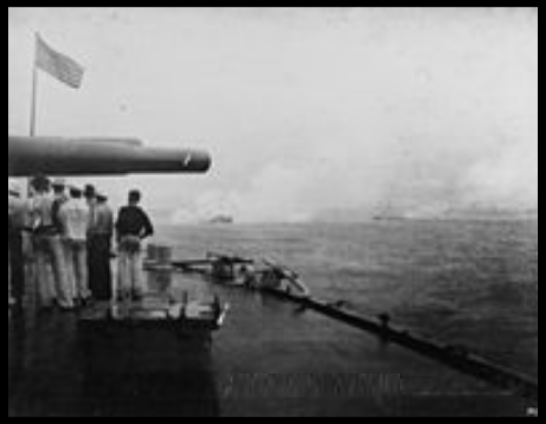
In the early morning hours of May 12, 1898 a fleet consisting of several U.S. Navy warship began the military campaign for the conquest of Puerto Rico. These warships conducted a devastating bombardment on the port city of San Juan, by firing a volley totaling 1,360 shells. Several Spanish Navy vessels were sunk while in the interior of the municipality many buildings were destroyed. What came after was a naval blockade of Puerto Rico’s principal ports.
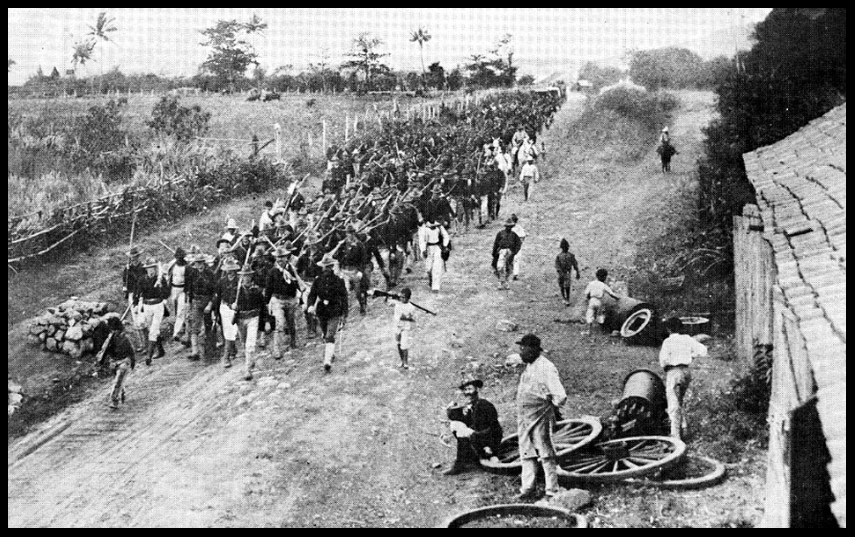
On July 25, 1898, 26,000 U.S. soldiers stormed the shores of Guanica, Puerto Rico — the stepping-stone to the invasion of the entire island nation. The invasion was led by the war criminal U.S. Army General Nelson A. Miles — a reliable servant of the U.S. capitalist westward expansion.
Miles was infamous for his role in the vicious suppression of the 1894 Pullman strike and other labor struggles fighting for the eight-hour day as well as workers right to unionize. He was also known for his capture and mistreatment of Indigenous leaders like Geronimo and Sitting Bull. But among Miles’ most outstanding crimes was the December 29, 1890, brutal massacre of 300 Indigenous men, women and children at Wounded Knee, South Dakota.


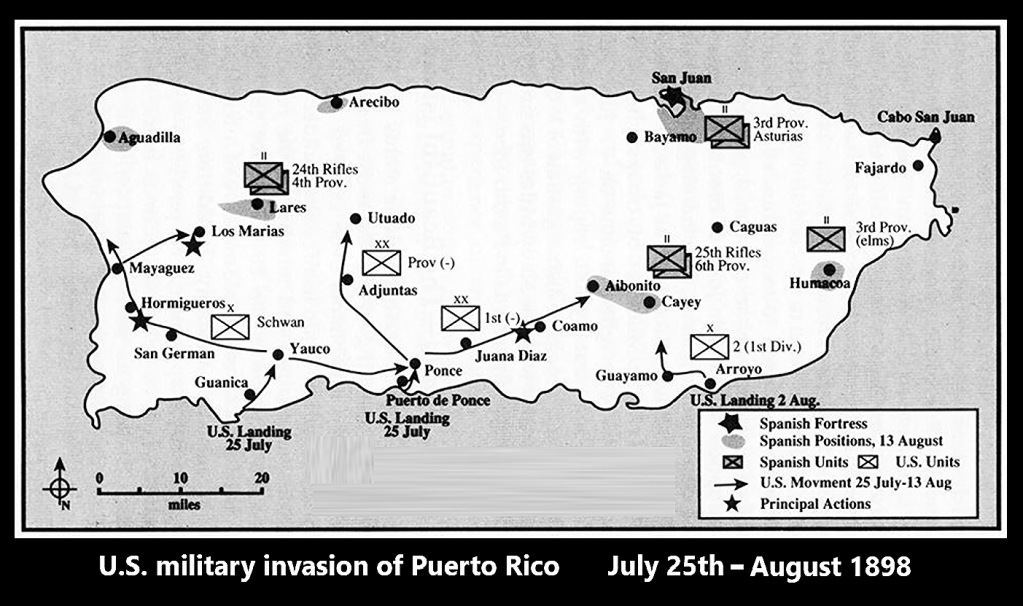
While American troops began their onslaught on Guanica, U.S. warships entered the Bay of Ponce. These vessels threaten to use their destructive heavy guns on the city if the inhabitants did not surrender.
As the U.S. Army marched through the mountains, they encountered peasants who had been forewarned of the invasion’s brutality. These mountain people (Jibaros), armed solely with machetes, valiantly attacked the U.S. soldiers. The peasants who were captured by the invading forces were often bound to trees and shot by firing squad.
The U.S. military occupations in the Philippines, Guam, Cuba and Puerto Rico were the opening shots of a wave of imperialist invasions over the next decades in the Western Hemisphere and other parts of the world.
U.S. troops were sent to Nicaragua in 1898 and again in 1899, 1907 and 1910, and from 1912 through 1933; Panama from 1901 through 1914 and again in 1989; Honduras in 1903 and again in 1911; the Dominican Republic in 1903 and again in 1965; Korea in 1904 and again in 1950; China in 1911; Mexico from 1914 through 1918; Haiti from 1914 through 1934; Cuba in 1898, 1906 to 1909, 1912 and again from 1917 through 1933; the Soviet Union from 1918 through 1922; Guatemala in 1920; Vietnam from 1955 through 1975; Grenada in 1983, Afghanistan in 2001, Iraq in Mar 20, 2003 and so on.
The list of U.S. military invasions continued throughout the 20th and 21st Centuries. With hundreds of military bases and interventions around the world it became a constant feature of world affairs to the present day.
CONTINUED ANTI-COLONIAL STRUGGLE
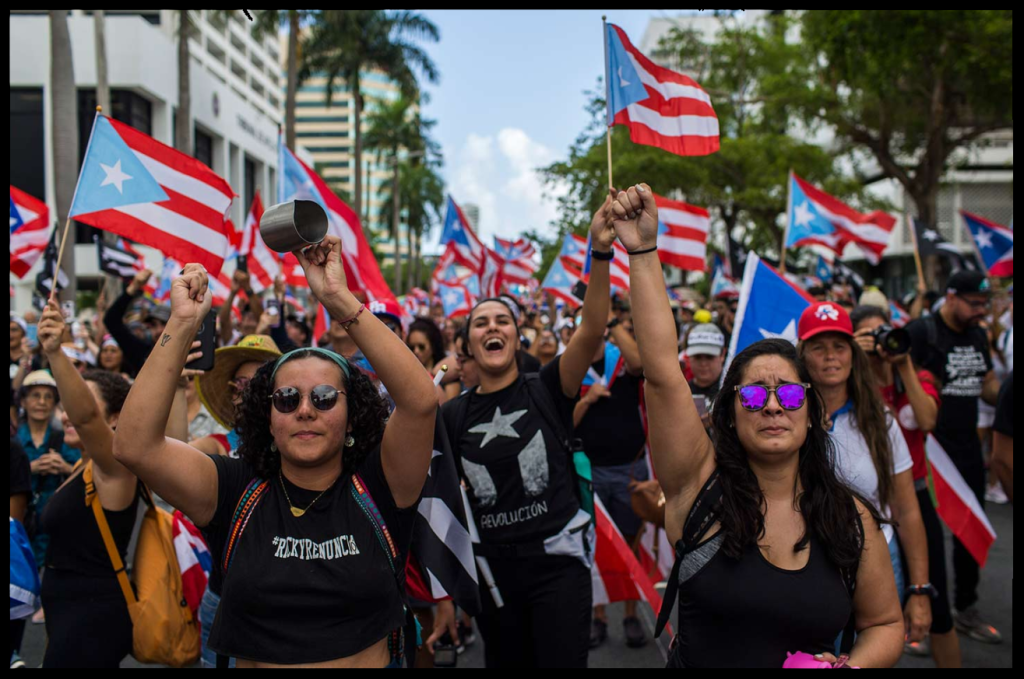
The corporate media has always made every effort to disguise the foreign subjugation of Puerto Rico. But events occasionally occur that push the truth to the surface, especially when the colonized people are driven to rise up and rebel.
Due to colonial circumstances Puerto Rico is one of the most plundered inhabited territorial entities on the globe. Giant U.S. corporations extract an average of $30 billion dollars annually in profits. For a country with a population less than 4 million makes the rate of exploitation one of the highest per capita in the world. This is why Puerto Rico continues to suffer economic devastation, especially after Hurricane Maria and since the COVID pandemic.
Because the United States is the most advanced capitalist country in the world, for it to use the oldest form of foreign subjugation dating back to the Assyrian, Greek and Roman Empires, says volumes about the barbarity of U.S. colonial policy.
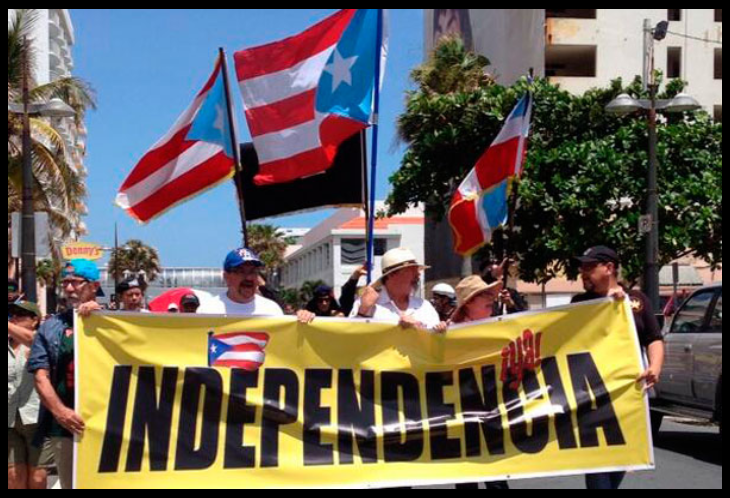
Denying the right of self-determination and independence justifies the continued people’s resistance, in Puerto Rico and throughout the diaspora. And with growing discontent throughout the world, the Puerto Rican liberation struggle shall inevitably contribute to the global elimination of the imperialist system.
QUE VIVA PUERTO RICO LIBRE!









 carlitoboricua