You say you’re disappointed – what on earth were you thinking about when Mueller was first appointed special counsel?
Sure the rulers are not homogeneous and are contentious among themselves, but keep in mind that it was an inquiry created by and approved by them. Mueller, who is also a Republican, is a staunch cadre of the ruling class, and is highly regarded by them. His military career and as Director of the FBI under both Republican and Democratic presidents confirms his complete loyalty to this system.
If there is a strict rule these villains in power live by is to protect the political integrity of the capitalist system. Mueller’s investigative mandate was not aimed to protect “democracy”, but rather, to protect a system of exploitation, social privilege and inequality.
Whose interest did you think the special counsel really represented? Certainly not our’s, the tens of millions of working class people who are being impacted by the policies of the Trump administration, and every administration that came before — which have acted consistently with the interest of the ruling class — a class interest that Democrats also represent. This fiasco was more like thieves investigating thieves.
Of course Trump should be indicted, most people in this country will agree. In fact, people are now speaking about the Mueller Report everywhere with the highest level of disappointment. But what Trump should have been investigated, indicted and imprisoned for goes beyond collusion — which many in the ruling class are also motivated to engage in for their business interest.
What Trump is indisputably guilty of is stepping up the full agenda of billionaires in this country, who conspire daily to execute an onslaught against poor working class, people of color.
What Trump is guilty of is working feverishly on eliminating the gains African Americans made during the Civil Rights movement and openly legitimizing traditional racist groups like the Ku Klux Klan and the Nazies. He is also guilty of degrading Mexican Americans, Puerto Ricans, Muslims, and other people of color. Special Council Mueller’s mandate did not include addressing questions of social oppression which are the unavoidable consequence of capitalist society.
Trump should also face criminal charges for plotting war against Venezuela; his disgusting and offensive disposition towards the Palestinian people when he established a U.S. embassy in Jerusalem; and his hurtful, chastising imperial behavior towards Puerto Rico, as thousands died horribly as a result of Hurricane Maria.
YES, Trump should be investigated, indicted and imprisoned, but by a people’s tribunal that can guarantee justice in the fullest sense, independent of financial interests and the intricate connections within the ruling class. Such would require a people’s revolutionary movement. Not only would Trump be held accountable for his criminal activities but so too would the capitalist system and the white supremacist movement which he represents.
The U.S. colonization of Puerto Rico began as a consequence of the Spanish-American War in 1898. Cuba, Guam, the Philippines and Puerto Rico were deemed as “spoils of war” — the result of Spain’s surrender to the United States. Puerto Rico was then colonized by a new tyrant. The island nation soon after became a staging ground for U.S. military ventures throughout the Caribbean and all of Latin America; a practice that continues to this day.
Throughout the history of the U.S. colonial presence in Puerto Rico outspoken advocates for independence have been the targets of Draconian measures. Members of the Nationalist Party of Puerto Rico lived under the constant threat of being blacklisted from employment, having their homes firebombed, imprisoned, tortured or killed by various repressive agencies.
U.S. colonial policy in Puerto Rico has always been administered with complete disregard for the wishes of the Puerto Rican people. It was precisely the disposition of colonial rulers which brought about one of the most horrifying events in Puerto Rico’s history.
The Ponce Massacre
In the city of Ponce, a peaceful demonstration was being planned for Palm Sunday, March 21, 1937. It was intended to commemorate the 1873 abolition of African chattel slavery in Puerto Rico and to demand the immediate release of imprisoned Nationalist leader Dr. Pedro Albizu Campos
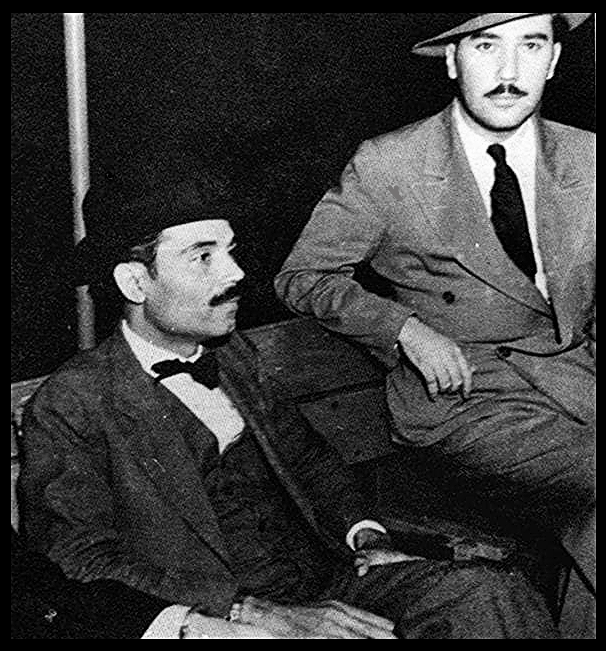
Campos was serving a ten-year sentence for seditious conspiracy to overthrow the U.S. government by force along with other leaders of the Nationalist Party which included its Secretary-General,Juan Antonio Corretjer(March 3, 1908-January 19, 1985).
Dr. Pedro Albizu Campos and Juan Antonio Corretjer.
Although permits were not required by law for public gatherings the organizers requested permission regardless as a show of respect for the sympathetic mayor of Ponce, José Tormos Díego. The organizers were granted a legal permit to proceed with their plans.
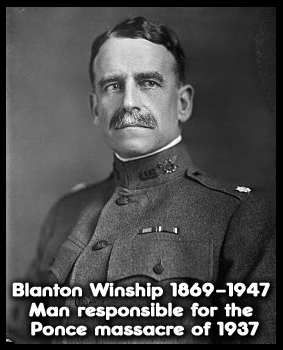
The notorious U.S. Army General Blanton Winship was appointed colonial governor by U.S. President Franklin D. Roosevelt, and answer only to him. Despite the “progressive” and “liberal” projections made by bourgeois historians and apologists, Roosevelt was just as brutal as any colonizing head of state acting with impunity. Puerto Ricans suffered tremendously under the FDR administration and Gen. Blanton Winship’s racist implementation of colonial policy.
Outright brutality was the preferred form of administering colonial rule in Puerto Rico. Winship tried everything possible to stop the scheduled nationalist event, including using blatant gangster-type methods aimed to intimidate the organizers. However, the Nationalists were resolute men and women of conviction.
In this period of intense repression, the U.S. government, through Winship, sought to stamp out all nationalist sentiments and the self-identity of nation — especially its quest for independence and self-determination.
On that Palm Sunday morning, hundreds of people – women, children and men – gathered at the town plaza, in defiance of the colonial government’s wishes. Among those who assembled were women dressed in all white who gathered as Nurses of the Republic; the mostly youth comprised Cadets of the Republic — the para-military wing of the Nationalist Party was present in uniform, black shirts and white pants; church congregations and community residents attended to form their contingents.
Re-enacting the Ponce Massacre.
A Nationalist color guard in military formation unveiled the Puerto Rican flag, outlawed by the U.S. colonial government. With clenched fists in the air, the crowd began to proudly sing “La Borinqueña“ — the original (revolutionary) version of the Puerto Rican national anthem, written by Lola Rodriguez De Tio.
At this point, the police had sealed off the area where the Nationalist protest was gathering. With grenades, tear-gas bombs, carbine rifles and Tommy sub-machine guns, under the directions of Blanton Winship the police prepared for the bloody onslaught.
Once the crowd began to march, knowing that the mostly young participants were unarmed, the police did the unimaginable — they opened fire.
Carlos Torres Morales’ photo of the actual moment when the Ponce Massacre began.
The barrage lasted about 13 minutes. The participants which included the elderly and children, helplessly attempted to escape the unexpected horror. People desperately ran to save their lives from bullets flying everywhere. They screamed terrified as they witnessed the chaos and blood splattering bodies of compatriots who fell to the ground from gunshots wounds.
One police officer of Puerto Rican origin, who was sympathetic with the Nationalist cause for independence, was shot in the back and killed by his commanding officer for refusing to participate in the mayhem against the unarmed crowd.
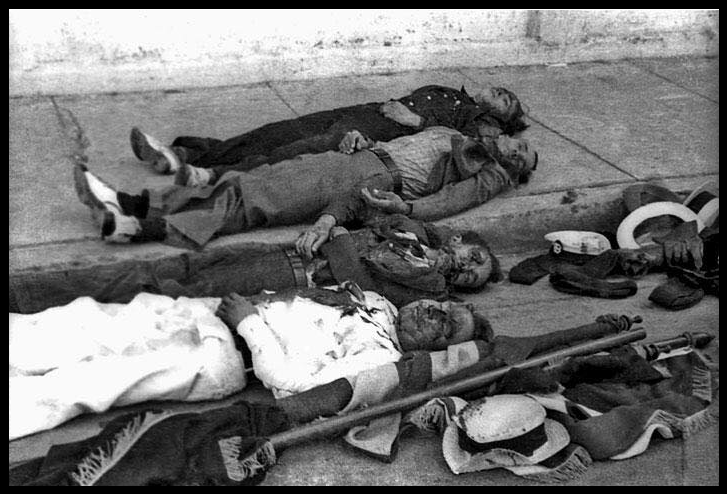
When the shooting ended, 21 people had been killed and over 200 were critically wounded. The American Civil Liberties Unioninvestigated the tragedy. It was concluded by forensic inquiry that those who died were shot in the back. The event brought sadness and shock throughout Puerto Rico. The funeral procession for the martyrs was one of the largest in the country’s history — about 20,000 people attended.
Victims of the Ponce Massacre.
The cruelty of the Ponce Massacre sheds light on many other heinous acts committed by the U.S. in Puerto Rico. Destruction, death, plunder and rape are the trademarks of colonialism. U.S. rulers perceive Puerto Ricans as expendable; let us not forget how in 2017 Washington officials allowed 4,746 Puerto Ricans to die from neglect, following the devastation caused by Hurricane Maria.
“It was love for the freedom of our homeland — Puerto Rico,” Nationalist iconic figure Doña Isabel Rosado once said, “that gave strength to the martyrs of Ponce. Nothing in this world is more powerful than this emotion — not even the guns of the colonial assassins.”
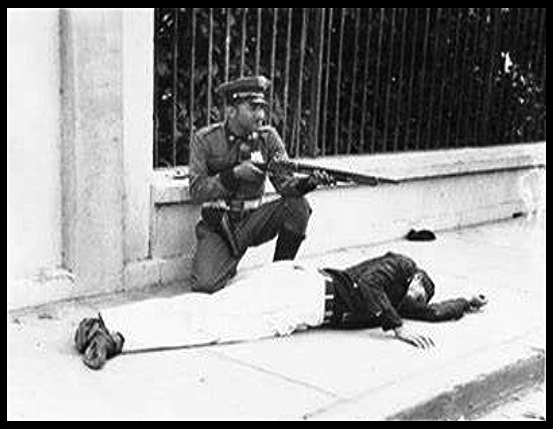
A Nationalist laying on the pavement after being killed by the colonial police.
And it is precisely this emotion that worries U.S. colonialism even to this day — an emotion that will prove fatal to them when the Puerto Rican masses eventually rise up to avenge the Ponce Massacre.
Changing the form of colonial rule
The nationalist movement that rose up in the first half of the 20th Century compelled the U.S. colonizers to change their methods of subjugating the people of Puerto Rico. Long after the Ponce Massacre, decades later into the present day, the U.S. colonizers became more sophisticated in their methods of domination.
By 1952, Washington, DC allowed some semblances of “democracy,” in an attempt to fool the people of Puerto Rico with illusions of self-determination and to disguise the exploitative nature of the colonial relationship before the eyes of the world.
A depiction of the Ponce Massacre by artist Pedro Brull.
The U.S. colonizers developed such a confidence in their new tactics of colonizing that they became willing to allow individuals of Puerto Rican origin, like the notorious Luis Muñoz Marin, to serve as governor of the colony years later, in the U.S. House of Representative and the Federal Supreme Court.
The rulers have no problem granting Puerto Ricans visibility — what they have problems with is granting Puerto Ricans political power, that is, independence. And because freedom is never granted from the “goodness” of an oppressor, it will require a revolutionary mass movement to obtain it.
The U.S. empire is more vulnerable than what most people realize. It has brought on itself enemies in every part of the globe. We should feel assured that Boricuas will rise up in rebellion one day and win the historical struggle for independence. On that glorious future moment Puerto Ricans will make their contribution to the worldwide defeat of U.S. imperialism.
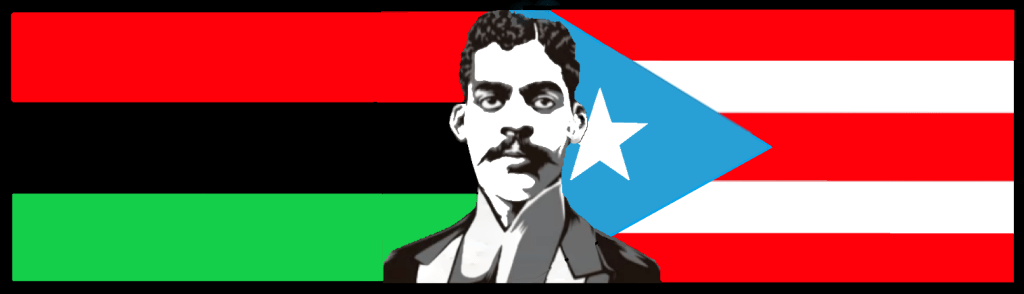
Arturo Alfonso Schomburg was born on January 24, 1874 in Santurce, Puerto Rico. He was a Black Puerto Rican scholar, historian, author and activist, who devoted his entire life to compiling vast collections of writings and art documenting significant events in Black history.
When Schomburg was just 8 years old he was told by a school teacher that Black people had no history. This assertion naturally bothered him for a long time. But as he gradually grew older, Schomburg found the teacher’s claim to make absolutely no sense. That encounter became Schomburg’s motivation which led him to set out and prove wrong such racist notions.
African chattel slavery also took place in Puerto Rico, it was the consequence of Spanish colonialism in both Africa and Latin America. In the year 1527, the first of many slave revolts in Puerto Ricooccurred which was among the bloodiest in Western Hemisphere history.
Despite the numerous contributions Schomburg made to the preservation of Black-Latino history, like many other Black scholars and professionals in different fields, he was not immune to anti-Black discrimination. Throughout his entire life, Schomburg experienced blatant racism, sadly within the Puerto Rican community as well.
Colorism, as an extension of white supremacy, often permeated conversations about “Los prietos” (the dark ones), “Pelo bueno y pelo malo” (good hair and bad hair), and so on. As in the United States, the not-so-hidden practices of racism has also existed in Puerto Rico and all of Latin America, like the widely known anti-Black, anti-Haitian “legal” practices of the Dominican Republic.
Arturo Schomburg was instrumental in documenting the role of African people in the cultural development of the Puerto Rican nation. The psychic, spirituality, linguistics, diet, music and dance of Puerto Rico pointed to the contributions made by Africans. Schomburg proudly identified as an Afroborinqueño (Afro-Puerto Rican).
Harlem Renaissance & Puerto Rico’s independence struggle
Schomburg became known during the famous Harlem Renaissance. He collaborated with prominent figures like Marcus Garvey, Carlos A. Cook, Hurbert Harrison, Langston Hughes, Alain Leroy Locke, W.E.B. Du Boisand other pillars of that movement. It was an exciting and enlightening period in history for the African diaspora, following the struggles to end the horrors of slavery. Harlem was viewed as the political and cultural Mecca of Black people.
The Harlem Renaissance, which unveiled the beauty of African culture also shattered many racist myths. This movement resulted from Marcus Garvey’s call for Black people to be profound with their identity in all areas of dignified expression. It succeeded in challenging the ideological facets of white supremacy through the literary, visual and performing arts.
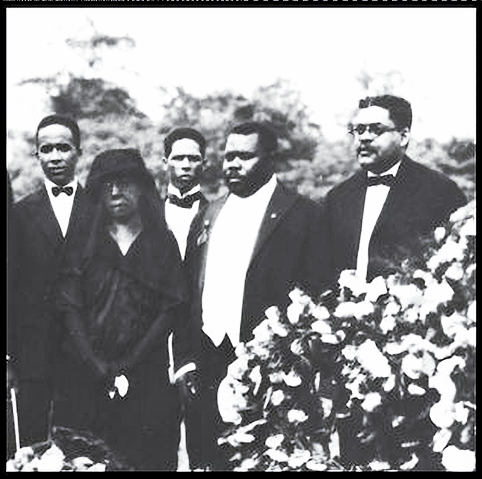
Marcus Garvey, Arthur Schomburg and other mourners at the grave of John E. Bruce
Before moving to New York City, at 17 years old, Schomburg was a leader in the secret Revolutionary Committee of Puerto Rico. This organization was created several years before Schomburg’s birth for launching the 1868 anti-slavery & pro-independence revolt known as El Grito De Lares. Although the attempt to rid Spanish colonialism failed, the Revolutionary Committee continued to exist clandestinely.
Schomburg was a firm advocate for Puerto Rico’s independence. In fact, he was the founder of Las Dos Alas (in English The Two Wings), an organization in New York City devoted to the independence cause of Puerto Rico and Cuba.
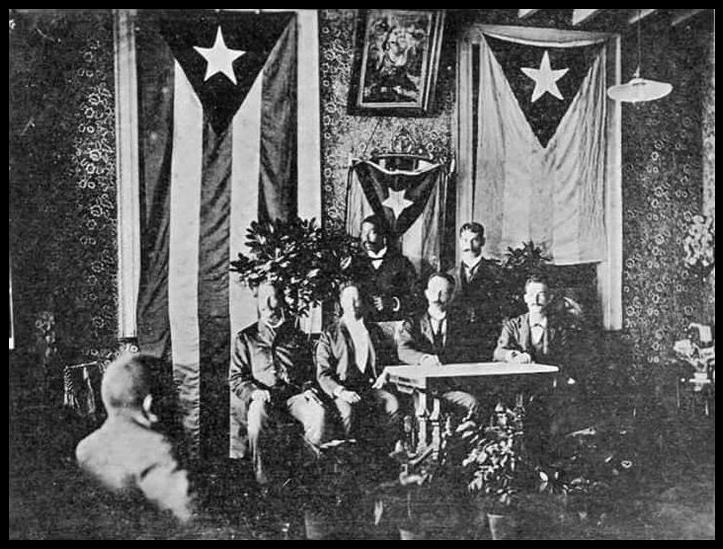
In 1895, Schomburg partook in a secret meeting held at New York City’s Chimney Corner Hall to discuss and approve by vote a proposed design for what became the official Puerto Rican Flag of today. The attendees of this meeting were mostly political fugitives being sought by the Spanish colonial authorities. Most of them became affiliated with the Cuban Revolutionary Party under the leadership of the legendary Jose Marti.
December 22, 1895, Chimney Corner Hall, New York City, where the Puerto Rican Flag was approved by vote. Schomburg was among the 59 delegates that partook in the decision of this secret meeting.
Schomburg shifts focus
But as the 19th Century came to a close with the U.S. military occupation of both Cuba and Puerto Rico, caused the independence movement in both countries to enter a period of stagnation. The anti-colonial struggle was temporarily paralyzed due to many people believing the overtures of U.S. invaders who promised to grant independence. As a result, Schomburg and other like-minded activists who resided outside of Cuba and Puerto Rico, began to re-vise their activities based on the change in the climate of imperialism.
Thanks to the powerful momentum inspired by Marcus Garvey and the Universal Negro Improvement Association and African Communities League (UNIA-ACL) Black people now had relative freedom to develop culturally, economically and politically in the surroundings of a white racist society. This was the setting in which Arturo Schomburg was able to make his contributions to Black history.
As the persecution of Black people in the United States intensified, with the extension of Jim Crow laws, lynching and white racist riots presenting a dangerous and menacing setting, coupled by Schomburg’s childhood memory of a demeaning comment made to him by a schoolteacher, raised his commitment to the idea of affirming the validity and truth of Black history.
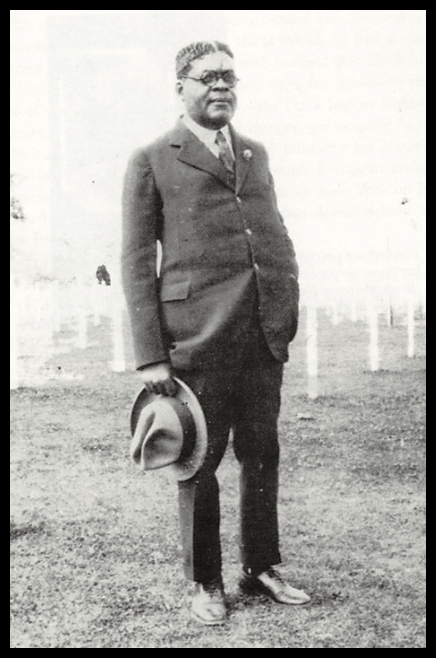
Arturo Alfonso Schomburg in New York City, 1932.
Ridiculing the racist fables about the origins and history of Black people became Schomburg’s central focus. His noble quest eventually proved the extent of white supremacy’s corruption and baseless reasoning for existing.
Once in New York City, and for the remainder of his life, Schomburg collected large amounts of materials relevant to the history of Africa and the African diaspora. His work unavoidably brought to light the falsehood of white historians who interpreted the history of human social development strictly from a European perspective, thus concealing what are the African people’s pivotal role in that process.
Although Arturo Schomburg never proclaimed to be a revolutionary, his academic achievements coupled with such fervent passion to preserve and protect the historic culture of the Diaspora shows otherwise. Long after his death, Schomburg’s accomplishments continue to shatter racist myths.
A 24″ X 30″ canvas portrait I made of Arturo Alfonso Schomberg.
His devotion to raise Black history to its rightful grandeur contributed immensely to the ideological struggle against white supremacy, thus, adding to the majestic qualities of Black nationalism.
Moreover, Schomburg was a consistent leader of debunking the dangerous narratives of racial superiority that ushered in social Darwinism and Eugenics. These world perspectives were often used by capitalists to politically hinder and divide working class people.
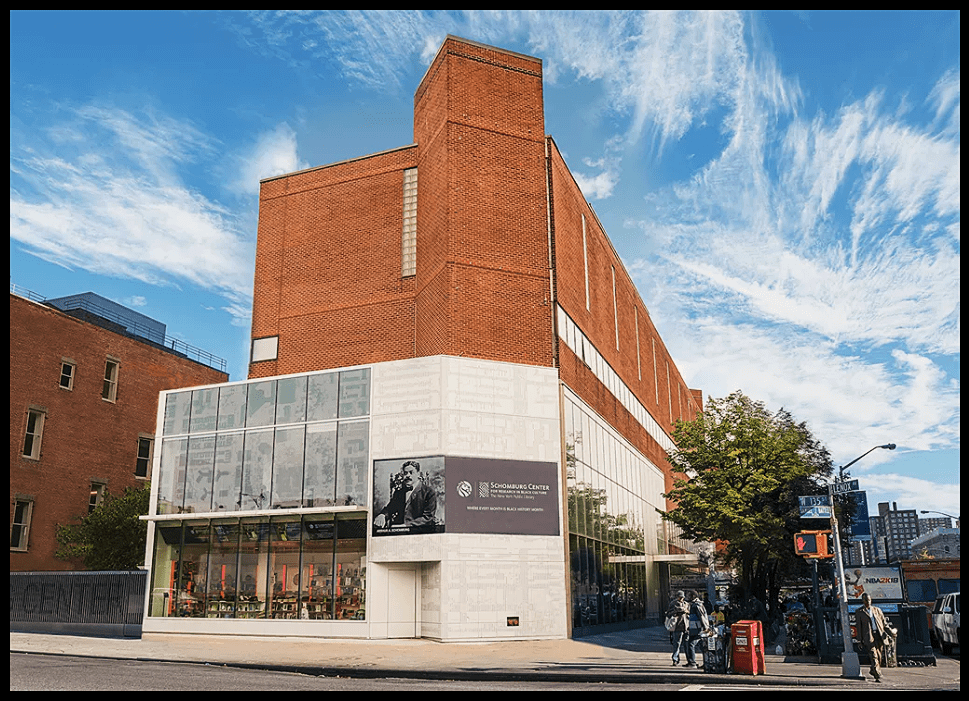
Schomburg Center for Research in Black Culture — Harlem, New York City
The vast and beautiful collection of literature and art materials he compiled throughout his life are permanently housed at the New York Public Library’s Schomburg Center For Research of Black Culture, located at 515 Malcolm X Blvd, in Harlem, NYC.
Arturo Afonso Schomburg shall be remembered for his bold intellectual defiance and as a hero of the oppressed. His lifelong contributions have strengthened the legitimacy of Puerto Rico’s independence cause as well as the historical struggle for Black liberation. Schomburg’s’ life embodied the epitome of Black & Puerto Rican solidarity.
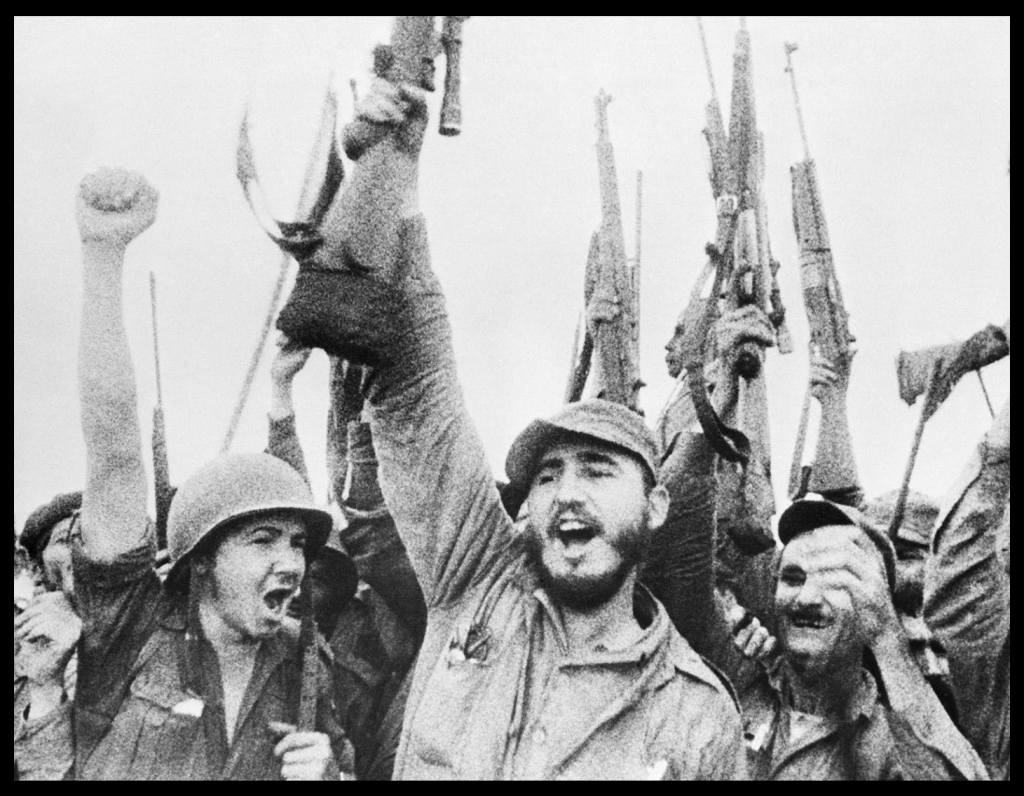
On New Year’s Eve, December 31, 1958, the revolutionary Rebel Army of the July 26 Movement, under the leadership of Comandante Fidel Castro Ruz, entered the capital city of Havana, Cuba. This was the final act in the overthrow of the notorious U.S.-sponsored Fulgencio Batista regime.
The closer the guerilla army approached the city on foot, horseback and vehicles, the more frantic the oppressors of the Cuban people became. Their world of lavishness with cocktails drinks on hand was abruptly disrupted.
Mafia gangsters, prostitution pimps, drug peddlers, casino club owners, CIA operatives and other imperialist agencies, military and police officials as well as top bureaucrats of Batista’s government, were all crowding Havana’s airport in a desperate rush to leave Cuba, in order to avoid capture by the guerillas.
This event marked the dawn of a new era in that country’s history while at the same time posing a threat to U.S. imperialism’s predatory intentions throughout the Western Hemisphere.
The Cuban Revolution had a tremendous impact on political circumstances in Latin America, the Caribbean and most especially in the United States, where a mass upsurge was erupting. In every sense, Cuba followed the examples of its neighbor, the glorious 1804 Haitian Revolution. It has been one of the greatest advantageous events for liberation struggles in Latin America, Africa and Asia.
Comandantes Camilo Cienfuego (left), Fidel Castro Ruz and fellow combatants entering the City of Havana.
Ever since the revolution’s military victory, and despite the criminal economic blockade it continues to endure, Cuba has been fiercely outspoken about the bullying foreign policies of the United States that keeps the Haitian people in a downtrodden colonial existence.
After the seizure of power, Cuba has also been a consistent advocate for Puerto Rico’s right to independence. The Cuban revolutionary government has brought to light at the world stage the horrendous nature of U.S. colonialism in Puerto Rico.
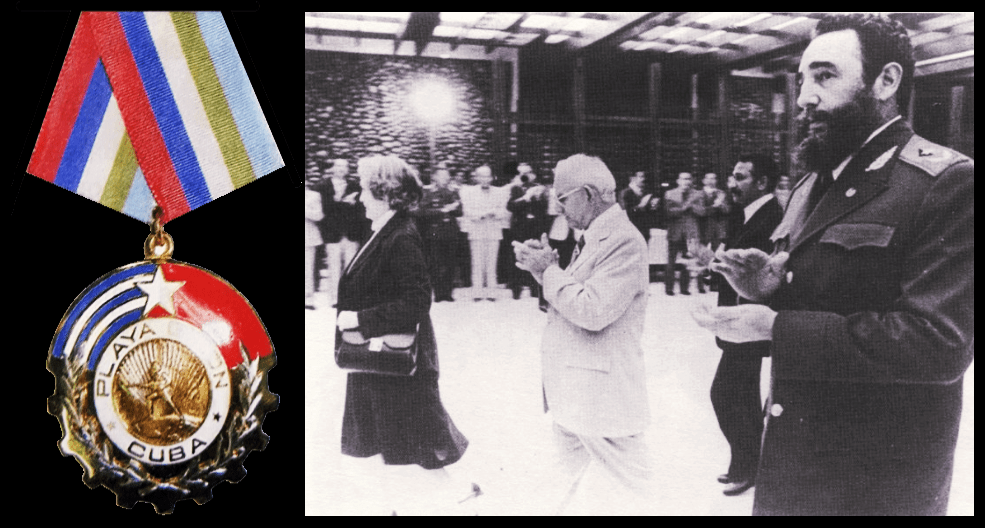
In 1980, Fidel Castro Ruz invited to Cuba the newly released Puerto Rican Nationalists political prisoners, Lolita Lebron, Rafael Cancel Miranda, Irvin Flores, Andres Figueroa Cordero, and Oscar Collazo. The Puerto Rican patriots came to Cuba to receive that country’s highest honor, the Medal of the Order of the Bay of Pigs.
Puerto Rican Nationalists being welcomed by Fidel Castro Ruz at a ceremony of honor, 1980.
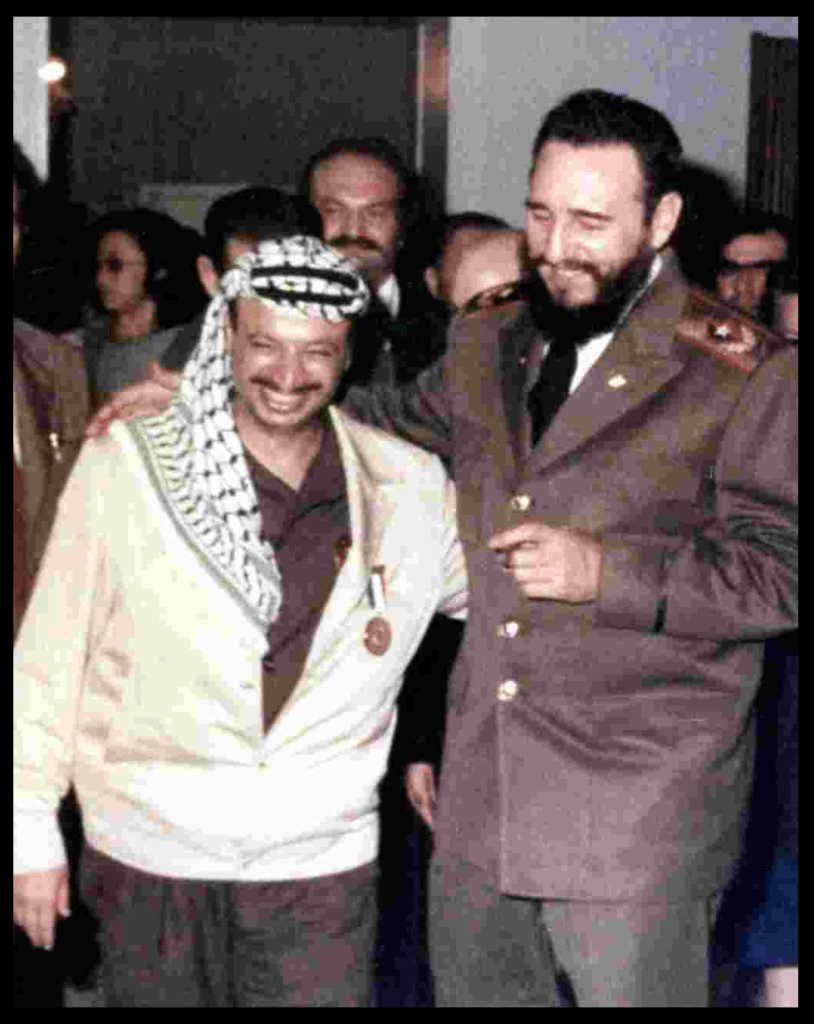
Revolutionary Cuba provided political and logistical support to the Palestinian liberation struggle. And it sent thousands of Cuban troops to Africa in an effort to assist freedom fighters there in their quest.
Cuban President Fidel Castro Ruz welcoming Palestine’s Yasser Arafat.
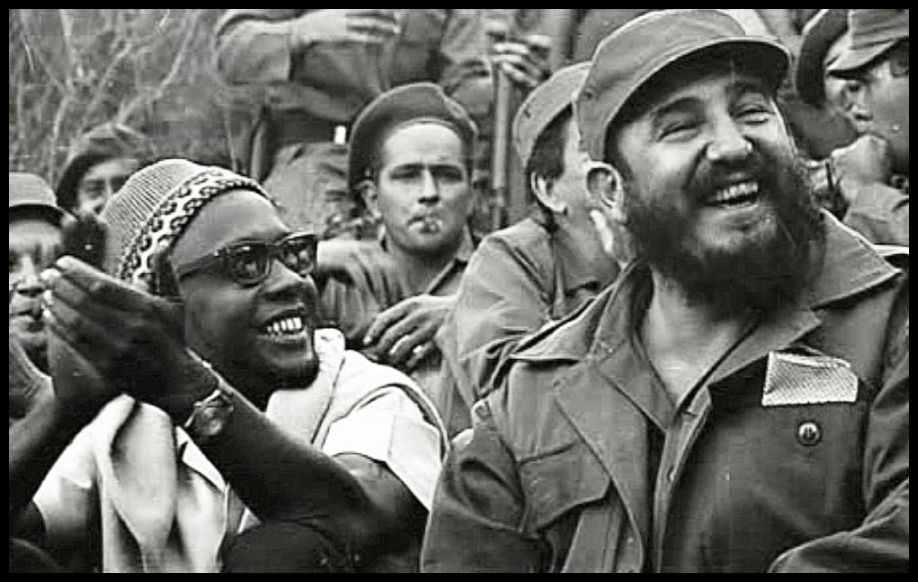
Cuban President Fidel Castro Ruz visiting Amica Cabral during the revolution in Guinea–Bissau.
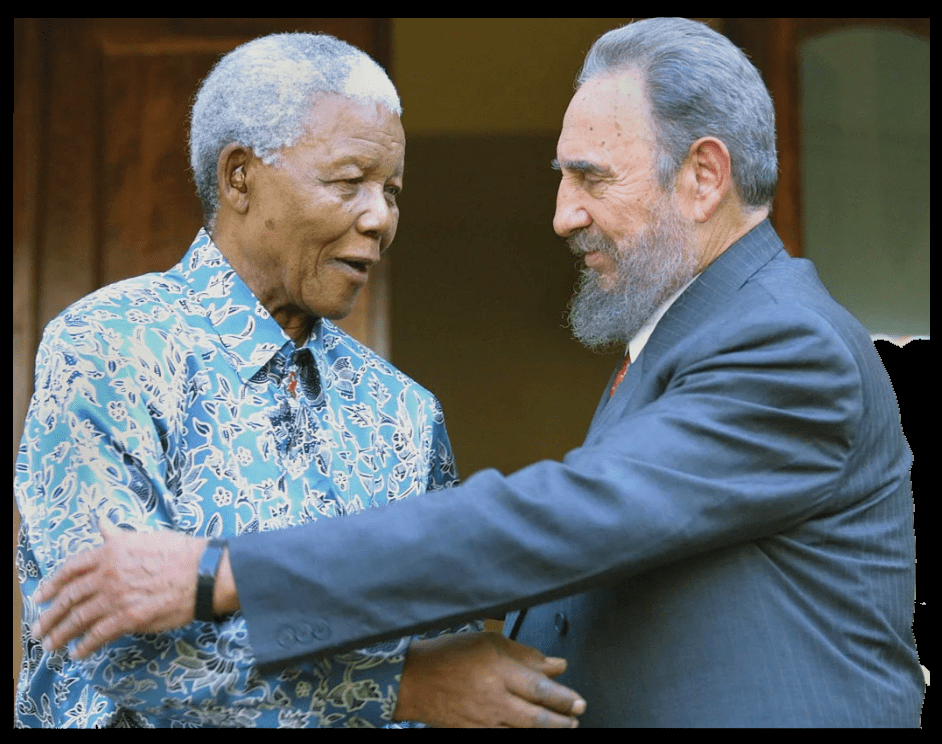
The most notable example of Cuba’s solidarity with Africa’s freedom struggle is the Battle of Cuito Cuanavale. In a combined effort with the Angolan military the Cuban Army surrounded and smashed the racist apartheid South African Army. It was this event that caused the gradual demise of Apartheid rule in South Africa, thus facilitating favorable political circumstances which brought about the release from prison of Nelson Mandela.
South Africa’s Nelson Mandela and President Fidel Castro Ruz.
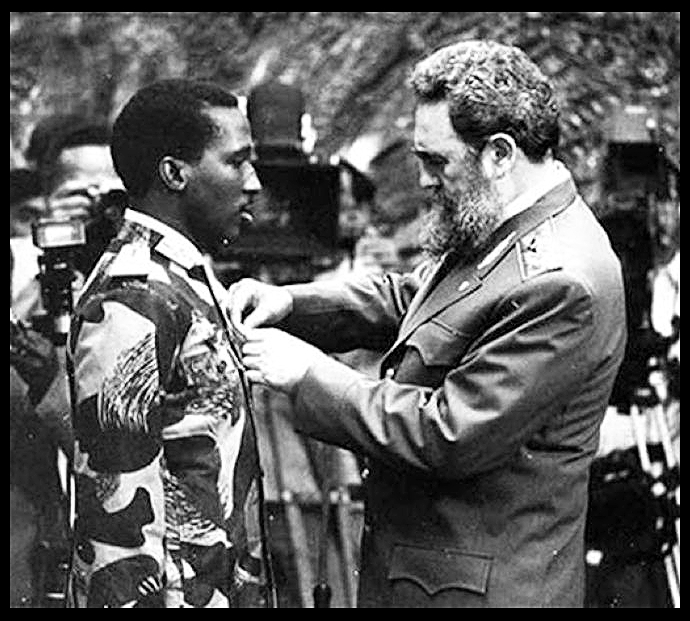
Cuban President Fidel Castro Ruz awarded Thomas Sankara with the Order of Jose Marti for his role in the liberation struggle of his people and upholding internationalist solidarity.
Of the most notable of Cuba’s acts of humanitarianism is its creation of the Latin American School of Medicine. Students from poor and oppressed communities from the United States and Third World countries, who otherwise could not financially afford it, are provided with a free education to become medical doctors, paid for by the Cuban government.
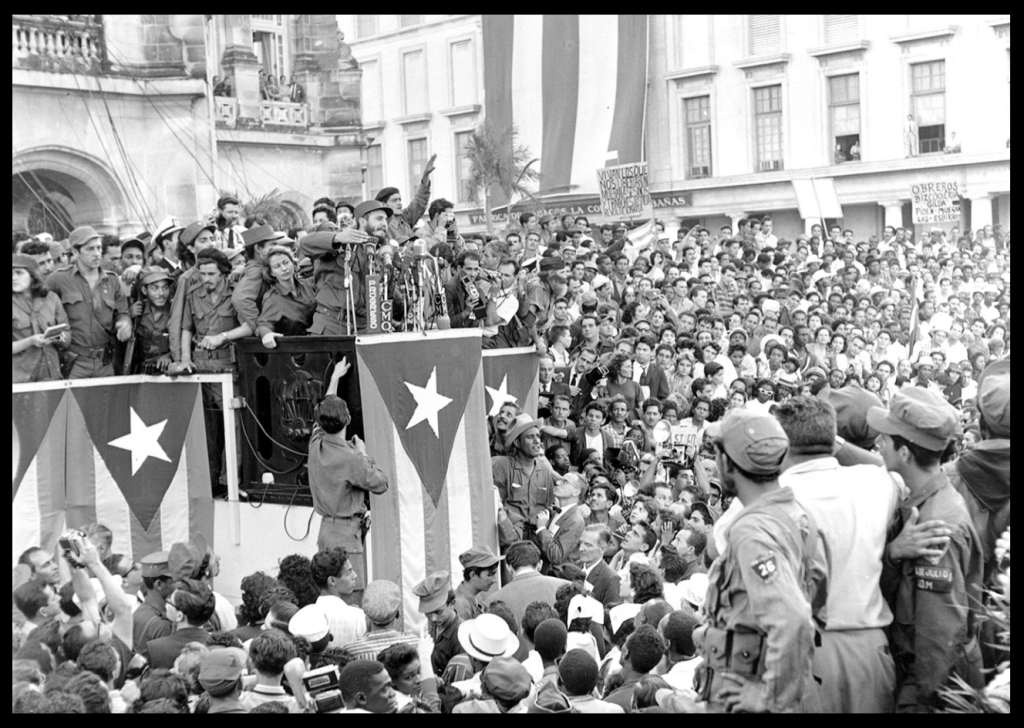
Comandante Fidel Castro Ruz addressing a crowd of tens of thousands.
And to demonstrate how serious the Cuban Revolution is about its convictions and sense of humanity, many people in poor countries have received medical attention for the first time thanks to Cuba’s well-known international medical program. In addition, Cuba has sent thousands of trained medical professionals to the poorest communities throughout the globe to heal and prevent deceases, even under the most dangerous circumstances.
Women in Cuba’s Revolutionary Armed Forces.
Cuba has also provided a safe haven to many political refugees sought by the agencies of imperialism, like Puerto Rican freedom fighter William Morales and Black Panther Party/Black Liberation Army (BLA) sister Assata Shakur. Cuba has also been a firm supporter for the release of political prisoners in the U.S., like Mumia Abu-Jamal.
Assata Shakur and William Morales were granted political asylum by the Cuban government.
Justice now had a new meaning, defined by the revolutionary aspirations of the oppressed. Uniformed villains of the Batista military and police who once tortured, murdered and raped the people were rounded up and brought to face criminal charges. Tribunals were held throughout the country for all to witness and participate in a completely new form of justice — People’s Justice — in which victims partook by providing testimony and in deciding the fate of overthrown government officials.
Batista government officials facing criminal charges at a Revolutionary Tribunal.
Thanks to the Cuban Revolution the people were no longer deprived of free healthcare, free education, and access to food. Such are the vital necessities denied to the working poor here in the United States.
It has been more than six decades since the military defeat of the U.S. puppet Batista government and the Cuban people remain firm on defending their right to self-determination. They have been exemplary in their resilience in the face of repeated U.S. attempts to undermine their sovereignty.
These attempts include terrorist actions on Cuba’s tourist industry, CIA subversive attempts to incite counterrevolutionary activities within the country, 600 known attempts on the life of the late Fidel Castro Ruz, and a criminal economic blockade that continues to this day.
Raul and Fidel Castro among others overwhelmed by the jubilant moment.
Despite these acts of aggression and Washington’s 65 years propaganda war aimed to demonize the revolution, no one can deny Cuba’s achievements in eradicating illiteracy, advancements in medical science, food production & agriculture, housing development and the infrastructure.
Cuba’s revolutionary leadership has prioritized the needs of the people and continues to make good on its pledge never to allow returning the country back to the domination of the United States. So, as we celebrate the coming of the new year, we should salute the Cuban people on their glorious anniversary. And may the year 2025 bring us a step closer to a world without exploitation, deprivation, oppression and racist violence.
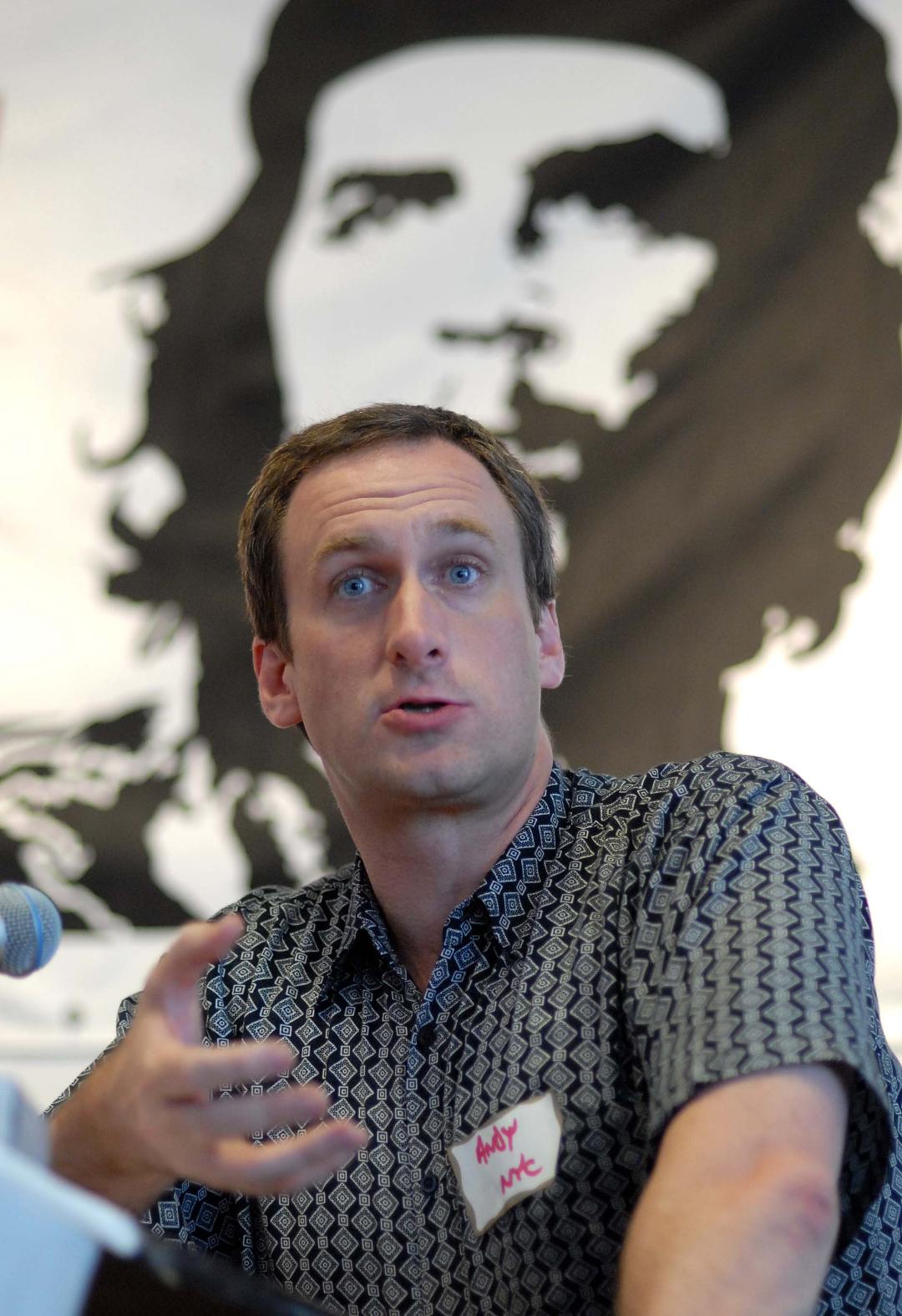
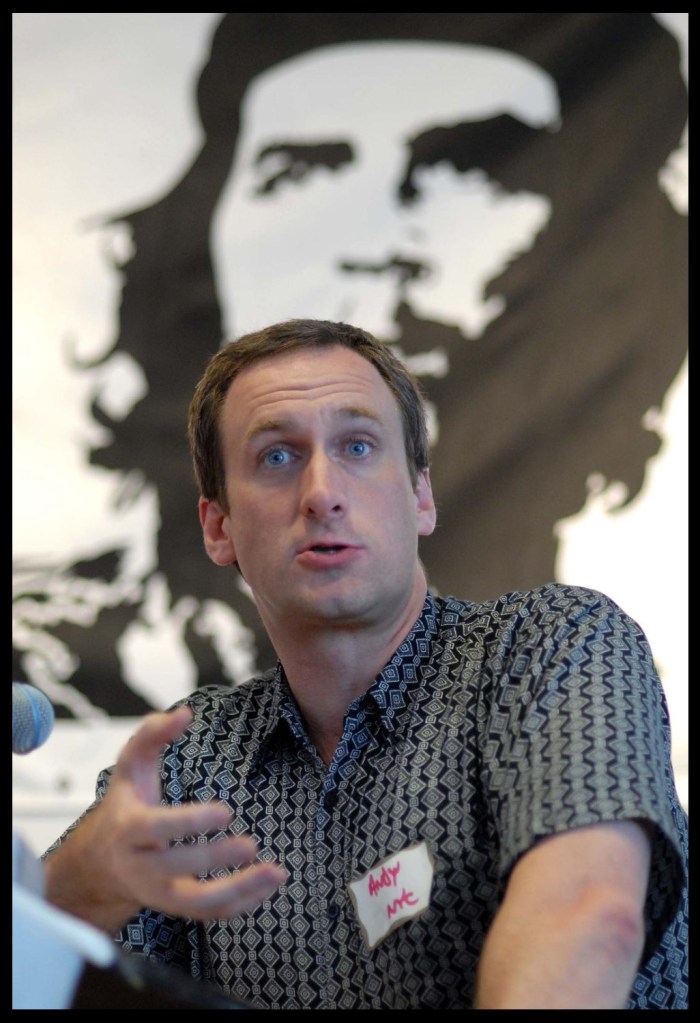
It saddens me to announce that on the evening of Monday, December 10, 2018, long time revolutionary activist Andy Mcinerney passed away after losing a long battle with cancer. As if it wasn’t enough losing my sweetheart & love of my life, Ana Lopez Betancourt, in the month of May 2018, I now grieve another major loss, my very best friend, brother and comrade, Andy Mcinerney.
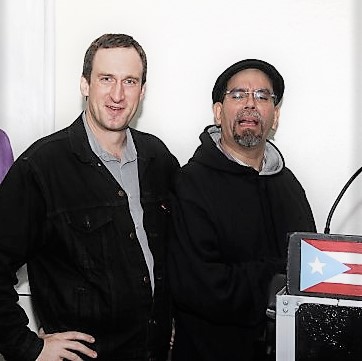
Andy and I at a Free Puerto Rico event 2011
Andy was a professor at Bronx Community College in New York. He will surely be missed by the many whom he taught as well as his colleagues who partook in struggles for bettering college level education and for increasing the benefits and salaries of professors.
Andy was a communist. He was always fascinated when learning about the liberation struggles of oppressed people. He was adamant about white progressives today requiring having the same disposition John Brown once had against African chattel slavery, if they sincerely claim being anti-racist. I always had respect for Andy, since I envisioned him fighting alongside John Brown if he were to live during the 1859 attack on Harpers Ferry.
As a person of white origin himself, Andy was critical of white leftists who tended to show inconsistencies of conviction, by being soft and evasive of criticizing white privilege and white entitlement. He viewed that kind of behavior unforgiving and a not-so-hidden expression of white supremacist ideology.
Andy and I became good friends during our mutual experience in Workers World Party and in the Party for Socialism & Liberation. It was in our experiences in these entities where our collaboration first grew to the finest pitch, which later on continued.
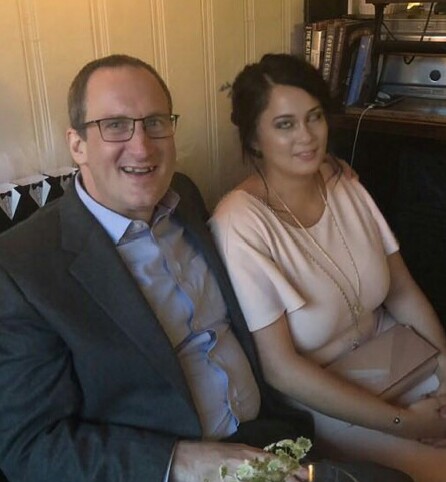
Andy McInerney with his loving partner and spouse, Eline Elara.
Wherever Andy found himself, whether organizing events on campus or mobilizing for mass demonstrations, he always sought ways to promote and apply Marxist-Leninist theory. He recognized that his moral obligation was to build in the present in preparation for the future battle for socialism in the United States.
Andy was indeed a revolutionary who also contributed to my own political development. In 1991 when I first met him the world revolutionary movement went into disarray, resulting from the impact the collapse of the Soviet Union was having everywhere.
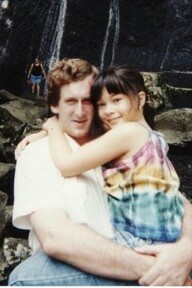
Andy and his daughter Arlen McInerney.
Andy & the very young Arlen McInerney.
He was an optimist, even under dim circumstances. He always told me that the collapse of the Soviet Union was only a temporary victory for imperialism and that we should maintain our course in building for revolution in this country regardless.
Andy understood that throughout history such phenomenon also occurred with other social & economic systems. It was Andy who told me “Not to worry” and enlightened me to how the rise of Napoleon Bonaparte in France was equivalent to the restoration of capitalism in Russia. Bonaparte restored the political power of the monarchy that was defeated by the 1789 French Revolution.
Andy was of Irish descent. He demonstrated the utmost respect to me when he discovered that I was a Young Lord and a Puerto Rican revolutionary nationalist. In our exchanges we strengthened each other’s understanding of the Irish-Puerto Rican connection. It was Andy who first made me aware that Irish revolutionary James Connolly had asked Puerto Rican Nationalist leader Dr. Pedro Albizu Campos to draw up a draft for the Constitution of a free Irish republic.
Ana Lopez Betancourt and Andy McInerney
There is much more that can be said about Andy Mcinerney. He touched the hearts of so many people. His greatest trait which describes his finest qualities as a human being was his incredible love and respect for teaching and learning, a fundamental requirement for what it takes to be a revolutionary. Andy’s disposition came with an eagerness to learn and pass the knowledge on to others.
I will miss you my dear brother and comrade, Andy McInerney. You were always there for me during the thick and thin. There is much about you that I will cherish and feel honored that you were in my life. And above all, I shall eternally be grateful to you for helping me strengthen my resolve to keep fighting until this social system of oppression is finally smashed by the will of the vast majority of oppressed and exploited people.
“We say you don’t fight racism with racism. We’re going to fight racism with solidarity. We say you don’t fight capitalism with no black capitalism; you fight capitalism with socialism.” -BPP Chairman Fred Hampton
In a coordinated effort between the Illinois State Attorney’s Office, Cook County Police Department, the Chicago Police Department and the Federal Bureau of Investigation (FBI), in the morning hours of December 4, 1969, a heavily armed assault team launched a heinous attack on the residence of Black Panther Party, Illinois Chairman Fred Hampton.
With a vicious sense of racist hatred and no regard for human life, these law enforcement officials fired a single shotgun blast through the entrance door of the apartment instantly killing Mark Clark, by striking him to the chest. These murderers then fired their weapons at will through a wall separating the hallway from the apartment, critically wounding Fred Hampton as he laid in bed.
According to accounts, after the police smashed through the front door entering the apartment, one of the police officers who entered Hampton’s bedroom was overheard saying “He’s still alive.” At that point the handcuffed occupants can hear from another room the kill-shot that ended the Panther leader’s life. In a matter of minutes, two inspiring revolutionaries were maliciously murdered.
MARK CLARK WAS A LOYAL PANTHER
Mark Clarke was 22 years old, an enthusiastic youth with talents in the arts. He was eager to fight against the racist oppression Black people endured since chattel slavery. That became the motive why Clark joined the Black Panther Party soon after he met Chairman Fred Hampton during a visit to the BPP national office in Oakland, California. From then on Hampton and Clark became good friends and comrades until the tragic end of their lives.
Once he embraced the BPP ideology and discipline, specifically it’s Ten Point Program and Platform, Clark organized the Peoria, Illinois chapter of the BPP with 50 recruits, including two of his siblings. Under Clark’s leadership a Free Breakfast Program was established which drew support from many residents from Peoria’s Black community. Clark was appointed by the BPP’s Central Committee the rank of Defense Captain, which he accepted and took seriously.
Mark Clark and Fred Hampton
In the days that followed, law enforcement officials were quick to reinvent the facts. They claimed that the occupants of the apartment fired guns at police. Their story never held water. Evidence gathered from the forensic investigation and other inquiries pointed exclusively to police savagery in the attack.
The shaping of Fred Hampton’s leadership
Like millions of African Americans, Hampton’s parents left the South during the Great Migration of the 1930’s to look for a better life and flee the constant threat of racist terror. They settled in Maywood, Ill., a suburb of Chicago where they worked at the Argo Starch Company.
Hampton was attracted to books and took it upon himself to read the speeches and writings of Marcus Garvey, W.E.B. Dubois, Joan Elbert, Martin Luther King Jr.,Malcolm X as well as Marxist–Leninist classics. He gained a reputation for his knowledge of Black and world history which helped develop his sense of the need for struggle.
As a student at Proviso East High School, he noticed that most of the students who failed were Black. Hampton began to speak out against the school administration for not providing tutoring and remedial programs for students. He was also critical of the fact that the faculty and administration were all white when one-fourth of the student body was Black.
Hampton challenged the school’s exclusive racist practice of nominating only white girls to compete for “Miss Homecoming Queen.” He organized a protest, walk-out and school boycott. As a result, the following year Black female students were included in this contest.
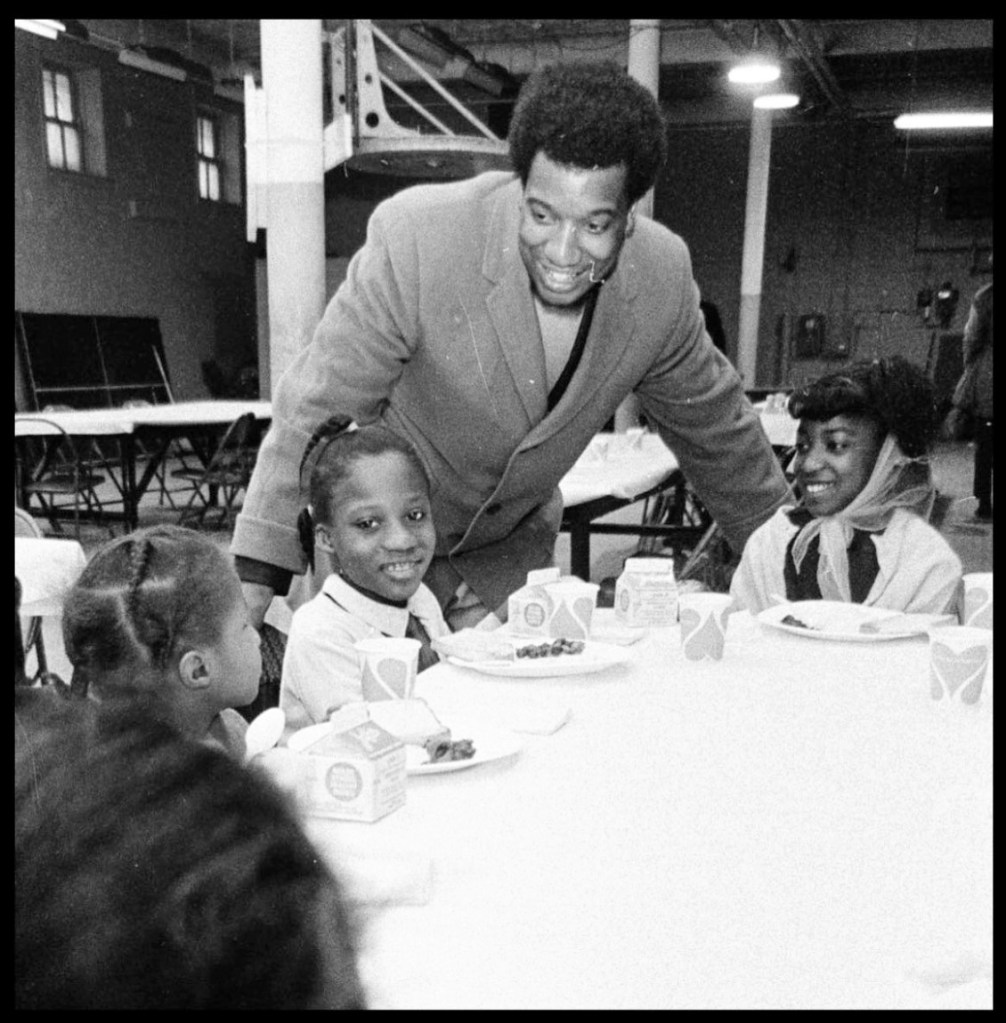
Chairman Fred Hampton speaking with children at the Free Breakfast Program.
Fred Hampton was respected by white and Black students alike. The year after he graduated from Proviso East, a school administrator requested his help to calm racial tensions among students.
An event that likely affected the young Fred Hampton, much as it affected most of Chicago’s Black community, was the 1955 gruesome lynching of Emmett Till. The 14-year-old Till was visiting family in Mississippi when he was abducted and killed for allegedly whistling at a white woman. Till was the son of family friends and neighbors of the Hamptons.
While Hampton was in the NAACP, the Black Panther Party was opening chapters across the country and becoming a prominent force in the Black liberation struggle. Hampton began to absorb and understand the revolutionary content of the Panthers’ political perspective and joined. He soon demonstrated his leadership abilities and became deputy chairman of the party’s Illinois chapter.
His disposition and skills as a speaker earned Hampton a moral authority. His political achievements included brokering peace with the supposed “street gangs” of Chicago, amongst them the Puerto Rican group the Young Lords. Hampton was instrumental in transforming the Young Lords into a revolutionary political organization.
BPP Chairman Fred Hampton and Young Lords Chairman Jose Cha-Cha Jimenez.
The white, racist U.S. ruling class was appalled. How dare the descendants of African slaves call themselves Socialists and aim to achieve Black people’s right to reparations! Even more daring was the Black Panther Party’s call for the overthrow of capitalism—a demand the ruling class could never tolerate. Their ability to forge unity in struggle was a threat in itself.
All this was happening while resentment for the war in Vietnam was on the rise. The men of privilege and wealth, with a stake in preserving the imperialist system, grew apprehensive the more it became apparent that a mass revolutionary movement was arising.
Hampton valued the need for a multinational revolutionary struggle, and organized the original Rainbow Coalition comprised of the I Wor Kuen of the Asian community, the Brown Berets of the Chicano-Mexican community, the poor white workers of the Young Patriots, the Young Lords and the Black Panthers. The Black Panther Party set standards for waging struggle. Their enthusiastic projection of socialism allowed many to envision its relevance to African Americans and other oppressed nationalities.
Operation COINTELPRO, an acronym for Counterintelligence Program, was established in the mid-1950’s to deter the development of any movement deemed a threat to the existing social, economic and political order. It remained secret until 1971, when courageous anti-repression/anti-war activists broke into an FBI field office in Media, Pa., and confiscated files revealing the hidden operation.
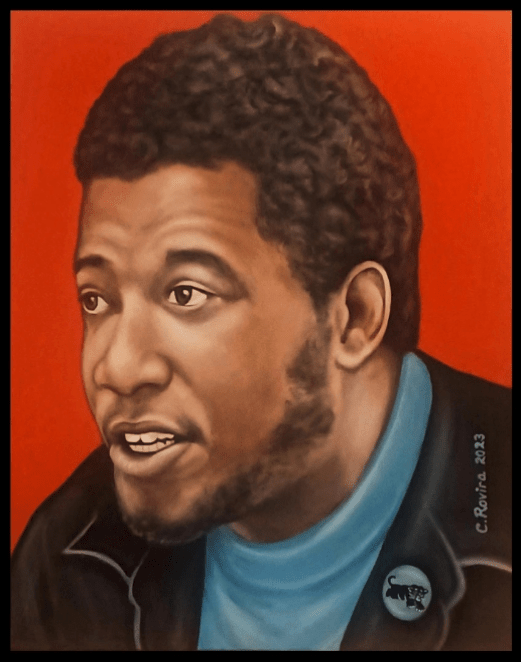
My portrait of Chairman Fred Hampton. 20″ X 24″, acrylic paint on canvas.
As the Civil Rights movement advanced—galvanizing strength from all sectors of the population, breaking the despicable Jim Crow laws and compelling the U.S. Congress to pass other progressive legislation—the FBI increasingly turned its attention to the Black liberation struggle.
The slanderous editorials against the Panthers in the capitalist-owned mass media, combined with Hoover’s frequent verbal attacks, reflected the wishes of the ruling class who sought the complete destruction of the Black Panther Party and the ideals it embodied. Internal FBI memos show that the government had a special interest in Hampton’s political activities and his associations; Chicago police were encouraged by the FBI to find a way to lock up Hampton, if not worse.
These circumstances compelled the government to carry out the horrible attack on Fred Hampton as part of their strategy to destroy the Black Panther Party and ultimately the entire revolutionary movement.
“The greatest threat to national security”
The Black Panther Party openly advocated for socialist revolution, and openly supported the Chinese and Cuban revolutions. The Panthers’ breakfast program for children, among other social programs, underlined their commitment to meet the needs of communities that received nothing but oppression and neglect from the government.
Prior to Hampton’s death, police raided the Panthers’ Chicago office on three separate occasions. William O’Neal, Fred Hampton’s bodyguard, was a police informant who was instructed to draw up a floor plan of the targeted apartment weeks earlier. Law enforcement used the information gathered by O’Neal to murder Hampton.
The staunch anti-capitalist stance of these young revolutionaries who declared themselves Marxist-Leninists made them the target of the most ruthless, racist elements in power. On numerous occasions, the notorious FBI Director J. Edgar Hoover expressed a special disdain for the Black struggle, particularly towards Dr. Martin Luther King Jr. and Malcolm X. Many were not surprised when Hoover declared the Black Panther Party “the greatest threat to national security.”
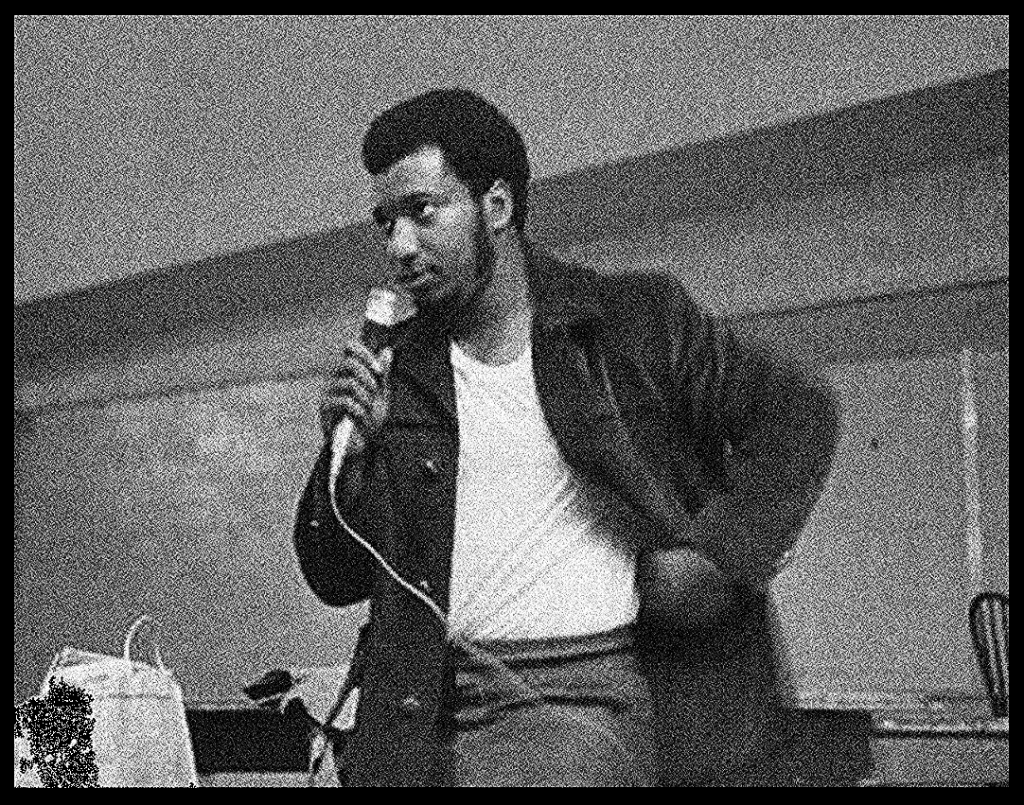
Chairman Fred Hampton was a widely respected orator.
Hampton’s murder was part of a pattern of police raids, false imprisonment and executions of Black Panthers. COINTELPRO documents proved that assassination of Black leaders was among its aims. Fred Hampton and the Black Panther Party had to be eliminated simply because they had touched upon capitalism’s greatest weakness—the decisiveness and strength that a multi-national movement has in a battle against this system.
The Black Panther Party arose from the struggles of the African American people, historically the most oppressed and exploited group in the United States. They symbolized hope and received the greatest affection. They attributed Black oppression to the capitalist system, and dared to pick up arms against the state. The militancy and defiance of these young revolutionaries deeply impacted the Civil Rights and socialist movements.
Hampton and the Black Panthers believed all would benefit if the struggle against racist oppression was taken up by the whites as their own. Hampton knew that it was possible to smash the racial barriers created by capitalism to divide and conquer the working class. His confidence was based on the strong belief that this system provides motivation for all to unite and engage in revolutionary struggle.
Long live the Legacies of Fred Hampton & Mark Clark!
THE U.S. MILITARY REFLECTS THE RACISM IN CAPITALISM
African Americans’ role in the military during the Civil War was wholly progressive. Indeed, Black soldiers had a vital stake in smashing the hideous system of slavery.
While President Abraham Lincoln often expressed his indifference to the issue of emancipation, he was forced to recognize the absolute necessity of arming African Americans.
Black soldiers soon became feared by the Southern slave-owning class. Their tenacity, skill and valor as soldiers proved decisive to the North winning the Civil War. For instance, when General Ulysses S. Grant was sent to fight Gen. Robert E. Lee’s military forces in Virginia, he requested Black regiments as his principal shock troops.
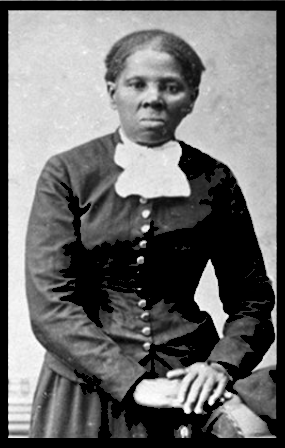
Then there was Harriet Tubman. A former slave, she became an intelligence officer for the Union Army, operating behind enemy lines. Tubman’s courage made possible the capture of Confederate garrisons and by working with the “Underground Railroad” she led hundreds of slaves to their freedom.
But Tubman’s boldest and most successful mission is when she led many Black Union soldiers on the daring raid at Combahee Ferry on June 1863. In this courageous action Tubman and Black soldiers under her command were able to free 700 slaves while under fire from charging Confederate troops.
Harriet Tubman
The Civil War was the last time African Americans had a positive stake in a U.S. war’s outcome. It was the only time in U.S. history when the interest of the capitalist class coincided with the aspirations of Black people.
After the Confederacy was militarily defeated “colored” volunteer units of the U.S. military were disbanded. All told, 200,000 African Americans served in the Army and Navy while 30,000 of that number died in combat.
After African Americans were betrayed during Reconstruction, they were further undermined and impoverished when the South was overrun by capital investments in manufacturing, lumber and agriculture. The capitalist rulers began to cast their eyes abroad.
By 1870 four regiments of Black troops were re-organized but were used for the vicious campaign to annihilate tribal Indigenous nations in the “Indian Wars” of the West and Southwest United States. These units were named by Indigenous people “Buffalo Soldiers.”
In 1898 all four of these re-organized Black regiments were sent to be among the invading forces in the Spanish-American War. African American soldiers were used for conquering other oppressed people. The U.S. became a world imperialist power.
BLACK SOLDIERS IN THE IMPERIALIST ERA
The mysterious explosion of the U.S. battleship Maine in Havana, Cuba on Feb. 18, 1898, served as an excuse for Washington officials to declare war on Spain. The U.S. invaded the Spanish colonies of the Philippines, Guam, Cuba, and Puerto Rico, colonizing them anew. The Monroe Doctrine had already reserved all of Latin America and the Caribbean to be exploited exclusively by U.S. capitalists.
In 1899 under the leadership of Aguinaldo, the Filipino people furiously fought the new invaders. They inflicted many casualties on the U.S. Army, which falsely claimed to be “helping the people’s quest for freedom.” The U.S. government retaliated by slaughtering hundreds of thousands of Filipino women, men and children.
This genocide was not passively accepted inside the United States, as mainstream historians contend. The Anti-Imperialist League held many mass protests in major cities throughout this country.
Significant anti-war sentiment was also expressed widely in the Black community. The Black press as well as other representatives of the African American people vigorously denounced the war. The great historian, socialist and African American leader W.E.B. Du Bois played a notable role in this anti-war movement.
Most important, Black resistance surfaced inside the U.S. military. Four Black regiments sent to fight in the Philippines established a bond with the Native people there, who also were dark-skinned. These Black troops resented white officers and soldiers describing Filpinos with the same racist slurs applied to African Americans in the United States.
Filipino insurgents appealed to Black soldiers not to fight on the side of U.S. imperialism. Posters denouncing racist lynchings in the United States were placed throughout the islands, as a show of Filipino solidarity with African Americans. This political agitation helped lead to many Black troops deserting the U.S. military.
Some of these African Americans soldiers went over to the other side, joining the Filipino guerrilla army. The most notable was David Fagan, formerly of the 24th Infantry Division. The Filipino freedom fighters so respected Fagan that he was made a commander in their army. David Fagan’s example demonstrates how unity among different oppressed people is possible.
David Fagan, formerly of the 24th Infantry Division became a commander in the Filipino guerilla army.
BLACK RESISTANCE IN THE MILITARY
In the post-Reconstruction period, as Jim Crow laws re-introduced the “Black Codes” throughout the South, top military officials were contemptuous to the idea of having large numbers of African American recruits. But in 1917 President Woodrow Wilson conveniently signed the Selective Service Law. The U.S. entered World War 1.
The two world wars in Europe created circumstances that demanded the recruitment of large numbers of soldiers. African Americans were now accompanied by Puerto Ricans, Indigenous, and Mexican Americans as oppressed nationalities looked upon as cannon fodder. Military recruits from these sectors of society faced disproportionate casualty statistics while continuing to confront racist segregation, discrimination and violence, during and after their service.
African American servicemen in England prior to D-Day.
Although African Americans made an exerted effort to prove their bravery and diligence as soldiers during war they were unable to escape discriminatory practices and customs deemed “normal” in the United States.
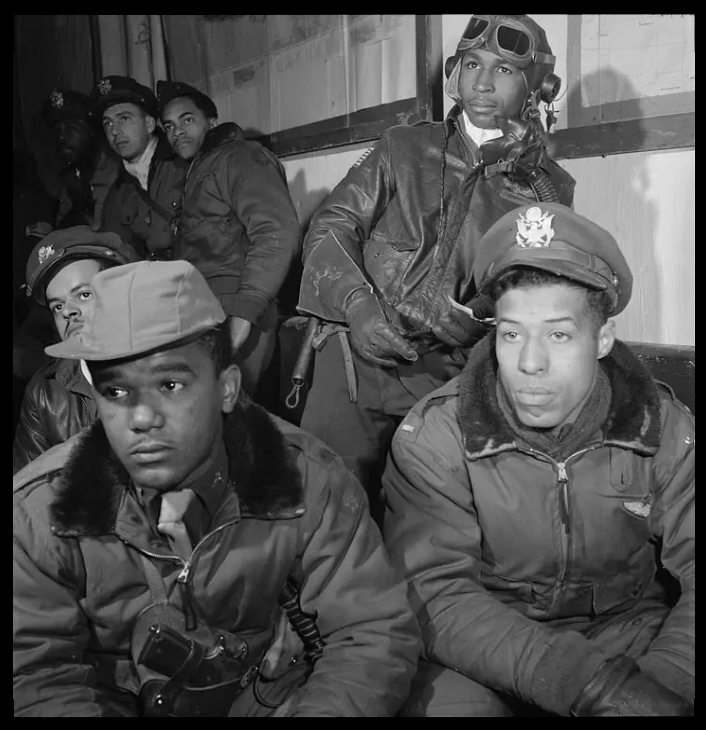
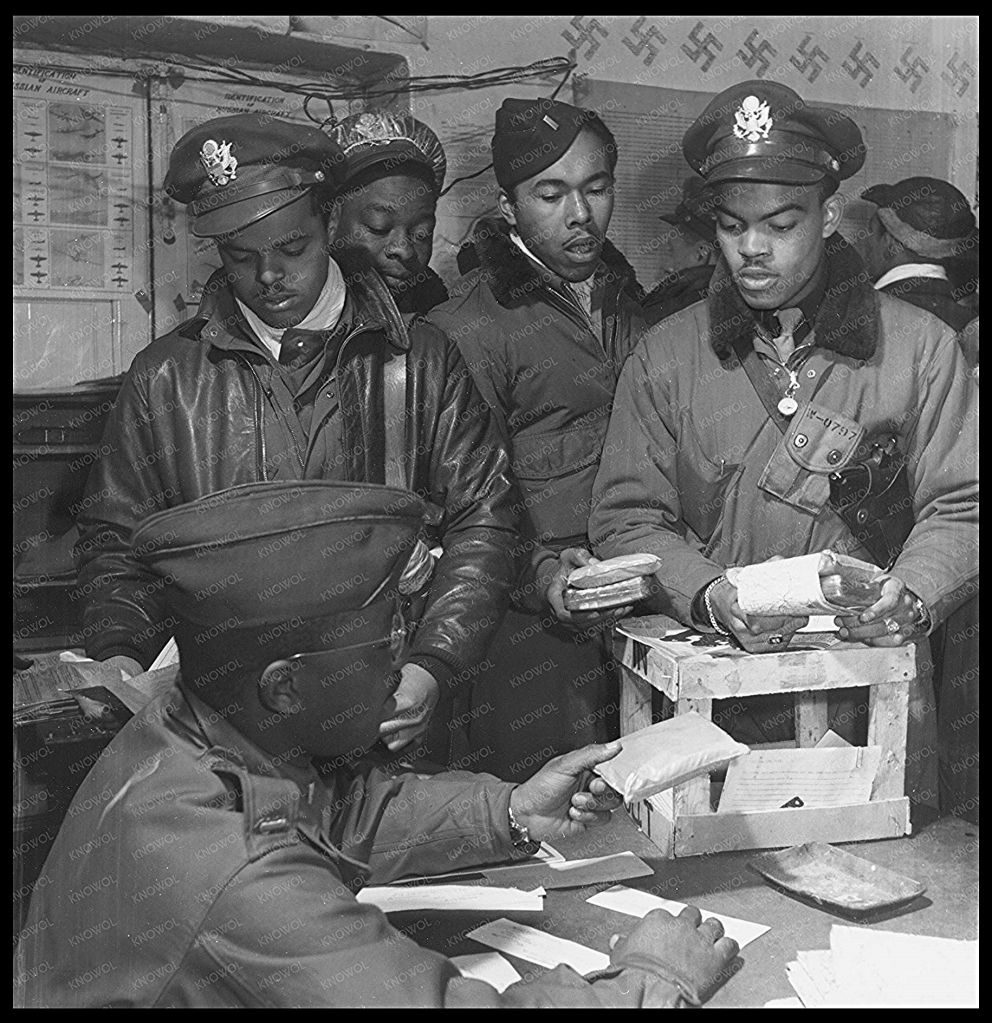
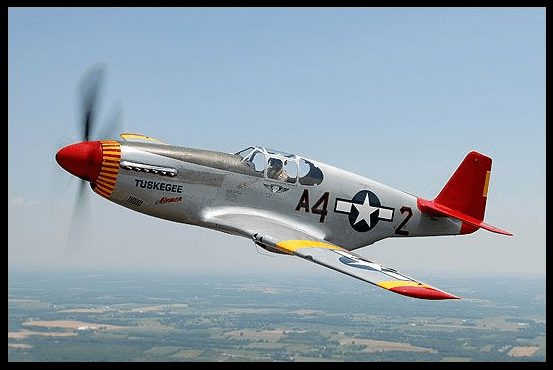
An example was the Tuskegee Airmen, known as the “Red Tails.” These African American pilots proved their bravery and high-level of skills in aerial combat with Germany’s Luftwaffe during World War II. Until the end of the war, they were denied recognition by top military and government officials to avoid acknowledging that they were Black.
A squad of the segregated, all-Black Tuskegee airmen in the Army Air Corps.
The Tuskegee Airmen primarily used the P-51 Mustang fighter planes.
On June 24, 1943 racism within the U.S. military showed its ugly head once again. But this time the dignity and defiance of Black people also showed it’s face in the form of armed resistance at theBattle of Bamber Bridge.
England did not have racist segregation laws like the United States. Black soldiers were embraced in social settings by British citizens. However, white U.S. military officers, especially those from southern states, objected to racial interactions involving Black servicemen under their command.
In one particular instance military police were sent to Bamber Bridge, in the township of Lancashire to absurdly enforce segregation laws. African American soldiers from the 1511th Quartermaster Truck Regiment were abruptly confronted by MP’s in pubs and restaurants. Before long a deadly clash ensued between Black and White men wearing the same uniform.
AFRICAN AMERICANS & THE VIETNAM WAR
By the second half of the 1960’s the Civil Rights movement began to gather widespread approval and support while anti-war sentiments grew in response to U.S. military intervention in Vietnam. Washington and Pentagon officials had unleashed a massive military campaign in an attempt to crush the Vietnamese revolution, which defeated the French in 1954.
The outcry opposing this war increased in Black and Brown communities, due to the agitation of the Black Panther Partyand Dr. Martin Luther King’s open condemnation of the war in 1968. Growing resistance to the military draft paralleled the rise of the Black power movement. Black and Brown resentment to racism was now accompanied by widespread opposition to conscription.
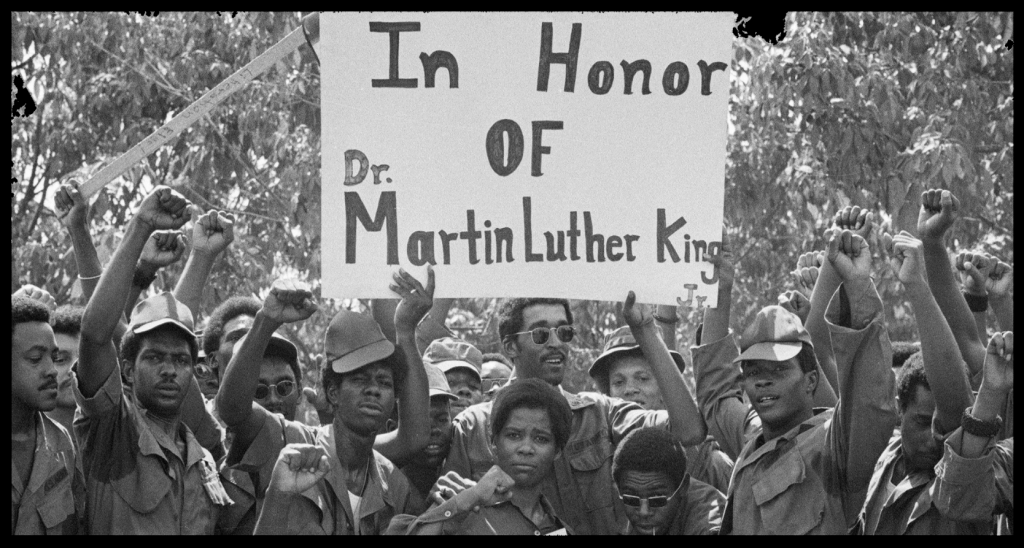
Black soldiers protesting the assassination of Dr. Martin Luther King, Jr.
The Vietnam War was the first U.S. military incursion where units were no longer racially segregated. However, white racist die-hearts among officers and enlisted soldiers continued with their traditional outlook towards Black and Brown people.
In addition to mistreatment, Black and Latino soldiers were usually ordered to carry out life threatening tasks, usually suicide missions. Although they comprised less than 30% of the U.S. population combined at the time their death toll was 3 out of 5 killed in Vietnam.
The Vietnamese understood the plight of Black people in the U.S. and sympathized with their struggles. In 1924 Vietnam’s iconic revolutionary leader Ho Chi Minh wrote his famous pamphlet titled “On Lynching and the Ku Klux Klan” which served as a condemnation of racism in U.S. society and outlined the commonalities between the Black and Vietnamese liberation struggles.
It was no coincidence when Vietnamese insurgents (National Liberation Front) released Black and Brown G.I.’s captured in battle. After having political exchanges with the prisoners Black and Brown soldiers were usually released and not held as POWs.
Black soldiers faced disproportionate casualties in Vietnam.
As the war intensified many Black and Brown soldiers rebelled by collectively refusing to obey orders, and in many cases causing injury or death to white officers. In every objective sense the rebelliousness of Black and Brown soldiers, along with the spread of the anti-war movement at home aided the Vietnamese liberation struggle, thus weakening U.S. imperialism.
Being aware of internal friction and demoralization within the U.S. military while the Vietnamese People’s Army and the National Liberation Front gained the upper hand militarily, compelled U.S. rulers to withdraw from that war in 1975.
Throughout the history of Black people serving in the U.S. military were never free of the same racist oppression they faced in civilian life. The U.S. Armed Forces were created to preserve a system of inequality and for securing U.S. domination throughout the world. The ideological foundation of U.S. militarism is also based on white supremacy.
Since the Civil War the presence of Black people in the military has presented a paradox to U.S. rulers. Out of necessity government officials welcome the enlistment of people of color but at the same time fearing them obtaining skills that can be used against this system in revolutionary struggle.
When oppressed and exploited people find common ground in their quest for freedom unity can be established, as what occurred in the Philippines during the Spanish-American War and in other instances where Black soldiers were sent to shed blood. Social movements throughout history have proven that oppressors are only as strong as we the people allow.
Working class people of all races and nationalities in this country comprise the majority and are in the position to put a stop to the chaos that now exist. Such is what will lay the basis for ending Black oppression and the reign of U.S. imperialism. It is the only way that we can bring into existence a world without continual war and suffering.
Since the earliest human societies, people have used animal images to express their beliefs. Painting animals on pottery, garments and cave walls arose from ritual notions about the power of this imagery.
With the development of class society, animal symbols took on new meaning. Animal characteristics have been interpreted in folklore to explain the miserable reality of the poor or to justify social privileges for wealthy rulers.
Leading capitalists like J.P. Morgan, John D. Rockefeller and Andrew Carnegie promoted Herbert Spencer’s “social Darwinism” during the rise of imperialism. This “theory” described the exploited and oppressed as “weaker species”, etc. Moreover, the predatory bald eagle was chosen to glorify a government that sanctioned genocide and African chattel slavery.
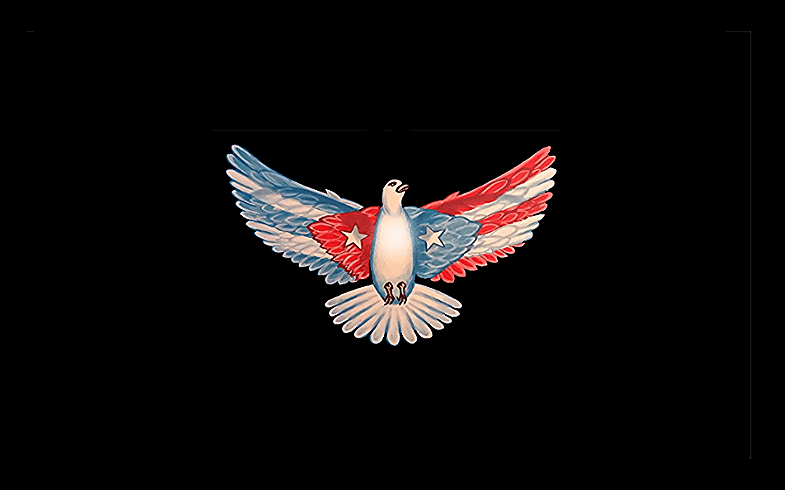
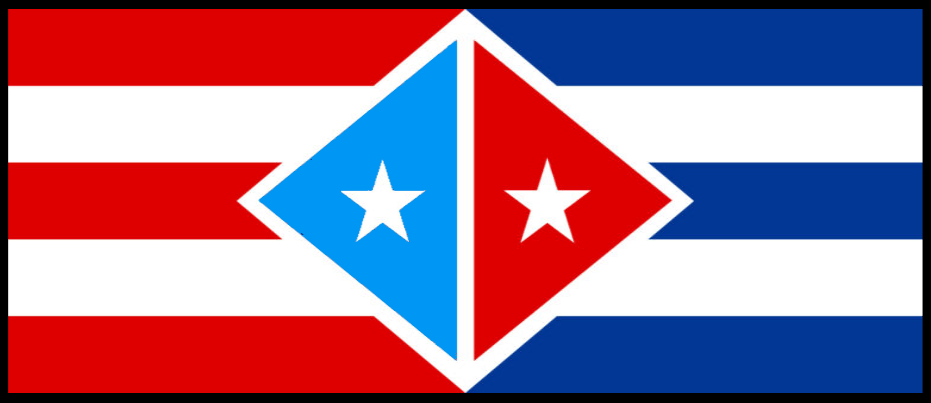
On the other hand, the oppressed have also used symbols, in this case to express their resistance. One famous example is the “Two Wings of the Same Bird” concept. This metaphor was created by the legendary Puerto Rican revolutionary literary and poet Lola Rodríguez De Tió. It was later on used in musical rendition by Cuban poet and revolutionary leader Jose Marti. It describes the historic relationship of solidarity between Cuba and Puerto Rico.
Since some of the most beautiful birds in the world inhabit the Caribbean, it was easy for Lola Rodriguez De Tio to use this life form as poetic symbolism in revolutionary politics. The “bird” she described is made up of the island countries of the Greater Antilles — the Dominican Republic, Haiti, and Jamaica, with Cuba and Puerto Rico on opposite ends of the region, functioning as wings.
The concept of a Caribbean federation of nations originated from the Haitian Revolution. For most of the 1800’s Haiti was the beacon of revolution in the Western Hemisphere, like what the Soviet Union symbolized during the early part of the Twentieth Century.
Dr. Ramon Emeterio Betances, who was of African descent himself, was the principal leader of the 1868 El Grito De Lares uprising in Puerto Rico. He had a deep respect for the ideals of the Haitian Revolution, an event that had tremendous influence on him.
Based on commonalities of political perspective, Betances and Lola Rodriguez De Tio became trusted comrades to one another. Along with her own direct familiarity with the Cuban struggle is likely what motivated her poetic expression “Two Wings of the Same Bird”.
Both Lola Rodriguez De Tio and Jose Marti were internationalists and expressed revolutionary traditions in poetic form. De Tio and Marti identified with all anti-colonial struggles in addition to having a special affection for the liberation struggles of each other’s country, which shared a common suffering under Spanish tyranny.
In the early 1860s revolutionaries from both countries secretly met in a hotel on Broome Street in New York City to form the Society for the Independence of Cuba & Puerto Rico.
Members of this group helped facilitate the 1868 “El Grito De Lares” uprising. Under the leadership of Ramon Emeterio Betances, African slaves, workers and peasants all did their part to build the efforts for this battle. When their attempt for independence failed, about 2000 Puerto Rican rebels went to Cuba to continue the fight against Spanish colonialism. Among the Puerto Ricans to join this venture wasJuan Rius Rivera, who became a commander in the Cuban rebel army.
Caribbean People Fight for Cuban & Puerto Rican Freedom
Haitians, Dominicans, Jamaicans and Puerto Ricans were among the insurgents who fought in El Grito De Lares and Cuba’s El Grito De Yara, both in 1868. This inspired Jose Marti to preserve the use of the “two wings” metaphor.
Marti recognized the threat a rising U.S. imperialist power would pose to the Caribbean peoples. His wish for a united Caribbean federation was based on a calculated necessity. Familiar with the atrocities the U.S. rulers committed against the oppressed at home, Marti knew he could expect no better treatment from the United States than from Spain.
In 1895 Cuban revolutionaries launched a war for independence. They were gaining the upper hand in the war against Spain. But in 1898 their efforts were interrupted when the United States invaded Cuba, Guam, the Philippines and Puerto Rico.
One year prior to the U.S. invasion, on March 24, 1897, Puerto Ricans attempted once again to use force in their quest for freedom at the uprising known as “Intentona de Yauco. It was the last attempt to wage a struggle for independence from Spanish colonialism”.
Jose Marti died in 1895. He never saw come true his wish for a free Cuba in a Caribbean federation. But thanks to the 1959 Cuban Revolution, his ideals remained alive to this day. Although Puerto Rico and Cuba live under opposite circumstances there is still solidarity between the peoples of the “two wings.”
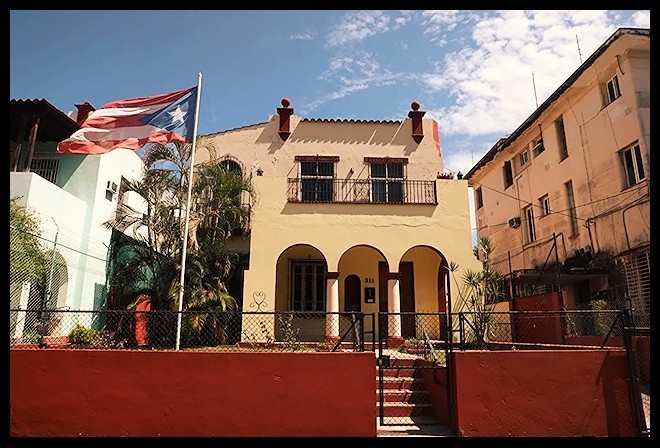
On March 8, 1966, Cuba’s revolutionary government has officially recognized Puerto Rico’s independence struggle. Cuba has established an “Office of Puerto Rico” serving as an official embassy. It is the only one of its kind in the world.
The Puerto Rican Mission, inaugurated on March 8, 1966, by President Fidel Castro and Juan Mari Bras, serves as a solidarity diplomatic office in Havana Cuba focused on supporting Puerto Rican independence.
Cuba has also given political asylum to Puerto Rican anti-colonial fighters sought by the U.S. government. At the United Nations, Cuba has fought for world recognition and support of Puerto Rico’s historical struggle for independence and self-determination.
Many Puerto Ricans return this solidarity by continuing to break the criminal U.S. blockade against Cuba, traveling there from Puerto Rico itself. For decades these anti-colonialists travel back and forth to Cuba.
The oppressed peoples’ drive to unite and maintain such traditions in their common struggle is a vital weapon to end U.S. imperialism’s rule. No country in the world has remained committed and firm in their solidarity to Puerto Rico’s struggle for national liberation than Cuba.
On July 25, 1978, the colonizing Puerto Rico Police assassinated two young pro-independence activists. This brutal and blatant murder, known as the Cerro Maravilla murders, exposed for the world to see the violence used by U.S. imperialism to keep Puerto Rico in chains to this day.
The controversy and the cover-up that followed were like none other in Puerto Rico’s political history. It involved government officials at the highest level, top police brass as well as theFederal Bureau of Investigation (FBI)and Justice Department. The case was indisputably identical to what COINTELPRO did to members of the Black Panther Party and other entities of the U.S. left during that same period.
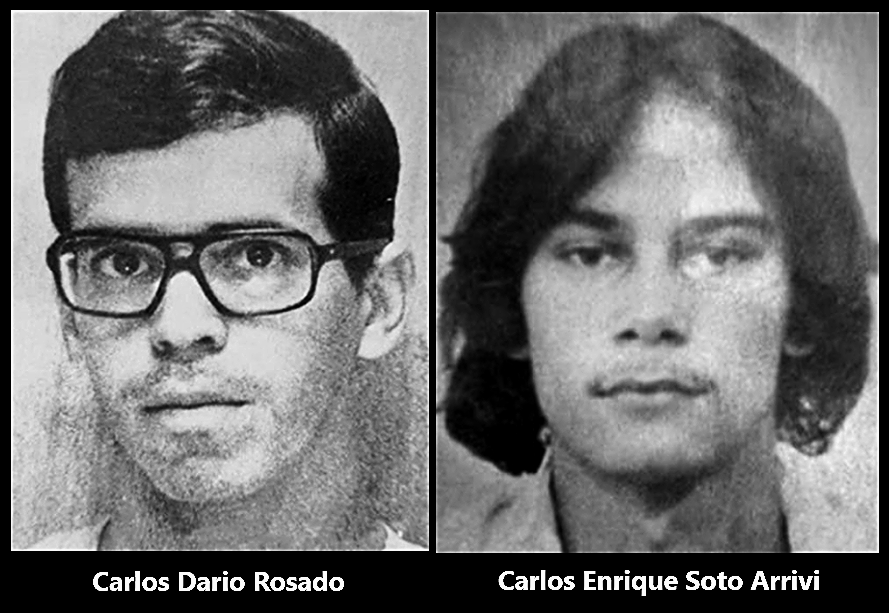
Arnaldo Darío Rosado, 24, and Carlos Soto Arriví, 18, had been involved in pro-independence groups before. Inspired by the heroes of independence who championed the liberation of the homeland from U.S. rule by any means necessary, they joined the Armed Revolutionary Movement (MRA). The MRA had no experience in such matters, it never carried out any military actions in the past.
A police agent named Alejandro González Malavé, infiltrated the group. He recruited Darío and Soto to set fire to a communications tower on the mountain named Cerro Maravilla. Supposedly, the act was to protest the imprisonment of Puerto Rican Nationalists Lolita Lebron, Rafael Cancel Miranda, Irving Flores, Andres Figueroa Cordero, and Oscar Collazo.
By 1978, the freedom of these political prisoners was a campaign of paramount importance, both to the pro-independence movement in Puerto Rico and to human rights advocates around the world. In fact, it was a frequently mentioned issue in news outlets and United Nations Organization discussions.
It was a clever ploy by the Puerto Rico Police. First and foremost, July 25th is the date of the 1898 U.S. military invasion. And because Arnaldo and Carlos were highly devoted to the cause for Puerto Rico’s independence but were too inexperienced to detect how they were being lured into a trap, it was easy for the police to lead them to their deaths.
COLONIAL POLICE MURDER ARNALDO & CARLOS
On the evening of July 25, 1978, the three forced taxi driver Julio Ortiz Molina to drive them to the communications tower at the top of the mountain in Cerro Maravilla.
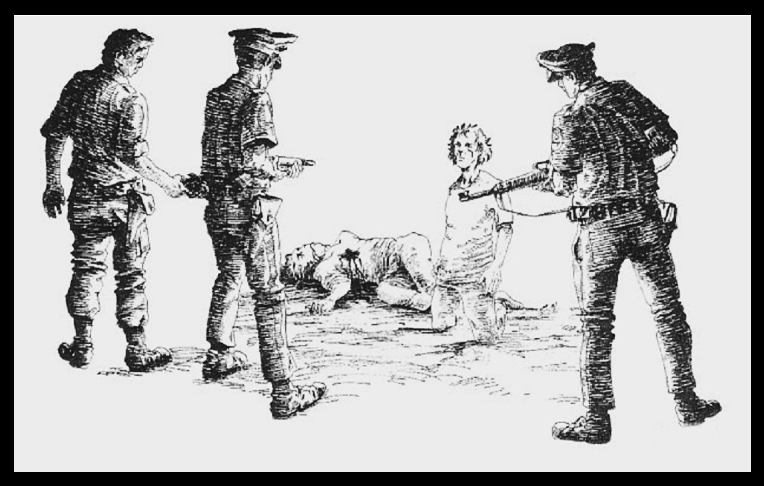
Once the vehicle arrived at the location, heavily armed police opened fire on the cab. Darío and Soto shouted, “Don’t shoot, we surrender,” according to well-documented testimony. The two were dragged out of the car, savagely beaten then forced to kneel. They were then shot dead, execution style.
The cops who testified during the investigation disclosed that several hours before the murders, officers assigned to the sting operation were ordered by Col. Angel Perez Casillas, commander of the Intelligence Division, that, “These terrorists should not come down (from the mountain) alive.”
Eyewitness accounts confirmed what many in the independence movement had all along asserted. The assassination of the two independence activists was a political statement on the part of the Puerto Rico Police.
A drawing depiction of the Cerro Maravilla murders, by Artist Juan Alvarez O’Neill.
Then Governor of Puerto Rico, Carlos Romero Barcelo, of the pro-statehood New Progressive Party, immediately hailed the cops as heroes. Pretentious investigations were conducted by the colonial government, as well as by the FBI and the Justice Department, but only to assist in a systematic cover-up motivated by the already existing colonial setting in Puerto Rico.
In the aftermath of the killings, every agency involved in the investigation was quick to exonerate the killer cops and demonize the two victims, and for clear-cut and well-defined reasons. The Puerto Rico Police exists as the principal enforcer of U.S. colonial policy.
Historically, every repressive act involved the complicity of the Puerto Rico Police. It has served as the pit bull of U.S. agencies, most especially the FBI, dating back to the attacks onDr. Pedro Albizu Campos, the Nationalist Party and the brutal Rio Piedras and the Ponce Massacres.
This specially trained armed attachment of U.S. colonialism is perhaps one of the most sophisticated apparatuses of law enforcement in all 50 states and occupied territories. It is defined by colonial law as a “quasi-military” organization which is granted assistance by the National Guard, in everything involved to the work of a “civilian” police force.
TYRANTS ARE NOT INVINCIBLE.
Regardless of differences in political beliefs, widespread indignation to these murders came from all sectors of the population. A momentum grew to such a degree of pressure that it caused a political crisis for the U.S. colonizers in Puerto Rico.
On April 29, 1986, the undercover copAlejandro González Malavéwas assassinated in front of his mother’s house in Bayamón. He was shot three times by an armed Boricua group identifying itself as the “Volunteer Organization for the Revolution.” Puerto Ricans everywhere applauded the death of this police scoundrel and viewed his killing as well-deserved justice.
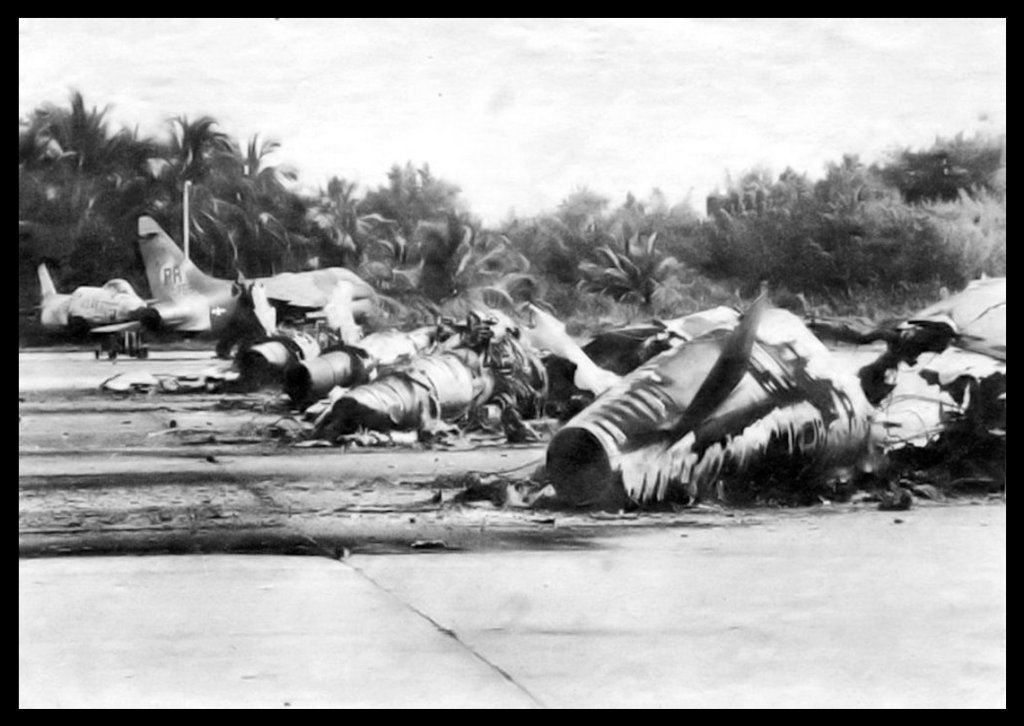
The FBI considered this group “one of the most dangerous terrorist organizations in the United States.” On December 3, 1979, the V.O.R. claimed responsibility for an attack on a U.S. Navy bus in Puerto Rico in which two Navy personnel were killed and 10 injured, and the destruction of 6 jet fighters at the Muniz Air National Guard base near San Juan on January 12, 1981.
In 1981 the VOR destroyed 6 U.S. jetfighters at the Muniz Air National Guard base.
In the end, eight police officers were convicted and given prison sentences, ranging from 6 to 30 years. But these prison sentences were merely a concession made by the colonial court to ease the mounting outcry for justice. The greatest concern Washington officials always have is the potential for mass rebellion.
Protest demonstrations occurred everywhere in Puerto Rico and the diaspora, demanding justice for Arnaldo and Carlos. News of the details surrounding this case reached global attention and pointed to the inhumanity of the U.S. presence and domination in Puerto Rico.
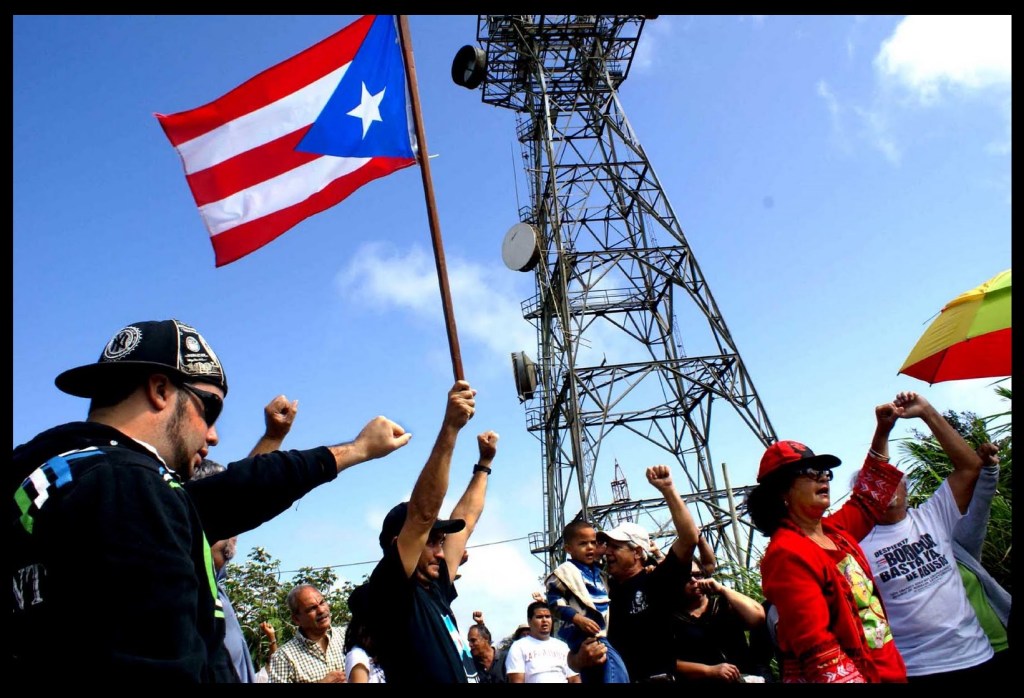
Protest gatherings occur annually on site of the tragic event.
The Cerro Maravilla murders was not the first-time brave men and women were killed for advocating independence for their beloved homeland. Nor will the threat be gone of future incidents like Cerro Maravilla in 1978, as long as U.S. colonialism in Puerto Rico prevails. The armed agencies of U.S. colonialism are the real terrorists.
No matter where, when or how the decisive battles for Puerto Rican national liberation may ensue, it will certainly contribute to the global defeat of U.S. imperialism. The murders of Arnaldo Darío Rosado and Carlos Soto Arriví shall serve as added reason to condemn and bring about the demise of this corrupt and vile system.
Arnaldo Darío Rosado & Carlos Soto Arriví – PRESENTE!
In the past week many people have been devastated, especially in New York City’s Bronx community, by news video coverage of 15 year old Lesandro Guzman-Feliz, who was also known as “Junior.” The graphic video shows Lesandro being savagely stabbed and hacked to death by members of a street youth gang known as “Los Trinitarios.”
There has been a tremendous outpouring of sympathy by people throughout the city and across the country for Lesandro Guzman-Feliz’s grieving mother and family, who will be impacted by this tragic event for years to come. Unfortunately, public discussion of this case was immediately limited by the media and has not addressed the social context that fuel these events in poor working-class communities.
Media reports have emphasized the perpetrators’ life-time record of criminal activity and zeroed-in on outcries for justice by neighborhood residents. And understandably so, mainstream news outlets sensationalized reports of this tragedy and have in various ways called upon stepping up police activity in oppressed people of color neighborhoods while insidiously attempting to facilitate community support for this end.
First we must ask, why is the racist police —with the assistance of the news media— trying to manipulate the justified anguish of this predominantly Dominican Bronx neighborhood? Why is the police controlling the narrative of these events?
As we well know, the police have never been a friend of the Latino community. The NYPD has historically been responsible for killing scores of unarmed Black and Latino people in this city, with violence comparable to that which was deployed against Lesandro.
And despite the police’s repeated mention that Lesandro Guzman-Feliz aspired to be a cop and that he was a member of the Explorers, a youth club under the auspices of the NYPD, when the police was called to the scene it treated Lesandro with the same contempt it treats all youth of color.
In fact, the attitudes of the two responding NYPD officers serve as a window into how the police view violence among people of color. A later-released video shows that as Lesandro laid bleeding to death two uniformed cops stood back without attempting to save his life.
No one can deny that these hideous crimes merit punishment and justice. Such acts are indisputably a clear indication of a mental and emotional departure from basic moral values and a sense of humanity. Death by senseless violence continues to be part of a disturbing panorama that describes the reality for many communities of color.
Violence conducted by individuals for the pettiest of reason is a behavioral matter that can only be addressed in a discussion of culture of the society within which it happens. That is, the violent historical setting from which capitalist culture developed. And because culture is at the heart of this matter, it is unfortunate that a percentage of unstable individuals among oppressed people will tend to mimic the violence of our oppressors.
Violence among oppressed people will never be a problem that the police will attempt to eradicate. They will point to its existence but only as a ploy to convince us that diminishing civil liberties and other meager freedoms works to our “safety.” In short, the deviant behavior of a few will always be used to enhance the powers of the police, courts and prisons.
In fact, since the very beginning of the police, dating back to slavery, their profession centers on inflicting violence on our people whenever they deem necessary. For this reason alone, poor working-class people cannot rely on the police state for salvation.
Gang violence was never as acute of a problem as it is now, until the 1980’s, when an influx of drugs consumed many communities of color. There was ample evidence, then, pointing to law enforcement, along with the Central Intelligence Agency (CIA), as the main perpetrators in what soon thereafter became a widespread crisis. Gang leaders were corrupted which made these organizations an essential part of the operations that led to funneling drugs into poor communities.
Ultimately every oppressed person in this country will be compelled to realize that peace and security can only come about from our own actions and organizing efforts.
Historically, not all street organizations involved themselves in hideous criminal activity. Many youths joined these groups for noble reasons and simply to obtain a sense of safety and belonging. There are instances in history where street youth groups protected neighborhood residents from crime.
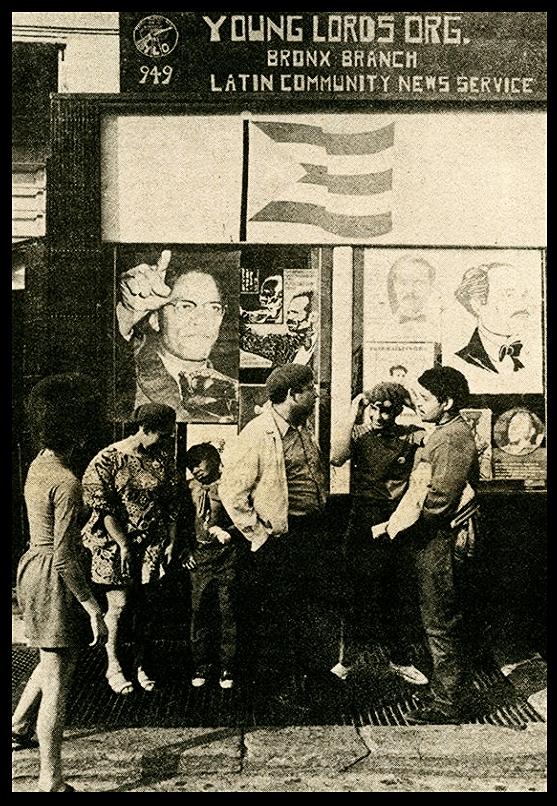
One good example is the Young Lords, a Puerto Rican/Latino youth group that developed on the streets and prisons in Chicago during the 1960’s. They were influenced by the political events of that decade, especially by the activist work of the Black Panther Party. Eventually the Young Lords transcended to become a revolutionary entity.
The Young Lords began on the streets and prisons of Chicago. They eventually transcended to become a revolutionary entity.
Such is the direction that these street youth groups of today must take. They must either side with the people and fight on their behalf or allow themselves to be absorbed by the efforts of the police state. In which case they would risk feeling the wrath of a rising revolutionary mass movement.
Justice and protection from criminal elements that have gone to the point of no return, and forgiveness, as Lesandro Guzman-Feliz’s killers, can only come about with a politically and organizationally sophisticated militant mass movement. And that would automatically imply our people exercising the right to use all techniques and methods of self-defense.





















 carlitoboricua